

In this episode, I welcome back Zsofi Lang, a Brussels-based illustrator and graphic recorder who shares how a personal passion project, drawing science comics for her daughter during COVID, unexpectedly led to a six-part children’s book deal with UK publisher Flying Eye Books.
We dig into what made her sketchnote-influenced style attractive to a publisher, why self-disqualification holds so many visual thinkers back, and how following your curiosity can open doors you didn’t know existed.
Hey, I’m Mike Rohde, founder of Sketchnote Lab. I’m celebrating summer's arrival with 20% off paid Lab memberships through June 30, 2026.
Special link: sketchnotelab.com/summer20
Listen to the episode:
Running Order
Introduction to Zsofi Lang and her return to the podcast
What Zsofi does: live illustration, graphic recording, and a new shift into children’s books
The origin of her science comics series on Instagram during COVID
Discovering publisher Flying Eye Books through Adam Ming’s Substack
How reaching out to a publisher led to a six-part book deal
The reframing: from “How to Explain Science to a Five Year Old” to “How to Explain Anything to Grown-ups”
Writing and illustrating for seven to ten year olds
Why a sketchnote style was exactly what the publisher wanted
The danger of self-disqualification and discounting your own work
Passion as the key ingredient: doing 20 comics before ever pitching
Kevin Kelly’s quote on becoming the most improbable person you can be
AI, authenticity, and leaning into your unique perspective
Privilege, accessibility, and finding ways to express creative passions
The practical process: working with subject consultants, visualizing facts, and adding personality
Experimenting with personal projects and reviving buried work
The Milwaukee party at South by Southwest: a story about doing things without permission
Collaborative murals: team building through paint-by-numbers style projects
Where to find Zsofi
Resources & Links
Sponsored by The Reflective Travel Workshop
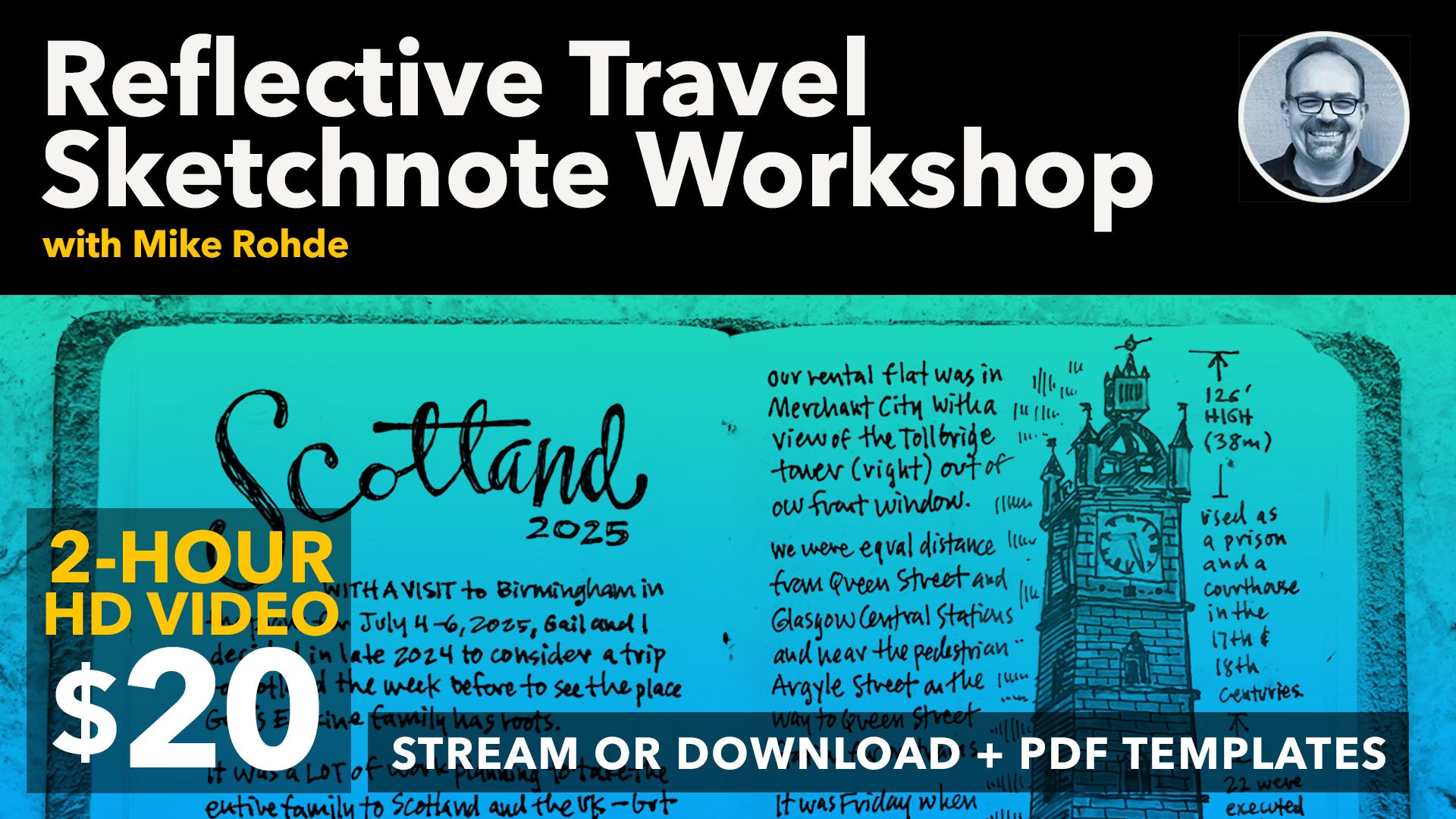
Have you ever wanted to create travel sketchnotes from an experience you’ve had, just using the photos and memories you’ve got?
In the Reflective Travel Workshop, I’ll guide you through my process for creating travel sketchnotes and then help you reflect on your own photos and memories so that you can make travel sketchnotes of your own trips, too!
This 2-hour recorded video includes a set of downloadable, printable sketching templates and a process to kickstart your own travel sketchnoting practice.
All this for just $20.
Subscribe to the Sketchnote Podcast
You can subscribe to the podcast on iTunes, Google Podcasts, Spotify, Amazon Music, YouTube, or your favorite podcast-listening app.
Support the Podcast
Support the creation, production, and hosting of the Sketchnote Podcast by buying Mike Rohde’s bestselling books. Use code ROHDE40 at Peachpit.com for 40% off.
Hey, I’m Mike Rohde, founder of Sketchnote Lab. I’m celebrating summer's arrival with 20% off paid Lab memberships through June 30, 2026.
Special link: sketchnotelab.com/summer20
Episode Transcript
Mike Rohde: Everybody, it’s Mike Rohde and I’m here with my friend Zsofi Lang. Zsofi, it’s so good to have you. Now, Zsofi, Zsofi, Zsofi, Zsofi was on the show when it used to be called the Sketch Note Army podcast back in 2022, season 11, episode four. But we had been chatting, we’re both using Substack as a platform. And she reached out to me and said, hey, Mike, I’ve got an interesting story that might be useful for other visual thinkers. And I thought, yes, let’s have Zsofi back on.
Zsofi Lang: Hi. Hi, Mike.
MR: So Zsofi, first tell us what you do and then we’ll get into the discussion that we want to talk about today.
ZL: Okay, awesome. So Mike, good to be back. Thanks for having me again. I am an illustrator and I’m a huge, huge sketchnote fan. And most of the stuff that I do is live illustration. So graphic recording at conferences. I’m based in Brussels and there are a lot of events happening here. So that’s pretty good.
and I do some illustration for publications and things like that. And something exciting has been happening in my career that there is this shift that’s going on and I’m in the middle of it. So I don’t know how it’s going to turn out. I’m hoping for the best, but we’ll see. And which is that I got into books. I got into children’s books and that’s really exciting.
MR: This is great.
ZL: It’s a whole new avenue for me. I haven’t done this before. so yeah, that’s that’s that’s the news
MR: Wow, that’s really great. And let’s get into it. I think, so we both follow a fellow friend, Adam Ming, who teaches on Substack platform as well. Really great guy, super generous. And he’s teaching people how to do this kind of, this kind of work, right? That’s sort of his specialty. He does specifically children’s books. So although I think he probably does more and then he’s teaching other people how to do this, which I really like his attitude because, it’s this idea of bringing other voices.
You think about the voice of how something looks, but also a perspective, right, into the space. So kids have really interesting mix of options to see different things, right, than just the stuff you always saw before, which is great. So, which leads into your story. So why don’t you tell me, like, how did this all happen? What was the, lay it out for me.
ZL: Yeah, so Adam has a big role in this story, but I want to go back a little bit. So I’m a mom, I have two daughters, and when the other one was still small, around two years old, I had this itch to start drawing for myself and for her these little comics I was drawing for Instagram that was about explaining science topic to kids and the...
MR: Mm-hmm.
ZL: The name was How to Explain Science to a Five Year Old. And then I would think about like, my God, one day she’s going to ask me about gravity or like whatever, like how do airplanes work? And I’m like, OK, I know the basics, but I need to get like the meat of it. Like, OK, how do they work? So I would look these subjects up and try to be like scientifically accurate about it and draw it in a funny way that...
that she would like, hopefully, and I was posting these on Instagram. And that was really just for me. And I really enjoyed it. And that was fun. And there was COVID in the middle. And it was just, you know, like something that that energized me in the middle of all of that, you know? And then I didn’t do anything with it for a long time. And then I saw fast forward to two years ago, 2024, I was new on Substack and I was looking at
other people, illustrators, and Adam’s profile came up and I was reading his stuff and I just really enjoyed and he’s, yeah, like you said, he’s such a generous soul. Was very nice. And he was talking to a woman or he was sharing the story of a woman who reached out to a UK publisher called Flying Eye Books about her own project.
And I was like, okay, Flying Eye Books, let’s check them out. Who are they? What do they do? And I saw that they were encouraging illustrators in the nonfiction space, if they have anything that they could get in touch. So I thought, hey, I have this series. Why don’t I show it to them thinking maybe my style could be good for something that they are already working on.
So I reached out to them and they responded and they liked the stuff. And we started talking and they were helping me rework it. And then eventually that led to a book deal. And it’s going to be a series of children’s books. So initially a six part series. And it’s for kids aged seven and 10-ish. So it’s a book that you as a child can read alone if you want.
but you can also read it with the parent together. And the framing of it, so the title is How to Explain Anything to Grown-ups. So, Flying Eye was changing it up because we thought that maybe when you’re seven, something for five-year-olds is not your thing, but when you switch it around and you say, this is going to help you explain stuff to grown-ups who never listen.
MR: Hahaha
ZL: but then now you have the knowledge and you have the key to stuff that’s important, that’s an exciting framing. And that’s the book that I’m working on, or that’s the book series that I’m working on now. And the first two books in the series about the human body and dinosaurs, they will come out in March, 2027. So I’m finalizing those books right now.
MR: Well, so you’re literally in the middle of it, right? You’re two books in, prepping. And I love the framing where you empower the kids to be the expert. Obviously, you worked with the publisher to figure that out. If you go back to the Instagram or whatever posts you were making, that sort of is what it was, right? It was you were explaining to the kid, but it gave the kid the power to then explain to other adults like,
No, that’s not how gravity works. It works like this and you or other kids. Yeah.
ZL: The idea, when I showed it to my friends, you know, who are also parents, I remember specifically one friend who told me, oh, this is useful for me. Like, I forget this stuff. So this is useful. So, I don’t... That was fun. Although I just looked up my emails with Flying Eye and I have to say that the flip to say how to explain anything to grownups.
MR: Yeah.
ZL: It’s coming from them. I’m giving credit. Credit is due to them. Yes. Yes.
MR: That was a... Okay. Set the record straight, right? So what’s funny about this is like, okay, it’s aimed at seven to 10 year olds. And it’s this idea that these kids who are kind of tweens, right? They’re not teens, but they’re not kids. They’re sort of in in-between state. I have kids too, so I remember those years. That they are speaking to their adult friends.
But I think there’s a sneaky little thing that might be another angle, which is parents or adults who want to know this stuff but don’t want to admit it. So they buy a kid’s book, right? To say, I’m buying it for my kid, but it’s for me. Like, I want this series because it’s cool and I’m learning something, but no one, yeah, that’s for my kid. Yeah, yeah, yeah. You can sort of pass it off.
ZL: Well, I am definitely this person. I am definitely, definitely this person. Yeah, yeah, it could be. It could be. Yeah.
MR: Yeah, me too.
MR: Yeah, that might be a small, you know, small portion of the audience, who knows? I mean, I don’t really care what people think about the books that I buy, so I would buy it and proudly proclaim, this is for me, you know, kids are too old for this, this is for me.
ZL: You know, Mike, for example, like dinosaurs. I was never a dinosaur geek. I know that a lot of people are, especially a lot of kids. It was just not my thing. I knew nothing about dinosaurs except for the basics. And yeah, they are fascinating. And then I learned about them for the book and I’m like, I had no idea. This is great. And then...
MR: Mm.
ZL: Yeah, I think a lot about dinosaurs actually and how it’s incredible that they were here. Where we are now, they were here. That’s crazy. So yeah, it’s like that.
MR: Yeah.
Well, that’s really cool. So I think the lesson here that I’m taking away is if you’re a visual thinker or sketchnoter or something and you think, you know, my stuff isn’t, you know, I can’t make a book because you have to be a fancy artist and you have to have an author and blah, blah, blah, blah, that maybe there’s more opportunity than you are thinking about. So let’s break down the principles of what happened here. What do you think?
Now that you’ve been through this and you’re in the middle of it, what do you think was the most attractive thing for the publisher? Now, obviously every publisher is different. They’re looking for different things. Was there something that you think that caught their attention? Obviously you’d done like, from my perspective, you just kind of did the work for them, right? You had laid out this approach. They identified it, maybe they named it and they thought, okay, what if we flip this thing? We have Zsofi draw it and maybe she can even write it too, but
Like what do you think was so attractive to them? Is that something you can determine?
ZL: I have two things to say to that. The number one thing is passion. This for me was a thing that I did for myself because it made me happy. Years later, I submitted it to them. It was 20 comics. It’s not like one, two or three when I’m like, hey, I can do this. Are you interested?
It was 20 comics, it was a whole book. And I think that that is attractive in itself because it shows that I’m really, that this is coming from inside. I don’t know how to say that. Yeah, that it matters to me and I’m not doing it for...
MR: Yeah, you’re committed. Yeah, motivated.
ZL: I’m not just doing it to do a book, it’s me a little bit. And I think there is something attractive in that. And the other thing that I know that they liked about it, which was surprising to me, and you alluded to this, Mike, is that...
Let’s talk a little bit about sketchnoting because it ties together. And I know that you’re familiar with sketchnotes. Yeah, just a joke. So I just a little bit, man. So I thought that my style as a sketchnoter is not a good style for children’s books. You know, I had this, this preconception and, and that’s why.
MR: A little bit.
ZL: When I was looking at the kids books that my kids have, those are all beautifully illustrated and very, very detail oriented and literally just gorgeous, gorgeous pieces, many of them. So I thought this is not my field. When I put this all aside and then I went to this publisher and then they said, yes. And afterwards they said that what they like about the work is that it’s not too detailed. It’s quick.
and I can work fast and I can do several books a year. And this is what they were looking for because many of the authors that they work with, they produce these beautiful children’s books and to make one, it takes a year because it’s really, really high quality and really, really like a lot of work goes into that. It’s almost like fine art. So they were interested in having somebody who can work fast and who’s a little bit more,
MR: Mm-hmm. Mm-hmm. Takes time.
ZL: You know, like ideas, not art, what you’re saying that this book is about the ideas, the basic ideas that relating to science or relating to dinosaurs or the human body. Yeah. And, and I was surprised that for them, this was attractive. So, so, so yeah, I think this matters. And I think, I think it’s important for, for the people who, who are into sketchnoting, but who maybe think that,
that this kind of style doesn’t have a place in that kind of world to rethink that. Because I think that it does. So yeah, that’s,
MR: Two thoughts that come from what you said there is you sort of disqualified yourself before you even had a chance, right? In some way, right? For a long time, you thought, like, know, my stuff is sketchnoting. Like, nobody wants that. And eventually, you thought, finally someone said, we’re looking for nonfiction. That I, it felt like the key for you, right? And then you submitted these comics that you did, which were in sort of your...
ZL: Yeah.
MR: Amazing sketchnote style and submitted it so you had all that time you had self disqualified that it wasn’t good enough because you had this like again I take this back to even like what I thought about sketchnoting when I wrote my book was so many people are hung up on making perfect art and beautiful art and it’s the same problem, right? That I disqualify myself because I can’t make a beautiful painting or a beautiful drawing or you know, whatever, so you just don’t do anything.
It’s sort of the same problem and sort of was a reminder that actually this is really attractive because the second thought was it’s approachable. So that is what I think I see in this is it’s approachable for kids. But like I said, like it’s aimed at seven to 10 year olds, but it’s approachable to adults too, right? Which is why, you know, adults still buy comic books and still like stuff like that as well. Right. And it sort of comes at it from a little bit different angle and little...
Like I think even like when I look at your work, like just looking at it makes me smile. It’s sort of like a little bit fun, right? Even just the look of it, like before I even read what you’re writing, if you have quotes, when I see you post your spreads from your daily diaries stuff, right? Like it just, makes me think of Zsofi and happy and obviously even the stuff you’re writing about sometimes is sad, like something bad happened, but.
There’s a level of like, sort of puts me in a frame of mind, which I think there’s something about the way you draw that communicates that way. And I think everybody has a different thing that they offer. So we’re taking the long roundabout way to say, hey, if you’re a sketchnoter or someone like that, who is disqualifying yourself, don’t do that. That there might be opportunities for you to communicate in your way. And I think the other component you identified was that you had a passion for it. You made it because you wanted to make it.
I mean, a lot of the stuff that I do is I do this podcast and I’ve done it for so long because I’m, I find people fascinating and in our space, the people that do this work are really fascinating and have really interesting stories and all that kind of stuff. Right. So it, it’s me really like expressing my interest in our community and finding out these are really interesting people, but like, nobody knows about them. Let’s get them on to talk about their story because they have a really interesting, interesting story. Right. So.
If you have passions about things, that’s kind of the place where it is. Like that’s where to be, right? Because it’s unique. And especially, you know, in this season, we’ve talked a bit about AI here and there. It’s sort of inevitable for the last couple of years. So like in a landscape where AI exists, like the way forward is what you’re doing. It’s leaning into yourself because
AI tends to toward the median, it tends toward the boring and the average and the most acceptable. It even will like, you know, frost it to look like it’s legit, even though it doesn’t know what it’s talking about. Because again, it’s trying to tell you the most likely next thing. So by kind of like making a left turn and doing the work that we do and it’s personal, that seems like the path forward for people who have a style or have a perspective.
ZL: I think we all have a perspective and just leaning into that is... Yeah, that you feel that. You feel when somebody is passionate about something and that feeling, that’s a nice feeling to witness or to have. I don’t know.
MR: I’m bringing up something that I saw the other day. It’s from Kevin Kelly. He’s an author and he had this quote. Your life’s goal should be to become the most improbable person you can be. Your path, your character, your life should be the most unlikely, the most unexpected, the least predictable version you can make. Improbable lives have fewer competitors, more unique rewards and are harder to replace with AIs since AIs run on the predictable. This is true whether you favor
traditional humanist directions or work on a frontier. I thought that was really insightful and it sort of ties into our discussion.
ZL: I saw this quote, Mike, and I was thinking about my life with this lens. And I thought, there is some truth to that. I think my life, especially my work, is more unpredictable than the regular nine to five. But at the same time, you know...
MR: Mm-hmm.
ZL: I’m this mom who takes the kids, like who picks up the kids and who goes to the grocery store. So, I don’t know, in many ways, my life is very, very predictable. Also, there is...
MR: Yeah, sure.
ZL: There is a lot of privilege in doing this kind of thing, especially like doing art for a living. Not everyone can do that, and that sucks. Yeah, so it’s good to acknowledge that I personally am a very lucky, I have a very lucky situation and...
MR: Yeah. Yeah.
ZL: And if it weren’t for this, I’m not sure if I could do my work and then maybe my life would be more unpredictable. But yeah.
MR: Yeah. Or maybe, you know, maybe you’d have to sneak it in a little bit differently. Like I think about all these great, there was some story that I remember reading. There was a guy that called a plumber once. And, I can’t think of who the, was a famous composer, a famous composer showed up to do his plumbing or something. It’s like, what are you doing being a plumber? And he’s like, I love plumbing. You know, it’s how I pay the bills. And then I do this other stuff on the side. Right. So like people are really
curious and interesting and find ways to do like if it’s passion, it’s if it’s a passion, it’s worth finding a way to kind of express it. And maybe it comes out in different ways than you might expect. Even even those now maybe that doesn’t qualify for like say a taxi driver who drives seven days a week and works long hours like what is their what is their art or their passion? Maybe maybe it’s making people feel welcome in their cab. I don’t know. So
ZL: I think those people probably have passions they don’t have time for, which sucks. Maybe they love playing chess or bridge or painting or singing or whatever, but just their economic situation doesn’t let them to for now.
MR: Yeah, I think so. Yeah.
MR: Yeah, exactly. I was curious now, you know, I always have to have some practical aspect to these just because that’s the way that I’m built. Like you’re okay. So you’re in the middle of this thing. Talk to us about like, what was the experience like? How can you provide some insight to someone who’s now like thinking, I have this thing and maybe I can approach a publisher or I can make a video or I can do a thing. Like what, how did the process work and how did you...
Because you normally do graphic recording, right? For companies or you do illustration projects for contracts or it’s usually working for someone else. They’re providing you the content. And I think to some degree, maybe this publisher is too, but you certainly have your say in it and you pick the topics probably or negotiate them. Like how did, how did you make this fit into your life? Because this is unusual for you. You don’t normally do this. What kind of things did you do to help you to produce this work?
that might help someone else who’s thinking about taking a passion thing and using it in this way.
ZL: It feels to me that you’re asking several things all jumbled into one. So I will try to respond and if I don’t do it well enough, you let me know. When I sent this to the publisher, I didn’t think that this would happen. Or I thought maybe they have a project and I could illustrate.
MR: Yes, I am. I definitely am.
ZL: But I was very surprised when they said yes. They didn’t say yes right away, but they did say that they are interested and we started working together and they were giving me...
MR: Sure.
ZL: giving me feedback on how to reframe it so that it’s ready to be pitched. And then they pitched it to colleagues and then the whole company decided that they wanna take it on. And then from then on, the work is very similar to what I do for graphic recording because the way that we do it is that for each book, for each subject like...
MR: I see.
ZL: So human body, dinosaurs, the next one is going to be the solar system. There is an expert who is giving me a text, you know, like a summary of each subject. I’m using the original comics from Instagram that I posted. Like vaccines, I did my research there and it’s a very basic useful...
MR: Mm-hmm.
ZL: good research, so there is no reason for the consultant to write again about vaccines because that is already covered. But there were a lot of subjects that were not covered. And then for dinosaurs, which I had absolutely no clue about, they would give me a lot of facts. And then the way my mind works, maybe it’s the same for you, maybe it’s different, but when I read something, my mind is making these images in sketchnotes already.
MR: Mm-hmm.
ZL: So it’s, in a way the work is very easy because I just have it and I just need to, I just need to draw it down. So in that respect, it’s pretty similar than when I work for a client. Now the difference here is that I can, I have my personality, which is like this, and I can put that personality into this work.
MR: Okay.
ZL: much more than with a client. With a client, it’s serious business and oftentimes it’s public policy or advocacy or those kinds of stuff. They don’t need my personality in that. They just need a visual summary and that’s fine. But here I can be funny. I wanna be funny and I’m really trying to be. And sometimes it works and sometimes it doesn’t.
MR: Yeah.
ZL: But that’s wonderful. That’s such a thrill, you know, because in a way I am this seven year old person who is just making silly jokes. And I remember when I was in school, the best day was when I made the joke and the class was laughing. I made, yeah, that was when I was the happiest. So...
MR: Yeah, of course.
ZL: So that’s how the process is working. And I think this is not the only way to make this kind of work. And I’m not saying that sketchnoting is, I’m saying that for me, this door was opened or got opened and that there are many other doors. I think the key is to...
is to try to give a bit more time to your passion and then you don’t know where it takes you, you know, Mike? So who knows where it takes you, but just try new things and yeah, just follow that. I think that’s what I want to say.
MR: Yeah, that’s great. That’s great. And I think what I take away from that too is that often we discount, like we talked about before, discounting what you’re doing as being, oh, it’s not important. Nobody cares, blah, blah, blah, whatever. Like maybe to do more experimentation and trying things that you’re curious about and doing, you know, not just one thing, but maybe five different things, you know, little experiments and see which one really lights me up.
ZL: Yes. Yeah.
MR: that I’m excited about. And then if you like it, you keep on doing it, that that might be the place where it goes. And I think the other thing too, to maybe consider is you don’t need, in your case, you got, I don’t know, approval from a publisher, right? The publisher was asking for stuff you submitted, not thinking, they don’t care about me. And they came back and said, we like your stuff. And then they helped you pitch it. And now you got this deal. Like that’s one path.
You don’t have to get approval from somebody else. You could just make it, right? That’s the thing that I’ve learned in my life, I remember. So I used to go to South by Southwest Interactive because I’m a trained designer, right? I would go to these. I was curious about the interactive world back in 2009, 2012 in that window. And I went for a couple of years and I started noticing, hey, there’s people that are having these parties with, and they just invite people like,
We should do a party. My friend and I were in the airport saying, you know, we love Milwaukee. The city we come from is a really unique place. We have unique culture. Why don’t we do like a Milwaukee party? We were talking about this in the airport. So in the intervening year, I think that was 2010 to 2011, we said, let’s do it. So we just started asking around our city. We asked the people that made bratwurst, hey, would you donate some bratwurst to ship to Austin, Texas? And they said, yes. Like, okay.
We talked to some beer pub producers, but they couldn’t because of laws in the state. So what we did is we approached a distributor in Texas and said, hey, can we get these Milwaukee beers? Can you ship them to this bar that we’re thinking about? And then we called the bar and said, hey, we want to do this Milwaukee party. How much would it cost? And they gave us a price. And then we went to the city and said, hey, can you guys donate? And we just started asking all of our friends.
Would you donate some money to this party thing? We’re going to promote Milwaukee and we got enough people to cobble together. I don’t think we did. Our intention was not to make profit on it. Like we broke even probably, but we had a friend that lived in Austin and we said, okay, if you have bratwurst, you have to have good buns. Like that’s an expectation in Milwaukee. So we said, hey, can you find some buns in Austin? He found a bakery in the city that would produce really similar buns to what we needed. Like we
just used our creativity and we like cobbled this thing together. And this is in South by Southwest before like the big Meta and all these companies would come in and like dominate, like they would buy every bar in a 50 mile radius. So you couldn’t do this kind of stuff, but this is before that. So we liked this bar and we went there because we liked this place. Right. And so we just cooked all this stuff. Brian and I cooked it all up and we did the Milwaukee beer and bratwurst and we just
basically started inviting people in this place and we had Milwaukee bratwurst. They cooked them right. We brought all our mustards and stuff and we had Milwaukee beers going around on trays and people had a blast. I remember like, so this most unlikely thing was there were these people coming up to me and saying like, Mike, it’s been so long since I’ve had a bratwurst. This is so good. Like this one guy said, I used to, when I was a kid,
My dad would drop me off at the Oakland A’s stadium with a $20 bill and I would watch baseball games and eat bratwurst and drink sodas. And it was like the best. And this is like bringing back that memory. And someone from Michigan came and said, like, it’s been a decade since I’ve had a good bratwurst. And we used to have these all the time. And it like evoked all these really good feelings for people enough that we said like, well, we should do this again. So we did a second one. We did it two years in a row and we, the same place, same, we got
all the same stuff, probably different sponsors. So we, in this most improbable way, we made this weird Milwaukee party in this bar with bratwurst and beers and other snacks. That was very much our passion. And it was really popular for two years. And then it was like the year after that was when like we called the bar back and they’re like, yeah, it’s going to be like $10,000. I was like, what? So that was the end of that. Right. So because all the brands realized, hey, we could do parties and like, you know, promote our stuff.
ZL: Meh.
MR: So we were a little bit ahead of the curve, but we didn’t do it because we were trying to be cool. We were doing it because we loved our city and we thought this city is really cool and people don’t realize how cool it is. How can we just because we love it, how can we promote it? That always reminds me like you could just do stuff. Like you don’t have to ask. We didn’t have permission of the Milwaukee city government. We asked for donations.
ZL: Yeah.
MR: We had the idea, we coordinated it all, but we asked nobody’s permission. We figured out how to get the money and paid for the place and ran the thing. And it was a lot of work, but you know, it just reminds me there’s so many times you can just do stuff and so many people are afraid to do anything because well, nobody gave any authority. It’s like, who cares? You know, if it’s good and it’s reasonable, just try it and do it in small little
tidbits and see, you know, does the experiment work? And if it does, then you keep on revving the experiment, trying it in different ways, add some detail, maybe it gets bigger. So yeah, this reminds me a lot of that is what you did was you did something because you love to do it. You did it so you could get away from the pandemic for a while. Your kids probably got a kick out of it. People probably liked it on Instagram. And then, you know, years later, you know, suddenly it’s turned into something else. So there’s probably
stuff you know you can think that way.
ZL: Yeah. Yeah.
ZL: And without the something else, without the book, it was already a good story for me. It was, yeah, yeah, yeah. To me, definitely, it was the best project. And there were a few other projects before that I also did out of, yeah, just because I wanted it. It’s a very good practice for any kind of creative person to go after what they are into, yeah.
MR: I mean that may...
MR: kind of look back, it might be worthwhile if you’re listening or watching is look back at the work you’ve done. What thing did you enjoy the most? And is there like, if you are, if you think about that as an idea and the resources you have available to you, is there a way that you can take that thing and make it into something new or expanded or kind of like what Zsofi’s doing? Maybe the permission is like, I did this comic book back in these days and I really enjoyed it. I’m going to make a zine out of it and just give it away to people.
That’s a success. People read your comic that didn’t see it before. It got buried in Instagram or somewhere else. You cannot bring it back to life. Because we live in this algorithmic stream, this river, this raging river, that there’s so much stuff piling on us every day. Sometimes you need to look back in the past and revive things because nobody ever saw it. And it would be really interesting. Or maybe the time has come for it.
And now there’s this opportunity in this right moment where you have the time and the mind space and the audience that it could be interesting. So that’s, these are all the inspirational quotes, I guess, about how to take things, you know? Yeah. So there’s definitely an opportunity. So how can people follow you and like, where will the books appear? I guess they would go to the publisher’s website eventually, but
What are some good places to connect with you? Because it’s been four years since you’re on a different show. So people may not know you other than when I mentioned all your articles in my Sketchnote Lab dispatch. Because you write great stuff, but like where’s good places to go see your things now that they’ve heard you talk.
ZL: Thank you, Mike.
Yeah.
So the number one place is Substack. I like writing there these days and I enjoy writing about, especially about creativity and drawing and how other people can get into it too or how they can improve their style if they are interested in that.
MR: Okay.
ZL: So there my handle is zsofilang at substack.com and that’s Z-S-O-F-I-L-A-N-G. And I write a lot about illustrated journaling, which we didn’t get into today, but if nonfiction...
MR: Yeah, you’re definitely into that.
ZL: for children is a passion, then illustrated journaling is my love language for sure. Yeah, yeah, yeah, yeah. So I really like that. I am there. And then I set up a domain for the book to be easily found. And this is howtoexplainbook.com.
MR: Well, it’s very much a close cousin, right?
ZL: And I’m going to share stuff about the book there and you’ll be able to pre-order once the time comes. So those are the two places where people can find me if they want.
MR: Well, and if someone wants to hire you to do your illustration work, that I’m looking up is zldrawings.com, where you talk about your graphic recording. Collaborative murals look really interesting. Can you touch on those for a minute while I’m looking at that?
ZL: Yes, that’s correct. Yes.
ZL: Yes, collaborative murals, I love painting murals, but they are very big and to paint them alone is a lot of time. I thought, so this is where creativity meets laziness is the tagline of this part. So this is for teams, for companies who are interested in looking a little bit inward and thinking about
MR: Ha ha ha.
ZL: what the values are, what the mission is, their history, and we are looking at all of those together. And then I come up with a design and then usually we paint it in their office or we go to an offsite and we paint it there and then we put it up in the office. So this is something that they can do actually and it’s artistic and it’s nice and it’s really a team building. So it’s a team cohesion
thing. Yeah, that is fun.
MR: And if you’re designing it with a team in mind, you’re providing them the structure so they just come in and paint inside the lines, right? So it’s not... Yeah, that’s cool.
ZL: Yes, indeed. Yes, indeed. So the design is ready and for them they are doing the painting. You can imagine it like a coloring, like a paint by numbers. That’s the story. Yeah.
MR: Yeah, that’s what I thought. So do you, so curiosity, do you draw all the black lines, like assuming you have black line edges, do you do the black lines for them? And then you bring them in to do the color or do they also do the black lines?
ZL: So first there is the pencil sketch and then they do the colors with acrylic paint and then we have either a Posca, these days it’s a Posca or a Molotov marker and then we make at the end, we make the black outlines together and you know as a control freak this is also always difficult for me but I have to
MR: Okay, paint marker.
ZL: I have to let this go. So I know that this is their art and actually people, I may want to think that I’m the only one who can draw a straight line, but first of all, I make mistakes and other people can also draw a straight line. So maybe I shouldn’t be that precious about it. So we do the whole thing together. Yeah.
MR: That’s great. And I think, you know, I look, I’m looking at the website now, like you don’t draw that many straight lines. They’re all hand drawn straightish lines. Right. So like.
ZL: Straight-ish, straight-ish I would say. But I do make mistakes, Mike, all the time and so I’m always reminded like, yeah.
MR: I think it’s probably better that other people all do the work, right? And it becomes their mural. You are just a facilitator, right? So when they walk by like, I drew that little garbage can or that whatever, that was me. I drew that. They can be proud of that. That’s pretty cool. So.
ZL: Absolutely. Yes. Yes. Yes. 100 percent.
MR: Cool, I love that idea, that’s really cool.
ZL: Well, you can steal it because I’m not traveling to the US for murals. So if you feel like doing it, you’re allowed, Mike.
MR: Yeah. And I’ve got some Posca markers that I bought just to experiment with. My daughter stole them the other day to make posters. So they’re definitely pretty fun. So maybe I need to propose that for our own company as a test and let us do it and see what it does. If we do that, I’ll send you a picture. So well, thanks so much, Zsofi, for coming on the show and telling us...
ZL: Please, yeah.
MR: I love that you’re in the middle of it. I think this is like the most fun part when it’s fresh and you’re thinking about all this stuff. And I hopefully it’s been encouraging to people who’ve been watching or listening to go dig around in their history and find things that they love to do. And maybe there’s a project hiding in there for you that would be. If anything would be satisfying for you, but maybe it becomes, you know, a line of work or an opportunity you hadn’t thought about.
So thanks for coming on the show. I appreciate your work. I love your attitude. Keep doing what you do. The world needs your work. And maybe we’ll see you again soon on the show when you’re, you know, like a super famous illustrator and we can, whatever, we can show the work. So.
ZL: Awesome.
ZL: Thanks a lot, Mike. This was really, really nice. I had fun.
MR: Good, good, that’s my goal. And for anyone listening or watching, this is another episode. Until the next one, talk to you soon.

Sketchnote Lab is Mike Rohde’s space designed to bridge the gap between sketchnote theory and practice. You don’t need to be an artist to think visually. Join Mike and learn to use sketchnotes to clarify your thinking, solve problems, and move forward. Learn more about Sketchnote Lab.
Mike is the author of The Sketchnote Handbook and The Sketchnote Workbook, bestselling books that teach regular people how to start sketchnoting and build a regular sketchnoting practice.
He founded the Sketchnote Army and hosts the Sketchnote Podcast, where he interviews visual thinkers to understand what makes them tick.
Mike teaches recorded, live, and in-person workshops to help accelerate your sketchnoting practice and provides personalized coaching for your specific visual thinking challenges.
He is the illustrator of bestselling books like REWORK, REMOTE, The $100 Startup, Honest SEO, The Culture Playbook, and The Future Begins with Z.
Become a Supporting or Founding Lab Partner to support Mike’s work.
Some links in Sketchnote Lab posts are affiliate links. If you purchase through them, I may earn a small commission at no extra cost to you. I only recommend tools and resources I use and believe in.
©2026 Mike Rohde, Sketchnote Lab


