

In this episode, I sit down with Andrew Tan, a freelance illustrator, art teacher, and creator of Drewscape, to discuss his journey from daydreaming about being a business major to becoming an independent illustrator in Singapore.
We dig into how his years as an advertising art director shaped his approach to working with clients, his love of vintage fountain pens, the push-and-pull between analog and digital tools, and what he’s learned about confidence, contrast, and giving yourself permission to be imperfect.
Hey, I’m Mike Rohde, founder of Sketchnote Lab. I’m celebrating Summer arriving with 20% off paid Lab memberships through June 30, 2026.
Special link: sketchnotelab.com/summer20
Listen to the episode:
Running Order
Introduction and Andrew’s journey from YouTube rabbit holes to professional illustration
The significance of sketching as a reflection tool and its flexibility
How culture and background influence Andrew’s artistic path in Singapore and America
Transitioning from art direction to independent freelancing
How Andrew’s art direction experience shapes his illustration work
Insights into Andrew’s tools: vintage fountain pens, monoprints, and more
The impact of storyboarding and speed training in Andrew’s skillset
Effects of the pandemic on Andrew’s professional projects and his COVID Chronicle series
Cultural perspectives on comics and visual storytelling in Asia and Singapore
Changing perceptions of comics from kids’ entertainment to sophisticated storytelling mediums
Favorite tools: iPad Pro, Procreate, and challenges with digital vs. traditional mediums
Embracing imperfections and the psychology of confident drawing
Techniques for sketching and illustration workflow, combining paper and iPad
Practical tips for visual thinkers in a creative rut: spontaneity, contrast, and permission
Connecting with Andrew: YouTube, website, and ongoing courses
Resources & Links:
Sponsored by The Reflective Travel Workshop
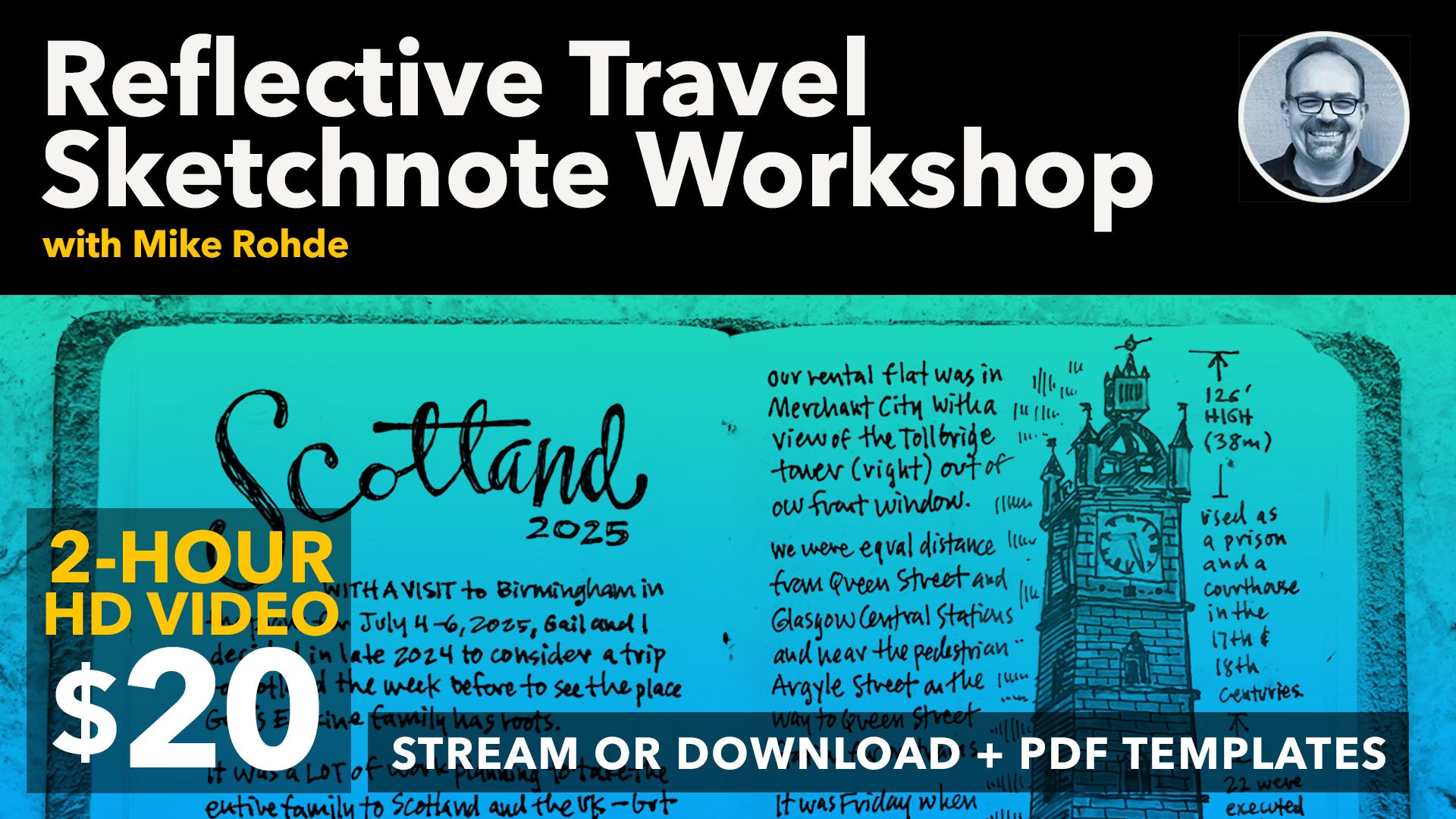
Have you ever wanted to create travel sketchnotes from an experience you’ve had, just using the photos and memories you’ve got?
In the Reflective Travel Workshop, I’ll guide you through my process for creating travel sketchnotes and then help you reflect on your own photos and memories so that you can make travel sketchnotes of your own trips, too!
This 2-hour recorded video includes a set of downloadable, printable sketching templates and a process to kickstart your own travel sketchnoting practice.
All this for just $20.
Subscribe to the Sketchnote Podcast
You can subscribe to the podcast through iTunes, Google Podcasts, Spotify, Amazon Music, YouTube or your favorite podcast listening source.
Support the Podcast
To support the creation, production, and hosting of the Sketchnote Army Podcast, buy one of Mike Rohde’s bestselling books. Use code ROHDE40 at Peachpit.com for 40% off!
Hey, I’m Mike Rohde, founder of Sketchnote Lab. I’m celebrating Summer arriving with 20% off paid Lab memberships through June 30, 2026.
Special link: sketchnotelab.com/summer20
Episode Transcript
Mike Rohde: Hey everybody, it’s Mike and I’m here with Andrew Tan. Andrew, it’s so good to have you on the show. Thanks for being here.
Andrew Tan: Thanks for having me, Mike.
MR: I was cruising around on YouTube and stumbled across this guy teaching how to do diary comics. I watched the whole video, went down the rabbit hole, watched all the videos you made, and reached out. I was so inspired that I put together a one-hour diary sketchnotes workshop on Sketchnote Lab and people really loved it. So thank you for that.
AT: You’re welcome. I didn’t invent the diary comic concept, but I was amazed at how you took to it.
MR: When I find cool things I think others will like, I try to share. Tell us who you are and what you do, Andrew.
AT: I work as a freelance illustrator — I do stuff for various clients, work from home, love the flexibility. I’m also a parent with two kids. These recent few years I’ve been teaching more — I’m an adjunct lecturer at a local art school. I think I got the love for teaching from my mom, who used to be a teacher, and the drawing part from my dad, who was an architect. I also like solving things, which can keep me up at night, but it’s also how I learned art. I didn’t go to art school — I was a business major — so figuring out how to draw something was like solving a problem for me.
MR: Tell us your origin story. You’re in Singapore, which is a unique culture. How did you come to where you are?
AT: Like all kids, I liked drawing. I liked it even more when people said I could draw well. I was a daydreamer — drawing was like playing with action figures on paper. What got me interested was Star Wars. I drew Star Wars comics in my school exercise books. My mom threw those away.
I wanted to study art, but my dad said artists don’t make money and sent me to Washington State University for four years to study mass comm and business. When I came back, I wanted to be an art director but didn’t have a portfolio, so I went to a certificate course in graphic design — at the same school I’m teaching at now, actually. I eventually got into advertising and became an art director doing work for corporate clients like banks. But I was at the agency until 11pm three times a week, handling five projects at once. I wanted out but my dad said don’t quit until you have clients lined up. My mood just got worse and worse until my boss picked up on it and said he thought it was time for me to leave. I was really happy. I told my dad and went straight into freelancing. I’ve never looked for another job since — that was about 20 years ago.
MR: Your art director background probably helps you understand exactly what clients need.
AT: Yeah, I know exactly what the art director is asking for, or I’ll ask the questions to get me there. And I already critique my own work before I hand it over — sometimes there are hardly any changes, or I’ll even propose changes they hadn’t thought of. I just have to be careful not to seem like I’m taking over their role. I stay in my lane as the illustrator and supplier.
MR: You did some storyboarding early on that must have trained your speed.
AT: A former lecturer gave me storyboarding work for Sony and other TVCs — 15 frames in two days, all colored in Photoshop. That definitely trained my speed and clarity. Right now I’m doing mostly finished editorial illustrations, which is really rewarding because there’s a concept and I’m free to find the right picture for it. During the pandemic the advertising jobs dropped off, but the National University Hospital commissioned me to do the COVID Chronicle comic series — chronicling the pandemic from inside the hospital, combating fake news with real facts. I did that for about two or three years, once or twice a week.
MR: Do you think there’s more acceptance of comics and visual storytelling in Asia compared to the West?
AT: I think we’re getting influences from all over — West and Japan. Education books are definitely using more comics now, where before you’d never bring comics to school. The manga and anime style resonates with younger people. I wouldn’t say Singapore is as immersed in it as Japan — there everything from train posters to books for housewives to books for businessmen is anime. Singapore is somewhere in the middle, with influences from both directions. But in any case, graphics help communicate to wider audiences. You can get something from just the visual, and then text plus visual gives you even more.
MR: Let’s talk tools. What are your go-tos?
AT: I got really into vintage fountain pens. What got me started was dip pens and the thick-to-thin pressure line they gave me. Vintage fountain pens could do the same thing. I found Greg Minuskin in California — he’s like an Indiana Jones of fountain pens, goes to flea markets, restores them, retips the nibs. We’re still friends. Every time I buy a new pen it makes me want to draw more. I like the flex nibs, the extra-broad double broads, the Fude nibs — anything that gives me an unusual line. For ink, Platinum Carbon Black is my most useful because it’s waterproof and scans cleanly as black. Beyond pens, I’ve got gouache, acrylic, acrylic gouache, oils, monoprints. I’ll never finish mastering all of it, but what excites me is the combinations — pencil with monoprint, fountain pen with watercolor. Each combination gives a different look.
Monoprinting is another method I like — you spread screen printing ink on an acrylic sheet, put your paper down, and draw on the back side. You get an unpredictable texture with accidental ink that adds a kind of dirt to it. Especially now with everything moving toward AI and more perfection, I like having something that goes the other way.
For finished illustration work I use an iPad Pro and Procreate. I’ll sketch the rough idea quickly for client approval, then transfer to Adobe Illustrator for the final vector piece. But I cycle back to paper often — I get tired of looking at the screen, or I want something I can’t move around on paper, and I go back to the iPad. Still figuring out the best method for comics.
MR: What would be three tips for a visual thinker who’s in a rut?
AT: First — practice drawing spontaneously with a pen, directly, no pencil sketch underneath. A diary comic or sketchnote is like a spontaneous diary. You don’t pre-plan your diary. Going straight to pen prevents overthinking. Whatever mistakes appear, just leave them or cancel them out. It looks more honest, more charming, and it trains your confidence.
Second — add black. A lot of artists forget the dark areas. They do midtones and outlines and call it done. But adding black to the areas of focus — the face, the eyes, the most important parts — gives contrast and lets the reader know where to look. Without contrast, everything is equal and your brain works harder just trying to figure out where to look.
Third — give yourself permission to be distorted or imperfect. I had to tell myself this because I didn’t go to art school. Especially from my storyboarding days, I’d want to erase every small mistake and I’d never get the job done. So I started giving myself permission: if it’s a bit off, just leave it. The imperfections are often what make it look nice. They make it human.
MR: Where can people find your work?
AT: Google Drewscape — that goes to my commission work and my blog, which I update more often. YouTube is Drewscape-art. I also have four short courses on Skillshare, slowly building that out.
MR: Well, Andrew, thanks so much for sharing your story — I loved the origin story, and we clearly have more in common than I initially realized. Not only Star Wars, but being in the trenches in advertising and design as art directors and illustrators. For anyone watching or listening, that’s another episode. Until the next one, this is Mike Rohde — talk to you soon.

Sketchnote Lab is Mike Rohde’s space designed to bridge the gap between sketchnote theory and practice. You don’t need to be an artist to think visually. Join Mike and learn to use sketchnotes to clarify your thinking, solve problems, and move forward. Learn more about Sketchnote Lab.
Mike is the author of The Sketchnote Handbook and The Sketchnote Workbook, bestselling books that teach regular people how to start sketchnoting and build a regular sketchnoting practice.
He founded the Sketchnote Army and hosts the Sketchnote Podcast, where he interviews visual thinkers to understand what makes them tick.
Mike teaches recorded, live, and in-person workshops to help accelerate your sketchnoting practice and provides personalized coaching for your specific visual thinking challenges.
He is the illustrator of bestselling books like REWORK, REMOTE, The $100 Startup, Honest SEO, The Culture Playbook, and The Future Begins with Z.
Become a Supporting or Founding Lab Partner to support Mike’s work.
Some links in Sketchnote Lab posts are affiliate links. If you purchase through them, I may earn a small commission at no extra cost to you. I only recommend tools and resources I use and believe in.
©2026 Mike Rohde, Sketchnote Lab


