

Hey everyone, it’s Mike Rohde, and I’m here with another All The Tips episode, this one wrapping up Season 1 of the Sketchnote Podcast.
One of the most popular episodes is “All The Tips.” I think hearing tips from all the guests in one single episode with a little inspirational music is a great way to wrap up the season. It’s always one of my favorite episodes to put together because I know how well it’s received by all of you listening or watching.
Listen to the episode:
Danny Gregory
Embrace constraints and personal projects. Constraints challenge your mind and spark problem-solving. Limit yourself to drawing only food on your next trip, or use only two colored pencils. Create a daily list of ten ideas, such as dishes you could cook with radishes or dead people you’d like to have dinner with. Do this for a year, and you’ll have 3,650 ideas (maybe five of them are great). Combine constraints with personal projects to create a sense of obligation and purpose that keeps you motivated.
Break through plateaus with a beginner’s mind. After a year of drawing, you’ll hit a plateau where your improvement stalls. To overcome this, try new subjects, tools, or styles, breaking your routine. Danny’s weekly YouTube stream, Draw With Me, encourages this by drawing 40 different items in an hour, upside down, with your non-dominant hand, or watercolor.
Redefine practice: drawing exercises like eggs, grids, cubes, and shading charts are just tools, not fun activities. Think of practice as professionals do… something you simply do and apply. To improve at drawing noses, fill a sketchbook with varied portraits of interesting noses. Keep it engaging and relevant to what you care about.
Sarah Greer
Learn to navigate the shitties. The creative process is a roller coaster. Every project (whether it takes a day or a year) will have a low point. The shitties are real, but they’re also just part of the process. Go for a walk, step away, hang in there. It’s always darkest before the dawn. Knowing that the low is coming means you won’t be surprised when it arrives, and you’ll know it will pass.
Challenge yourself often. Growth comes from discomfort. Sarah’s example: picking up an iPad for the first time and going straight into a live client meeting with it a week later. Or diving into Mental Canvas with no experience. Whatever tool or skill you’re curious about, dive in. Don’t wait until you feel ready because you won’t. Just go.
Find inspiration outside your daily practice. Go to museums, plays, musicals, and shows. Get fresh eyes on the world. Even crawling around on the floor with a grandchild and seeing things from a different height can shift your perspective. Inspiration rarely comes from staring at the same thing every day.
Adrian Peryer
Set the environment up right. If you want to do more and do it better, create the conditions for flow. Figure out what space, setup, or ritual gets you and others into a productive, creative state. Don’t leave your environment to chance — design it intentionally.
Find your wise mind every day. Try to be balanced, level, and check your ego at the door. For Adrian, that path led to yoga (inspired by Sarah), and it’s been the single best way to start each day in the right mode. Your path may be different, but finding something that centers you before creative work matters.
Remember that emotions are a wave. It never goes according to plan. Under pressure, when things don’t go the way you expected, pause. Remember that emotions — frustration, disappointment, overwhelm — are a wave. They will pass. It will get better. Give it time before reacting.
David Armano
Use AI to get unstuck, but push it. AI is sycophantic by default and will tell you what you want to hear. But if you know yourself well enough, you can push it to give you genuinely useful counsel. David has found it a surprisingly good substitute for a human career coach when used selectively and with self-awareness. The key is knowing what you want from it before you ask.
Protect your ability to be intentional. Step away from screens regularly. Consider going analog: David switched from an iPad to a Remarkable tablet that feels like paper and found it helped him be more deliberate and focused. Our biggest nemesis these days is technology and distractions that erode our ability to be intentional with our time. Watch out for brain fry (the opposite of flow state) that comes from multitasking across too many AI tools at once.
Make yourself memorable in person. Find ways to be experiential, distinctive, and ownable. Remote work and podcasting are great, but when there’s an opportunity to show up in person, take it. Face-to-face connection is more valuable than ever. Find your thing — wear the unusual sport coat, bring personality, and do something that makes people remember the experience of being with you.
Andrew Tan
Draw directly with a pen. Skip the pencil rough and go straight to pen. A diary comic or a sketchnote is spontaneous. You don’t pre-plan a diary; you just let it flow. A pen prevents overthinking and over-editing. Whatever mistakes appear, cancel them or leave them. The imperfections look more charming and more honest, and drawing directly builds your confidence in ways that penciling first never will.
Add black to create contrast and focus. A common problem in illustration is too many mid-tones and not enough contrast. Find the most important area in what you’re drawing and make it darker, almost solid black. A hat, a pair of eyes, or a shadow area. When everything is outlined in gray, the viewer’s brain has to work harder to figure out where to look. A little black makes the focal point clear.
Give yourself permission to be imperfect. Beating yourself up over small mistakes slows everything down. Give yourself little permissions as you draw; if it’s a bit distorted or a bit off, just leave it. Andrew found that accepting imperfection helped him draw better over time. And sometimes the wonky line or the slightly off proportion is what makes a drawing look human, warm, and alive.
Tabitha Walker
There is no right or wrong way to do this work. Everyone processes information and puts it on the page in their own unique way. The way you sketchnote won’t look like anyone else’s, and that’s not a problem; it’s the point. Don’t get caught up in whether you’re doing it correctly. Just start.
Practice to find your unique style and let it evolve. Your style will change over time, and that’s okay. The way Tabitha’s work looks now is different from how it looked five or ten years ago. Sketchnoting and graphic recording are living practices. Keep doing the work, and trust that your voice will continue to develop.
Don’t try to look like someone else. It’s tempting to look at the best in the field and think your work has to match theirs. It doesn’t. Whether you work in black and white, full color, all caps, or cursive… that’s your style. Own it. When your work has its own identity, people will recognize it as yours. That recognition is one of the most valuable things you can build.
Atom Brum
Let go of the filter. Just get it out. When you’re sketchnoting a live talk or lecture, overthinking headers and lettering means you miss what’s being said. The purpose of a sketchnote is visual communication and recall, not a finished piece of art. Let it flow. Accept what comes out. The act of doing it is already the benefit.
Make it easy for yourself with the right materials. Are you prepared? Do you have paper on hand? Do you have pens that feel satisfying to write with? The materials matter more than people realize. Adam’s go-tos: the Marvy Le Pen for a uniquely satisfying writing feel, and Micron 01, 03, and 08. Keep your toolkit simple and portable, and make sure it’s always with you.
Georgina Dean
Struggle first, then ask AI. Don’t go to AI for the answer before you’ve genuinely tried to work it out yourself. The struggle is where learning and memory happen. Georgina spent three hours fighting with a printer before finally asking for help, and she’ll never forget that experience. Creative friction is valuable. Give yourself a real shot before turning to a tool for the answer.
Use AI to analyze, not just to answer. Once you’ve done the work, AI can be a useful coach, helping you understand what went wrong, what you could do differently, and how to improve the process next time. It doesn’t have to be just a shortcut to the answer. Used reflectively, it becomes more like a mentor than a search engine.
When stuck on a visual, ask AI for words, not images. If you can’t visualize a concept, request text suggestions, such as metaphors or descriptions, instead of images. Your imagination, based on words, yields personalized results. Also, upload a finished sketchnote for feedback, but note that files uploaded to non-enterprise OpenAI may be used for training, so protect your work.
Zsofi Lang
Follow your passion. Sophie posted science comics on Instagram out of love, which led to a deal with a publisher. The journey from personal hobby to career isn’t direct but begins with consistent effort and sharing. Try new things and pursue what excites you.
Sponsored by The Reflective Travel Workshop
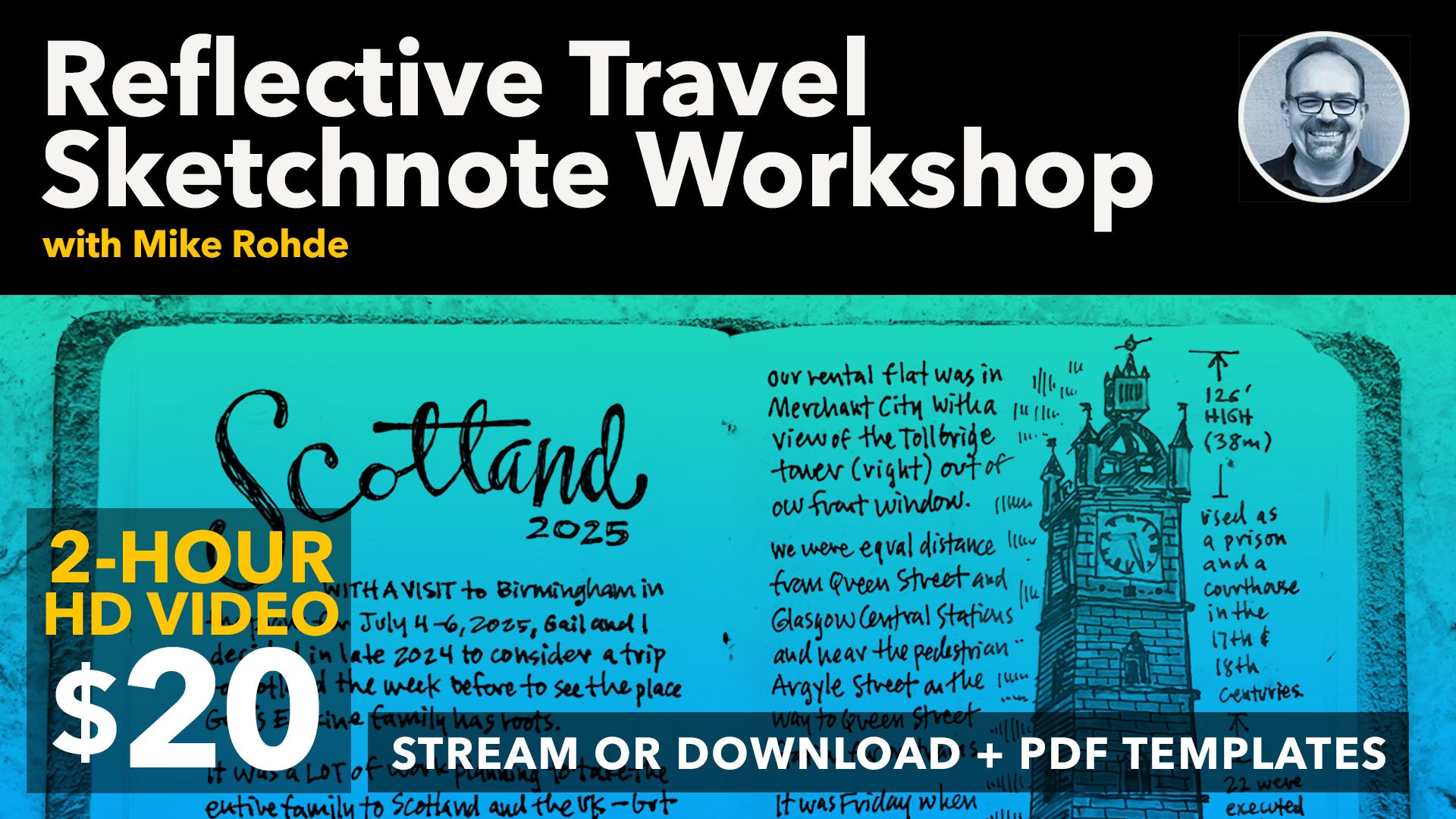
Have you ever wanted to create travel sketchnotes from an experience you’ve had, just using the photos and memories you’ve got?
In the Reflective Travel Workshop, I’ll guide you through my process for creating travel sketchnotes and then help you reflect on your own photos and memories so that you can make travel sketchnotes of your own trips, too!
This 2-hour recorded video includes a set of downloadable, printable sketching templates and a process to kickstart your own travel sketchnoting practice.
All this for just $20.
Subscribe to the Sketchnote Podcast
You can subscribe to the podcast on iTunes, Google Podcasts, Spotify, Amazon Music, YouTube, or your favorite podcast-listening app.
Support the Podcast
Support the creation, production, and hosting of the Sketchnote Podcast by buying Mike Rohde’s bestselling books. Use code ROHDE40 at Peachpit.com for 40% off.
I teach you to solve problems and capture ideas using loose, imperfect sketchnotes. To learn how, become a free or paid subscriber.
Episode Transcript
Hey everyone, it’s Mike Rohde, and I’m here for another episode of all the tips — this one for season one of the Sketchnote Podcast. As some of you long-term listeners may know, this podcast used to be called the Sketchnote Army Podcast. But with my focus on Sketchnote Lab this year, I’ve made a shift. We put Sketchnote Army into archive mode, and you can go and check that out.
All the archives are still there for you at SketchnoteArmy.com, but my efforts and energy are all going toward Sketchnote Lab, which is where this podcast landed as well. And along with that move, I made a decision to rebrand it and simplify almost everything about the podcast, renaming it to just the Sketchnote Podcast, and inviting, of course, the same really high quality, interesting guests to the show.
One of the most popular things we’ve learned from the podcast over the last five years or so is that the all the tips episode is really popular with people. Getting to hear all the tips from all the guests, or most of the guests, in one single episode with a little inspirational music is just a great way to wrap up the season. It’s also a great episode to listen to if you’re ever bummed out and you just need a little pick-me-up to hear how people — regular people — use visual thinking in their everyday lives and where they’ve come from, so often not from the places you might expect. So it’s always one of my favorite episodes to create too, because I know it’s so well received by you who are listening or maybe watching this final episode of season one of the Sketchnote Podcast.
So one thing I want to mention before I go is if you like this podcast, definitely check out Sketchnote Lab. You can go to sketchnotelab.com and see all the work that I’m doing there. I typically do a monthly dispatch where I collect five really interesting links that I’ve seen in the last month, along with everything that’s happened or coming up at Sketchnote Lab. We do monthly workshops, live workshops on Zoom. So that’s always really great. If you want to join and do some active work with a small community and with me on a Zoom call, that’s really great. And of course, it’s recorded.
So if you’re a member, you get access to all those recordings and you can go back and see all of them. And then finally, I do additional posts on Sketchnote Lab for different things that I’m encountering, anything I’m discovering, if I’m working on a project and I want to share it. It’s a great place to see all the work that I’m up to over at Sketchnote Lab. You can become a paid partner of the lab starting at $10 a month, or you can go $80 for the entire year. If you want to be a founding member, you can do that for $200 a year. And that includes a once-a-year, one-hour coaching session with me, every year that you continue to be a founding member at the two hundred dollar level. We can work on projects together and focus on specific custom challenges that you need some guidance and coaching on.
So that is my pitch for you. I would love for you to join me. Sign up for free and see what we’re doing over there. And I would love to have you become a paid lab partner and be part of the fun and get access to all the benefits that lab partners get.
So with that, this wraps up another episode of the podcast. Here we go. Without further ado, here are our guests with their tips.
Danny Gregory
Well, I think the tips I was going to give are broader, but they could certainly be applied to this. So the first one, ironically, fits into exactly what you just said, which is to embrace constraints. I think we’re so used to, particularly if you’re a creative professional, having constraints on what your ideas are. You have a strategy, you have a brief, you have a client, you have this and that, so you work within that box. I think a lot of times when people come to me and say, what should I draw? I’d love to draw, but I don’t know what to draw — they think they’re supposed to be making some art. So like, what is that supposed to be about?
But I think if you try to find constraints, those constraints could be just draw a certain way. You could say, I’m only gonna go to Paris, but I’m only gonna draw things I eat, and I’m only gonna draw food. Or you could say, I’m only gonna take two colored pencils with me and everything I do is gonna be just using those two colored pencils. Or you could say, I’m only gonna use materials that I find in Paris along the way. So when you have a constraint, that stretches your mind to solve a problem. You’ve created your own problem. And then it’s much more interesting.
When you look at impressionism, for instance, or lots of great artworks made within constraints, I think that’s also aesthetically really appealing. Because when you think about lots of different ways to solve the same problem, it’s like the old design exercise we all got in high school — how do you drop an egg off a building and protect it? When you work within that and you try to think of lots of things, your imagination really gets exercised.
I really like this exercise of giving yourself a list of ten things. You start by saying, I’m gonna come up with ten lists of ten things, ten topics for ten lists. So the first topic might be ten ways to drop an egg off a building, and the next topic might be ten things I could cook with radishes, and the next thing is ten people I’d like to have dinner with who were dead. You just make a list of ten things. And then the next day — and this is literally something you can do every day — you take ten things, ten people I want to have dinner with, and you come up with ten things. And so doing those kinds of things, if you do that every day for a year, that means you’ll have come up with 3,650 ideas. And there might be five really good ideas in there. You could just spend five minutes doing that as you’re brushing your teeth or whatever. So to me, having constraints really stretches you.
I also like the idea of having personal projects. Like when I first got Procreate, I decided I wanted to get to know it and I didn’t want to do a lot of courses or whatever. I just gave myself an assignment. Every day on Instagram, for a hundred days, I’m gonna post a different drawing of a dog — a different kind of dog and a different way of drawing that dog. And I did that and I did all kinds of styles, cartooning and oil painting and all the great things you can do with Procreate. And I learned how to use Procreate really well during those hundred days. I learned how to draw dogs well. I learned how to come up with ideas, cause each one was a different idea. My thing was just like, I’m gonna spend fifteen minutes doing each one, twenty minutes, whatever it is. It’s quick, get it up on Instagram, move on. I’m just doing it. And the reason I included Instagram was because it was another constraint — I have an obligation to do it. Not that anybody cared or was paying attention, but for me it was like, don’t break my streak. So I did it for a hundred days, and that was really helpful.
But I think there’s just a lot of projects that are really valuable. I drew my same teacup with the same pen every single day for an entire sketchbook’s worth of thing while I was waiting for the kettle to boil. I had a tea sketchbook that I kept next to the tea kettle, and then I would put the kettle on, wait for the pour, wait for it to steep. The whole thing would take about six minutes. And I would draw my teacup each time — sometimes the same way, sometimes different. So having things like this are just fun. They have no particular purpose, but something might come out of it. Projects can turn into things, but that’s not why you’re doing it. It’s just a way of channeling what you’re doing. So that would be my first tip: constraints and projects.
My second thought is plateaus. I think that if you draw a lot, after a year, sometimes longer, you will hit a plateau where you’re just not getting any better. You had this incredible run when you first were learning, but now if you look at what you drew six months ago and you look at what you’re drawing now, it’s kind of the same. You’re kind of doing it the same way. And basically you’re getting better and better at the same thing, but your brain isn’t really growing because there’s no more challenge anymore. I think about it in terms of exercise — the same things happen if you’re lifting weights or running or whatever. You just kind of get to this point and then you’re just doing it. And I think the danger with that is you will fall off the plateau and your enthusiasm for doing it will change.
So I think that an important way of getting across that plateau, getting back to getting better, is beginner’s mind. Beginner’s mind is what allows you to really take off. What I suggest is try something that you are really uncomfortable with doing. It might be subject matter that you never like to draw. It may be a tool that you’ve never used before. It may be looking at some artists who are very different from you, really studying what they do, and maybe trying to draw in their style. But whatever you can do to snap that default way you have of doing things will help you grow into something different.
I do this thing called Draw With Me, which is a weekly live stream on YouTube. I’ve been doing it for six years now. And every week we draw something really different. Sometimes we draw one thing, and sometimes I’ve done as many as 40 things in an hour. Sometimes we draw people, animals, things from our imaginations, things from photo reference, we do lettering, all kinds of stuff. But my objective in doing all of this is to really stretch myself and to stretch the people who come, and to just say, here are things — because everybody will say, I never thought I could draw X and I can’t believe that I did it. And a lot of what I do is I really move fast. I’m going, and I’m not waiting for you. You’re gonna keep up with me. And if I have photo reference, if you haven’t taken a screenshot, you’re out of luck. And I’m amazed at how people can do it. People can just learn to draw really quickly and they can draw really weird things. We draw upside down sometimes, we draw with our non-dominant hand sometimes, we do watercolor, all kinds of things. And at the beginning of each show, we show all the things that people drew and posted from the week before. So if you’re just feeling like ugh, I’m just not getting any better, try something like this or come join me on YouTube. Just get over yourself, get off what you’re good at, and get bad at something. Get bad. And then you will shake it up. So that’s my second thought.
And then the third thought is I don’t like the word practice. I think a lot of times we’re like, well, I really gotta practice and I should practice. I think when it comes to drawing, practice is really bad — it’s like drawing an egg or putting in the light shading. Maybe it’s cause I didn’t go to art school, but every time I sat down to teach myself and I would open a book on how to draw, I just didn’t want to do it. So I like the idea of thinking of practice the way lawyers think of practice, or doctors think of practice, or yoga instructors think of practice. It’s just a thing that you do. And what you’re doing is you’re practicing the thing you do — not because you’re doing exercises, but because you’re applying it. That’s what practice really means. You’re practicing what you preach, you’re practicing what you’ve learned, you’re applying it.
So think about what can you do so that instead of trying to learn fundamentals in the abstract, you’re applying them in some way. So if you say, I wanna get better at drawing noses, well then fill a whole sketchbook with portraits of people with big noses. Make it something else, but don’t just draw grids and cubes and all that stuff. People who are first learning to draw, that’s where they start. It’s like learning chopsticks. Nobody wants to play chopsticks. You want to play songs. So go and do that. You’ll be bad at it, but keep going and then you’ll get good at it. It’s really like keeping it interesting, keeping it varied — those are the things that push you forward. So those are my three tips: constraints and projects is one; plateaus and beginner’s mind is two; and practice redefined is three. Find practice for yourself.
Sarah Greer and Adrian Peryer
For me, I would say the first one is being able to navigate the shitties. And this is a crazy little term we heard about. We did a Pixar course a while back and decided to make a movie about a talking piano. That was not an easy thing to do because it’s an inanimate object — how do you make it smile and talk and do all those things? But the shitties is something I love because I’ve noticed I’ve been doing creative things all my life and the creative process is like a little bit of a roller coaster. And when you hit that downside, it’s like just hang in there and go for a walk or do something because it’s always darkest before the dawn and you’re gonna get out of the shitties. Just know that that’s part of the process. And so that would be kind of my first one. And it doesn’t matter if the project is like a one-day thing or it takes a year, you’re gonna go through that loop.
The second one for me is challenge yourself often. Like for me it was getting an iPad. I’d always just done things live and on boards and I got the iPad, trial by fire. I think a week after having it, we were doing something here and then a couple weeks later I’m on vacation doing orals for a big tech company on my iPad, like live in the meeting. And I just forced myself. I threw myself into the deep end. And I just recently had been really curious about Mental Canvas and got working with that and just did that the other day. Mental Canvas, it’s great, but it’s really hard and it’s challenging. So challenge yourself.
And I think the last one for me is just don’t be afraid to go find inspiration outside of your daily practice. So go to museums, go to plays, go to musicals, go to shows, get the fresh eyes. Because you can come back to it and, I mean, for me it’s like crawling around on the floor playing with my grandson. I’m looking at the world at a different level. So those are my three.
My three — you inspired me for the first one, which is when you talked about grabbing that space, that room and creating it. I would say if anyone out there is wanting to do more, set the environment up right for yourself. Figure out what will work for you that will get you and others into flow state more often, create more productivity, and allow you to be more creative. That would be the first thing.
The second is personal. Sarah’s an artist by background, I started as a therapist, and so we combine. I would say try and embrace and find your wise mind every day. Try and be balanced, try and be level, and check your ego at the door. I don’t know what the journey towards that is. For years Sarah did yoga and I didn’t, and I was like, hmm. She talked about doing yoga and I now do yoga inspired by Sarah and it’s the single best thing for helping me start each day in that mode. But you’ll figure it out.
But the third is connected to that and it’s different. It’s like, it never goes according to plan. And particularly us as humans, we always sometimes feel strong emotions. And I always say to people, just remember emotions are a wave. It will pass. So figure out under pressure, when you’re feeling like it didn’t go at work, pause. And it will get better. It will pass.
David Armano
Well, ironically, I found myself in a little bit of a rut a couple of times. And I’m doing the thing that you’re probably reading articles about telling you not to do, which is don’t use your AI as your therapist or even your career coach. And here’s why they tell you that — because absolutely AI is sycophantic and will absolutely tell you what you want to hear as a default. But I will say this: I learned you can push it. It’s kind of the same thing of like, I get what I want. I have been using it, and it’s not the only thing — I mean, I talked to my wife and whatever. But I will say I have had pretty good luck with AI helping me get unstuck. And I can even compare it. There was at one point I worked with a career coach, real accomplished guy, and it was great. But I’m even comparing that experience to now getting stuck and now I don’t have access to a human career coach. And I find myself like yesterday I did something that I got some counsel on from my AI and I was like, okay, that was really good. I have to be really selective. So I would say if you feel confident that you know yourself well enough that you could get what you want out of it, that could be one thing.
The second is, I was just talking to Noa Hanley. She’s an author and we had just had a great conversation about intentionality. And I was talking about how I went from using my iPad to even just getting a scribe to just pair back. For me, I didn’t need the iPad because I have the developed process, but going to a scribe has been helping me. It feels like paper, like a Remarkable. It gives me the best of digital and analog and strips it down to where I feel like I could be more intentional with it versus an iPad. But I think anything that you can do — and that’s an example in visual thinking — but even just going for walks and giving yourself the breaks. I think our number one nemesis these days is all the technology and distractions that take away from our ability to be intentional with our time. Ironically, you’re hearing this from an engineer, but it’s not just engineers. When you’ll find in vibe coding or in working with AI, it moves so fast. It almost acts like another, like if you’re in Slack too long or you’re multitasking, you’re not in flow — and when you’re spending time multitasking with AIs and doing all these different things, it almost puts you in a state of brain fry, where your brain basically gets fried and you have to step away. So you have to be mindful about that. That’s now another thing we have to deal with, like this brain fry versus being in flow.
If I were just to distill it down to one or maybe two things: figure out ways where you can be intentional about all these new emerging tools, and then find ways to be memorable, experiential, distinct. Find ways that you can own it and really lean into it. Like it’s great that we’re doing a podcast as a remote. I think there are so many awesome things, but when there’s opportunity where we meet in person, that’s different. That’s more important than it’s ever been.
Andrew Tan
I think the first one I listed here is to practice drawing spontaneously, directly with a pen. I was also teaching a comic class on diary comics and I was encouraging my kids to just go directly with the pen. Because especially a diary comic or maybe a sketchnote, it feels like it’s more of a spontaneous diary. You don’t pre-plan your diary, you just let it flow out. So a pen prevents you from overthinking or over-editing. You’re just there, and whatever mistakes are there, you just cancel them or just leave them there. It looks more charming, it’s more honest, and I like that. And it trains my confidence, I must say, after using a pen directly.
Then the second one — this is more of a little, I don’t know whether it’s nitpicking, but sometimes when I see a lot of illustrations by other artists, they tend to forget the dark parts. They do a lot of mid-tones and outlines, and then it feels complete. But I find that adding the black parts to add more contrast, especially where the focus areas are, is quite essential to at least allow the reader to focus in on the important parts. So adding a bit of black area to the important parts. For example, if I’m drawing a person, like drawing you, your face, I’ll find something that’s black. Like for example, your hat’s black. So I’ll make the hat blacker, darker, almost solid black. Your eyes I’ll make darker. So at least something stands out. If everything is just outlines and greys, it’s very hard to focus on anything. I feel my brain works harder when I look at a whole page of words and outlines and mid-tones. It’s hard to focus on things.
And the last one is give yourself license to be distorted or imperfect. I learned that for myself because I didn’t go to art school so I had to tell myself things. It was like giving myself little permissions as I draw. If not, I’ll keep beating myself over small little mistakes and redoing a sketch. Especially maybe it came from my storyboarding days — it’s like if I make a small mistake I feel like erasing it or undoing it or something. And I find like if I keep erasing I’ll never get the job done. So I tell myself, okay, just give myself permission if it’s a bit distorted, if it’s a bit off, just leave it. And I found that actually it helped me to draw better. And sometimes it looks nice. The imperfections look nice. So give yourself license to do that. It makes it human.
Tabitha Walker
My top piece of advice: there is no right or wrong way to do this work. Everybody has their own unique way of processing information and transferring that to whether it’s a journal or a chart or an iPad or whatever it is, everybody has their own unique way of doing that. And there’s no, well you didn’t draw the stick guy like that so that means it’s wrong, no. We all have our own unique style and that’s what makes this work so special — you put a piece of yourself into it. So the way you sketchnote won’t look like the way I sketchnote, won’t look like the way somebody else does it. And they’re all valid and they’re all good pieces of work. And so I noticed this when I first started getting into graphic recording and I would go to classes and people were worried, did I do it right? Or I didn’t draw the little person the way the instructor said. Like it’s a stick figure, we know what it is, and you wrote something and we can read it. That’s right. That’s not wrong. So don’t be concerned with, am I doing it right? Just start. So that’s number one.
The second one is it’s important to practice to find your own unique style. And it’s okay if your style changes over time. The way my work looks now is not the same as it looked ten years ago or five years ago. It’s going to morph, it’s going to evolve, and that’s also okay.
And number three, kind of along the same lines, it’s okay if your work doesn’t look like other people’s work. It’s common to see people who are at the forefront in this field and think, my recording has to look like that. And it doesn’t. If you want to do only work in black and white, or grayscale, or only work in color, write in all caps, or write in cursive, or whatever, it’s your unique style. Don’t feel like you have to dim your light to try to fit in with how other people are doing it.
So those are my top three. There’s no right or wrong way. Practice, practice, practice. Find your own unique style. And it’s okay if your work does not look like other people’s. Good when it doesn’t, because then it becomes your work, which is important. And then people will know — especially if you want to make a name for yourself or go do this as either a side business or a main business or at your actual day job — when they see a piece of work that you do, they’ll know. That’s a Mike piece, or that’s a Tabitha piece. They’ll know.
Atom Brum
I think the first thing that comes to mind is just like the filtering that happens. It’s like just kinda let it go. Try not to have a filter. And I think it’s easier said than done, especially when I’m doing headers and kind of text-based stuff in sketchnotes — that’s kinda where I get the most pause. And it’s kinda like, all right, let’s remember that the intention of this is not a piece of art. This is visual communication. This is for a certain purpose to recall. And by the act of doing it, we’re already getting that. So this is a note for those listening as well as myself to just let it flow, just let it happen. And especially when I’m sketchnoting something during a lecture or like someone is speaking live, if you’re tripping over those little details, you’re gonna miss information. So get it out.
Another tip I might recommend is, kind of like the pencils versus pen, I’ve found that changing materials can be the difference. Do you have the things that make it easy for you? Do you have the right size notebook, so that you’re gonna have paper on you? Where it’s like I’ll buy the nice Moleskine ones and then I’ll forget them because they’re too big or whatever. So it’s like, are you prepared? Are you making it easier for yourself? Do you have the brand of pens that are satisfying to write with? And maybe that’s relatable or not, but those are my tips because I like the Marvy Le Pen. That’s like one of my go-tos. I can’t fully explain why, but there’s something really satisfying about those pens. I get big packs on Amazon and I’ll just give them to people when I see them. I usually have a bunch of them on me. There’s just something about those that are really satisfying. Micron 01, 03, and 08 are my go-tos. And then that’s pretty much it. Pretty simple toolkit.
Georgina Dean
It’s so true. And I’m so glad you said that. Just yesterday or the day before yesterday, I had to return something to Amazon. And normally nowadays, here in the UK, you can just show the QR code and they can scan it and return your parcel. But it was a different courier that had to pick it up and I had to print a label. Anyway, so we didn’t have a printer at home because we’re mostly digital. So we ordered this cheap printer to have at home and it took me like almost three hours to set up.
So turns out we had router issues, and the router was the reason it wasn’t picking up the software through the Wi-Fi connection when we connected it in the back end. Anyway, long story short, I struggled, I got frustrated, and I was tempted several times to open my GPT and ask for the instructions. I chose not to because I was determined that I had enough intelligence to do this by myself as a techie, right? So I spent all the time and finally after three hours, I knocked on my husband’s office door and I was like, I’m really stuck. I can’t figure this out. Anyway, he came over and he couldn’t figure it out either. Then I felt much better because he’s an actual engineer. Anyway, randomly after the fourth attempt, it did connect. I finally went to my GPT after we got it connected to understand what had gone wrong exactly.
And sometimes that’s what we call in education backwards by design, where we look at the end goal of a project, and then you design your planning backwards from the end goal you want to get to, and you match into each of those parts an experience that’s going to help them remember. Well, trust me, I can’t remember the last time I spent so much time trying to connect a printer in all my experiences, right? So I’ll always remember that. But it’s an interesting use case equally for AI, in that we don’t always have to go to it first. It’s important to have creative struggle sometimes. You don’t always have to just choose to get the answer first.
And the second interesting thing is that once you’ve done the struggle, you can ask it to help you understand what went wrong, what can I take away, or what can I do to improve that process so that I can do it faster next time. It doesn’t have to be just to give you the answer, but to help you analyze. Like it’s like having an on-demand tutor in a sense.
In the context, I would offer the same visually. When you’re stuck on trying to visualize an icon for something that you don’t know in visual thinking, for example, try. The creative struggle is important. So take a couple rounds, give yourself a five-minute timer, try to sketch a couple of things. When you can’t come up with it, you could use a GPT to ask for suggestions, but don’t ask it to give you the images. Ask it to give you the text so that it’s not inputting the images into your mind. You’re reading the words, and your imagination based on your learned context from your life experiences may help you visualize something.
And a little bit like text, the other half of that tip: perhaps you may have written a story or an essay and you’d like the GPT to help you with your grammar and structure. It may be the same as an image. Some visual thinkers, sketchnote artists may disagree with me, and that’s fine. But you may input your own sketchnote into a GPT and ask it to give you feedback a little bit like a coach or a mentor — a little bit like me sending a sketchnote to Mike and saying, could you give me some things that you’d like me to improve on? It’s the same with a sketchnote. You’re not asking the GPT to recreate your sketchnote, you’re asking it for feedback. Just a little note on that for those who want to take my advice: please remember your data. If you’re going to put your sketchnote into a GPT like OpenAI that is not a lockdown enterprise version or a school version, then that will go into the training models. So just make sure before you decide to upload your data, including your own illustrations, that it is locked down for yourself if that’s what you want.
Zsofi Lang
When I sent this to the publisher I didn’t think that this would happen, or I thought maybe they have a project and I could illustrate, but I was very surprised when they said yes. They didn’t say yes right away, but they did say that they are interested and we started working together. They were giving me feedback on how to reframe it so that it’s ready to be pitched. And then they pitched it to colleagues, and then the whole company decided that they wanna take it on.
And then from then on, the work is very similar to what I do for graphic recording, because the way that we do it is that for each book, for each subject — like human body, dinosaurs, the next one is going to be the solar system — there is an expert who is giving me a text, like a summary of each subject. I’m using the original comics from Instagram that I posted. So like vaccines, I did my research there and it’s a very basic, useful, good research. So there is no reason for the consultant to write again about vaccines because that is already covered. But there were a lot of subjects that were not covered. And then for dinosaurs, which I had absolutely no clue about, they would give me a lot of facts. And then the way my mind works, when I read something, my mind is making these images in sketchnotes already. So in a way the work is very easy because I just have it and I just need to draw it down. So in that respect it’s pretty similar to when I work for a client.
Now the difference here is that I have my personality, and I can put that personality into this work much more than with a client. With a client it’s serious business and oftentimes it’s public policy or advocacy or those kinds of things. They don’t need my personality in that. They just need a visual summary and that’s fine. But here I can be funny. I wanna be funny. And I’m really trying to be, and sometimes it works and sometimes it doesn’t. But that’s wonderful. That’s such a thrill, you know? Because in a way I am this seven year old person who is just making silly jokes. And I remember when I was in school, the best day was when I made a joke and the class was laughing. That was when I was the happiest.
So that’s how the process is working. And I think this is not the only way to make this kind of work. For me this door was opened and there are many other doors. I think the key is to try to give a bit more time to your passion, and then you don’t know where it takes you. Who knows where it takes you, but just try new things and follow that.
Well, I hope that you really enjoyed this collection of tips from this season. I look forward to seeing you in the next season of the Sketchnote Podcast, where we’ll interview more interesting people, get to hear their perspectives, and learn from them. Until next time, this is Mike Rohde. Talk to you soon.
— Mike Rohde, Chief Scientist, Sketchnote Lab

Sketchnote Lab is Mike Rohde’s space designed to bridge the gap between sketchnote theory and practice. You don’t need to be an artist to think visually. Join Mike and learn to use sketchnotes to clarify your thinking, solve problems, and move forward. Learn more about Sketchnote Lab.
Mike is the author of The Sketchnote Handbook and The Sketchnote Workbook, bestselling books that teach regular people how to start sketchnoting and build a regular sketchnoting practice.
He founded the Sketchnote Army and hosts the Sketchnote Podcast, where he interviews visual thinkers to understand what makes them tick.
Mike teaches recorded, live, and in-person workshops to help accelerate your sketchnoting practice and provides personalized coaching for your specific visual thinking challenges.
He is the illustrator of bestselling books like REWORK, REMOTE, The $100 Startup, Honest SEO, The Culture Playbook, and The Future Begins with Z.
Become a Supporting or Founding Lab Partner to support Mike’s work.
Some links in Sketchnote Lab posts are affiliate links. If you purchase through them, I may earn a small commission at no extra cost to you. I only recommend tools and resources I use and believe in.
© Copyright 2026, Mike Rohde


