

This episode with Georgina Dean explores how visual thinking, digital balance, and project-based learning can transform education and personal growth.
Georgina’s insights highlight the importance of tactile exploration, the balance between analog and digital, and the power of visual tools to enhance memory and engagement, especially in a rapidly evolving tech landscape.
Hey, I’m Mike Rohde, founder of Sketchnote Lab. I’m celebrating summer's arrival with 20% off paid Lab memberships through June 30, 2026.
Special link: sketchnotelab.com/summer20
Listen to the episode:
Running Order
Welcome and Georgina’s background in education and sketchnoting
How COVID-19 triggered Georgina’s journey into visual thinking
The science of memory, metacognition, and multimodal learning strategies
Pedagogy explained: How we learn and teach across ages
The impact of drawing and annotation on information retention and recall
Balancing digital tools with analog experiences for children’s development
The return to tactile activities and the influence on human connection
The importance of balance between technology and humanity in a digital age
The cultural shift from analog to digital and back to equilibrium
How companies and parents can support responsible tech use and understanding
The era of creativity and innovation — exploring new learning playgrounds
The role of visual thinking in teacher training and classroom engagement
Real-world applications: sketchnoting in classrooms during lockdown and beyond
The importance of in-person teacher workshops and community building
Creative projects with students: from anime to storytelling and visual summaries
Project-based learning as a tool for real-world skills and critical thinking
Scaffolding and differentiation through project work and digital tools
Learning from struggle: the importance of perseverance and exploration
Using AI tools for feedback, brainstorming, and visualizing ideas
Integrating reading, writing, drawing, and tech in a cohesive practice
The power of community events like Sketchnote Camp to inspire and connect
Final thoughts: transforming education with visual thinking and purpose-driven technology
Resources & Links
Wonder with Georgina — Substack
Sponsored by The Reflective Travel Workshop
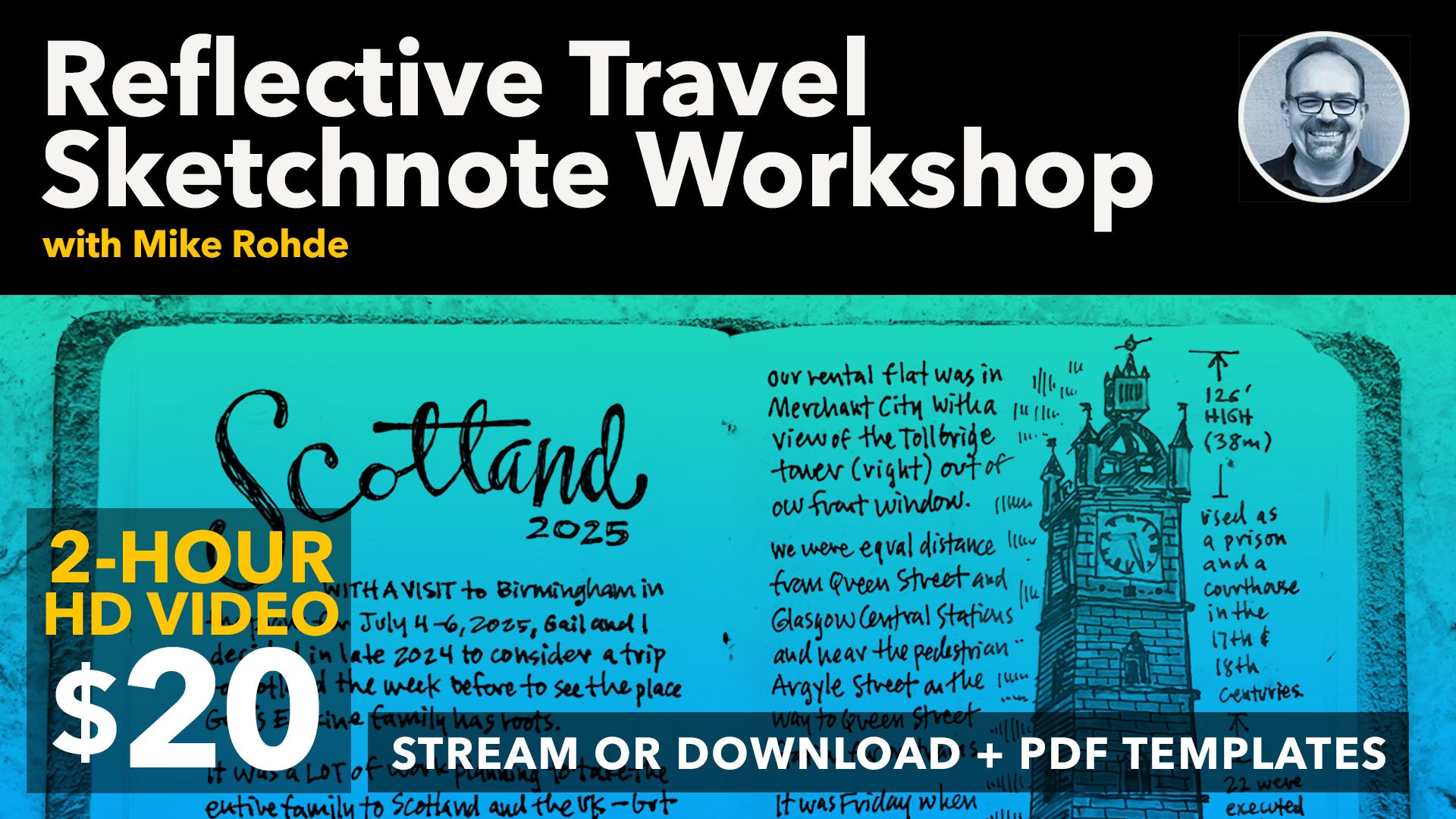
Have you ever wanted to create travel sketchnotes from an experience you’ve had, just using the photos and memories you’ve got?
In the Reflective Travel Workshop, I’ll guide you through my process for creating travel sketchnotes and then help you reflect on your own photos and memories so that you can make travel sketchnotes of your own trips, too!
This 2-hour recorded video includes a set of downloadable, printable sketching templates and a process to kickstart your own travel sketchnoting practice.
All this for just $20.
Subscribe to the Sketchnote Podcast
You can subscribe to the podcast on iTunes, Google Podcasts, Spotify, Amazon Music, YouTube, or your favorite podcast-listening app.
Support the Podcast
Support the creation, production, and hosting of the Sketchnote Podcast by buying Mike Rohde’s bestselling books. Use code ROHDE40 at Peachpit.com for 40% off.
Hey, I’m Mike Rohde, founder of Sketchnote Lab. I’m celebrating summer's arrival with 20% off paid Lab memberships through June 30, 2026.
Special link: sketchnotelab.com/summer20
Episode Transcript
Mike Rohde: Hey everyone, it’s Mike Rohde and I’m here again for another episode and I’m with my friend Georgina Dean. Georgina, welcome to the show.
Georgina Dean: Thanks for having me. I’m really excited to be here. It’s been like a milestone for me. And I was just like so honored when you invited me on. So thank you.
MR: Yeah, of course. You’ve sort of made your mark in the community for sure. I think I look back, it was probably about two years ago, maybe a little more, when we sort of crossed paths and you were really fascinated by the space. And I know that you came, I think you came to San Antonio. Is that right? Do I remember you came to San Antonio? That is kind of where we really kind of crossed paths and had a chance to chat and get to know each other. And of course you were involved in the Birmingham event last year.
GD: Yes, that was my first one.
MR: And you’ve just really accelerated and been really active in making, I think you just found the community suited you and you just sort of stepped right in, which I’ve really was really impressed with. And I think you had a really unique voice and perspective and wanted to have you on the show. I’m always looking for interesting people. If I can find someone who’s kind of at the edges of where things are at, that’s really interesting because, you know, that’s likely a chance we’re gonna go there. So welcome. And you know, with
every episode, let’s start with who you are and what you do.
GD: The big question, right? So yeah, I am Canadian and I’m currently living and working in the UK. And I have been traveling around the world for the last plus 20 years. So left Canada just over 20 years ago, and Egypt, Cairo, Egypt was my first stop. And I got the travel bug. I was an educator. Once an educator, always an educator. So we can still say still a teacher kind of thing.
but been traveling around the world for plus 20 years, different countries around North America, Africa, the Middle East, and COVID hit, and that’s really been a huge turning point as it’s been for a lot of people, both in terms of bringing me here now to the UK, but also in terms of sketchnoting, live scribing.
Graphic recording, all of those fun terms. So yeah, I’ve been working as an educator, teaching primary, elementary school, as well as high school. I’ve had the privilege and honor of working across the Canadian, the American, and the British curriculum. And then about plus 10 years ago, when Apple introduced the iPads, this was a really big game changer in K-12 education because it really helped us to personalize
learning for students and I joined an American school in Monterey, Mexico, and they had just got the first sets of iPads. And so there was a whole exploration and experimentation of how we could set up group work across the classroom.
helping students take on leadership roles and really moving learning through experiences rather than this rote approach to traditional industrialized education as we know it from decades ago. So that’s really what got me into the tech side, I guess we could say. And then I took that back to Africa to help schools with their digital transformation. So the last plus 10 years or so I’ve been working as an administrator, senior leader, working with teachers to learn how to
MR: Hm. Mm-hmm.
GD: integrate technology in a meaningfully pedagogical way with their students. That means not giving the iPad to say, go watch Netflix if you finish your worksheet early. No. It’s about what tools could we pick up on the iPad to help you engage with content through your curiosities and through the questions you have. How can you demonstrate your knowledge and skills
MR: Hmm. Mm-hmm.
GD: for what you’re learning through an app or through recording your voice or creating a video. And so it’s really experimenting with multimodal cross-media platforms to engage all learners because we all learn in different ways and at different speeds and rates. So technology really provided this accessibility, which is really important to myself, both as an educator, a human, and now a business owner. And so
MR: Hm.
GD: that’s really what got everything going. And then COVID hit. We were in Jordan in the Middle East at that time. And I was really busy, as you can imagine, being the digital transformation leader at the school, helping everybody get online, the parents, the teachers, the students, etc. But during the downtime, since we were in lockdown and in Jordan, you couldn’t leave the house for several months. So we really were like locked in the house for quite a while.
MR: Mm-hmm.
GD: I found an educational conference that was online through X, formerly known as Twitter. And I joined, and there was a graphic recorder slash sketchnote artist, you probably heard of her, maybe, maybe not, Jen Giffen from Canada. Virtual Gif, yeah. And she was sketchnoting the sessions from this online conference, and I was so taken aback.
MR: Mm-hmm.
MR: Yes, I know Jen, yep.
GD: By the visuals, and I just thought this is amazing. This is like a one-stop shop, but with visual notes. And I’m really into colors. And at that point in time, I would recall how I learned when I was in school as a teenager, you know, with highlighters and trying to get all my notes to study for an exam on one piece of lined paper, A4, and getting the colors out right. And then here she presented this beautiful.
MR: Hmm.
GD: canvas, single page with no lines, but I found my eyes and my mind just naturally navigating through the containers and the arrows and the connectors that she had. And I found myself having the synopsis of this conference webinar. And I was like, my goodness, I want to try this. This is so cool. So I fell in love with sketchnoting. And I guess I’m getting in a little bit into my origin story now. So maybe do you want me to just continue with?
MR: Yeah, just transition right in. Mm-hmm. Yep.
GD: Where I’m going, transition. Okay. So I wanted to, being an educator, sorry, let me just backtrack for one second. Being an educator, part of pedagogy is understanding metacognition as well. And it talks about how we learn, right? Not just learning something, but how is that process of learning? And so
retrieval practice is how we’re able to go from our short-term memory into our long-term memory to access information over a period of time. And our five senses can help us to do that. So often you may find yourself, you too, Mike, like you came across a smell and you had a flood of memories from when you were a kid, or you tasted a piece of food that your mom or your dad used to cook for you when you were little, or you listened to a piece of music and it reminded you of
X experience, right? And so talking about our senses and textures and everything help us also to recall information that is retained really quickly and flood your memory with all of the things around that experience. So visual is another one of those things, right? And so there’s a lot of evidence. I don’t have all the percentages at hand to say, but I’m sure we can all imagine together that it’s an increased percentage of people that can retrieve
information by both annotating it, right? Images and text on paper, as well as then using images to recall that information. What I found really interesting across my time, I really want this to be a conversation though. I feel like I should pause and let you hop in on something. So I think I’m just gonna pause there.
MR: Well, it’s fascinating. One thing that popped into my mind is for those who are not educators, and I’ve worked in the education space and I’m still not sure. What is pedagogy? How would you, what’s the definition for that?
GD: Really great question. Yeah. Thanks for slowing that down. So pedagogy is basically there’s pedagogy and that’s for younger students and then like teens, etc., and below. And then andragogy is what we call learning for adults. So pedagogy is the study of learning. So when I went to university to become a teacher in Canada, for example, at the University of Ottawa, it was a
MR: Mm.
MR: Okay.
GD: concurrent program at the time. I don’t think they offer it now, but basically, the program of study that I took, which was second language French teaching, I’m bilingual, was also my educational degree. And so when I finally took my Bachelor of Education, it ended up being the master’s for my program. It’s what we call a concurrent system, but basically you have a set of pedagogy, which is learning.
MR: Mm-hmm.
MR: Mm.
GD: and teaching, how to teach children and then how children learn. And then based on your subject, you have all the subject material. So since mine was language learning, I had syntax and phonics and all sorts of literacy, all sorts of things. You also have a bit of psychology because we need to learn also the developmental stages for children if we’re going to be teaching young people as well. So there’s a lot of different things, but the pedagogy is really looking at
MR: Mm-hmm.
MR: Right.
GD: how we learn and how we teach and that circle.
MR: Interesting. Okay, that’s helpful. The other thing that was interesting in what you talked about there was this idea that the retention percentage when you do drawing and annotation, which I’ve long believed. I think I’ve seen some studies. I suspect there’s probably more now. But I kind of instinctively knew that by doing it, that this was helping me remember. So I’ve kind of made the stretch jump that that’s likely helping other people too.
if they’re able to do this. And especially when I realized, well, if students are also benefiting from this, it seems natural that I should go as much as I can to education. Which, you know, honestly, it’s funny when I wrote the Sketchnote Handbook, we really did not have educators as a target market or a space that we thought about. We really focused on design professionals. Because I was a design professional, it made sense that other designers
are likely the ones that are gonna buy the book. And so that was, we had to pick something, and that’s all we really knew at the time. But what was interesting after a couple of years, the handbook and sketchnoting in general seem to really have this takeoff moment in the education space. I saw it mostly in the US because that’s where I’m located. But it seems like it’s gone worldwide really and has had a really positive impact. So we suddenly saw this second wind of educators buying the book and realizing, like, hey.
If my kids can retain more and they have fun drawing at the same time, like this is a double win. Teachers are always looking for ways that help their students learn and help them remember. So it was a natural fit. And I think from ever since it’s been definitely involved in the education space to different degrees based on where. But I always found that as like one of my proudest moments, like, okay, this is being used to help kids learn better and to think better and remember better. That’s pretty cool.
GD: Mm.
MR: And that I was really proud of that, even though like I said, we didn’t plan on it. It was really an accidental thing or a just a happenstance, but was really happy that that happened. So
GD: Such a great feeling to know you’re giving back, right? To like a huge community and like the future of the world. It’s great. Really congratulations to you. Yeah. It’s a huge win.
MR: Yeah, exactly.
MR: Yeah. So that’s exciting to hear that there are studies that are proving that to be true and that it’s helpful. So anyway, now that we’ve taken our little, go ahead.
GD: And I would even say, just to add a little point onto that as well, I would even say that there are newer studies now. If I can locate them, I’ll send them to you to add in the podcast episode if you want at the show notes. But there’s some new research being done and a couple that have been done on the difference between annotating on paper and that very, like the texture, the holding the pencil.
MR: Mm-hmm. Okay.
MR: Mm.
MR: Yeah, yeah.
GD: on paper and holding an Apple Pencil on an iPad. And there’s that little added percentage of it even goes deeper if it’s an actual pencil and an actual piece of paper. So then we have other companies like PaperLike, for example, that came out with screen covers that actually feel like paper. I personally use it and that helps a lot as well. I’m not sure that research has been done and if anybody knows, feel free to comment on this episode, but
MR: Mm.
Right.
MR: Mm-hmm. Yeah.
GD: if there’s research been done on adults and after we’ve gone through schooling, you know, in our generation of learning with paper and pencil, is there an actual difference going to the iPad now, or have we already, you know, integrated and ingrained those skills? But I think for children, there is a lot, like young children, I’m talking like below the age of 10, below puberty, there’s a huge amount of research around them being able
MR: Mm.
GD: to use the pencil even just for fine motor skills. That’s also part of the development, you know, through Piaget and the developmental stages. It’s important even for fine motor skills to get that as well. I think the other thing is there’s just such an important thing of balance. And I know we were chatting a little bit about our AI experiences together a little bit before, but it’s that idea of balancing tech, balancing
MR: Mm.
GD: art and it’s also between the analog and the digital, right? And so I think there’s an importance of we need to find a balance that allows children to be able to continue being curious, continue imagining. That’s going to require reading and having experiences in life that they’re wondering about, right? So
MR: Mm-hmm.
GD: curiosity, imagination, and having experiences where they can create with so many different things. You know, there’s a reason in pre-elementary classrooms. I think that’s called kindergarten in North America, if I remember correctly, and potentially pre-nursery school, maybe I think it’s called over there, where they have sandboxes and water tubs that they can play in.
MR: Mm-hmm. Yes. Yeah.
MR: Hmm. Yes.
GD: And it’s interesting how that term translates. I was gonna write a Substack post about this actually in June. Sandbox translates from that age, you know, three to five years of age, into tech product lines, right? And so they call it in the tech industry in terms of product the sandbox. And it’s where you have, I’m sure you know that as a techie too, Mike, that area where
MR: Mm-hmm.
GD: it’s a part of the app, but it’s a safe space where you can play and make mistakes because it’s not going to impact your actual product or your data or anything like that. So I find it interesting this idea of play and how that translates through time and through different subjects and through different workspaces. I forgot where I was saying all of that, but mostly just the importance of balancing.
MR: Yes.
MR: Mm-hmm.
GD: between play, analog, digital, and just not overdoing it on any part of life or work, you know, just having a bit of everything. It’s kind of like a mashup of all sorts of important ingredients. A bit like the food pyramid, right? You want to have a little bit of everything and not overdo any single one. What do you think?
MR: Mm-hmm.
Right. Yeah, I agree. I think it’s interesting. I’ve had this theory about younger generations. My son is twenty-three and he’s really fascinated by vinyl records. Now I’ve had a record player for a while, so he bought himself a turntable and he’s really fascinated by Def Leppard of all bands. So he plays his Def Leppard records on his vinyl record player and really enjoys that experience. He’s very much into cars.
GD: Wow.
MR: But he’s not interested in new cars. He’s interested in old eighties cars. So he has two nineteen eighty-four cars, and the reason he likes them is that they’re simple enough that he can work on them. And he tunes them and updates them and fixes them when they break. But he can do it, right? Like he really resisted becoming a mechanic of chips and computer systems because he felt like you’re just sort of hunting in the dark, that’s not what he wanted. But so he’s now become,
as of this recording, he’s an apprentice mechanic at a company that focuses on older, you know, German cars. So he’s getting to do what he loves and it’s a very physical job, which is oddly enough, and I’m exposing a lot about my son, but he used to hate barbecue ribs because his hands got messy. He would actually eat barbecue ribs with napkins because he didn’t like the feeling of being messy. And now here he is, years later,
getting all greasy and fixing cars and loving it. So but I, you know, that’s all to say, like there is an aspect of everyone, I guess to different degrees, that we as people, we’re physical beings, right? We touch things and we need that tactile experience. And I think sometimes when you veer away from that a lot, it can have an impact on your reaction to things. And the other reason I talk about this theory that young people are coming back to analog things is
their default is digital. You know, you think Gen Z to Gen Alpha and whatever is after that. Like everything by default is digital. And so they have to seek out analog. For me, you know, I’m older, so I grew up pre digital, right? So for me the exciting thing was all the digital stuff. And it’s almost like the pendulum is flipped the other way where the sort of the edgy stuff is the analog stuff. Like
GD: Mm.
MR: Polaroid cameras. I have a nephew who loves Polaroid cameras and my son likes vinyl records and old cars. And, you know, my other son, he likes drawing with a pencil and making comic books with me. So, you know, it’s interesting to see how humans, I guess the tactile part of things is important. And, you know, even the fact that PaperLike produces a screen protector, which I also use because I like it,
GD: Yeah.
MR: sort of says something about the slickness and the smoothness of that iPad screen being problematic. I mean there are some people that don’t use that, surely. But there is something about trying to get back to, you know, that feel, like the Remarkable tablet. I know some friends use those, right? Because it has a very paperlike feel. The feedback of the tip running on that surface is a lot like pencil on paper, right? You get a little bit of texture and it
GD: Mm.
GD: Yeah.
MR: reinforces the realness of what you’re doing, right? So I don’t know where that whole thing went, but I just have this perception that young people, and maybe this is a human thing, people in general, humans in general, need that tactile feedback. We’re physical beings. Not everything can be in your head or on a screen or in your eyes. We need touch and feel. That’s an aspect of being human that’s important. And I think maybe technical
GD: Mm.
MR: people doing software maybe don’t really appreciate that as much as maybe could be, right? I don’t know where that is all going, but that’s just my running theory as of late.
GD: It’s interesting you said that, Mike, because my, we’ve been, I work remotely from home now, so I’m not in the classroom anymore just to finish that loop. I went out on my own a couple years ago and I sort of do a little bit of consulting for schools or corporations and help them with their tech stacks and their digital transformation. But equally
I’m building out my visual thinking practice, right? And so that leaves me here. But on the last thing you said, so my husband and I both work remotely from home, and he has been working remotely for a decade. And during our next move, which will be back to North America in the coming couple of years, he’s looking forward to actually going back to the office. It won’t be five days a week, but he’ll be able to go in a couple days and then work from home a couple days. And just the other day he was saying to me,
MR: Mm. Mm-hmm.
GD: I’ve been sitting at my desk five days a week for 10 years. I can’t wait to just be back. And so I think it’s not just, I do believe that it’s not just a return to analog. I believe it’s a return to humanity. And one thing, however, that being said, that I would like to
reiterate because like you said it’s a pendulum and as a human society I’ve observed at least in my short lifespan that we tend to go from one extreme to another on that pendulum right and what I believe is going to be really important again is the balance. If we go solely back to analog are we really setting children up for the success they need without the skills they will need to thrive in an AI-fronted, tech-fronted world so
MR: Mm-hmm.
GD: I’m not saying I have the answer, and I don’t believe anybody does yet. We’re all in exploratory mode right now. And I do believe these are just important questions that we want to think about. How can we help children, for example, have the childhood learning experiences we had, which were jumping in puddles in our Wellington boots, building snow igloos and forts in the Canadian backyards in the winter?
MR: Mm-hmm.
Yeah.
GD: video games until 3 a.m. at Christmas, but then spending all day on the sled hills or skiing the next day, you know, having that balance and still helping them to understand, hey, how can we solve really big problems in the world using technology and global collaborations, right? Like climate or getting to Mars or building whatever it is, right? Sustainability. So
MR: Mm-hmm.
GD: I do believe balance will be important and it won’t be because we’ve decided to shut down the tech because it’s doing harm. And it won’t be because we’ve decided to stop having those childhood experiences. I do believe we need balance there.
MR: Right.
MR: Yeah, and equilibrium makes sense to me. And I think I was just thinking as you were chatting, like think back to the seventies when I was a little kid, like everything was analog, even up into the eighties and into the early nineties. There was a lot still analog. If you watch old movies from the nineties, you can see like When Harry Met Sally, you know, Tom Hanks is on this phone with a long cord so he can walk around his apartment, right? It was even pre wireless phones that were in your home, right? Not even wireless phones in your pocket.
GD: Right.
MR: And so like think about the impact that digital had on the culture and the culture is sort of adapted to it and maybe it’s springing back and it’s trying to find its equilibrium where, you know, like you said, these things can coexist, right? The going on the sledding hill in the morning and then coming in the afternoon and playing video games with hot chocolate or something, right? Like I agree with you, this sort of a moderate in between where you
appreciate all those things in their context and in their right time and not overwhelm one or the other by going all analog like living in a cabin, which I guess you could do. I mean that’s one perspective, or going all digital where you never leave your house and you just Door Dash everything. Like that’s not maybe so healthy. Probably the downside of going into the log cabin is like you lose the social connection of people.
Right. So like finding that balance and where those things fit seems to make sense for most people. And then, you know, that maybe the impact of digital stuff has been so strong that the swing back will come back to analog and then eventually it’s gonna settle in somewhere in the middle, maybe. I don’t know. We’re all just speculating.
GD: Mm.
GD: Mm.
GD: I think also it’s, no, absolutely, and it’s a fascinating conversation. I’m really enjoying chatting to you about it. But the, and I should say not but, and I do believe another aspect is also how are we supporting, how are these big tech companies supporting adults and families as they are integrating these new tech tools in. So for example,
just off the top of my head, let’s say X Company launches this application. Well, what videos and what documentation are they giving to parents to help them with a step-by-step of this is how you set up parental controls with this application? This is how your data is being used with this application. And I don’t mean a 50-page terms of service. I mean how are tech companies creating digestible content for parents and schools and teachers
MR: Hmm.
MR: Mm-hmm.
GD: to be able to set up and help them manage in that balanced way, right? In the family ecosystem. And I wonder, again, I don’t have the answers, I’m not the expert, but in my observation, helping families and schools around the world the last decade, is what could be done better to help those people. Because I do believe that’s where a great divide has occurred, where parents have had to fend for themselves, not knowing how to
MR: Yes.
GD: set up the tech and this really came out in the COVID times in my observation, that they didn’t know how to set up password systems on their routers, how do we turn off cameras, how do we protect and safeguard children, safeguard themselves, understand where their data is going,
all of those things, which this podcast is not about, but it basically just talks to like it’s the same with our digital sketchnoting tools to bring us back to visual thinking, right? Like when everybody downloads things, like I know you’re a fan of Concepts, for example, me Adobe Fresco, there’s a lot of other ones out there. When we have those apps, how do we know what of our data is being used or not? How do we know how to use it? Are there in-app tutorials that help us?
MR: Mm-hmm.
MR: Mm-hmm.
GD: What about if the children want to have an account on it? So it’s not just about AI, it’s not just about Netflix. It’s about any technical tool or service that’s being fronted, you know? I believe that’s a cultural thing. And I believe we all have as digital citizens and citizens of the world that we have a responsibility to make sure A that we understand before we use something. It’s like,
You know, you wouldn’t give your child a kettle without telling them about the safety issues. You know, you could get burnt, you could burn yourself, exactly. Same with a swimming pool. I often use that in keynote speeches when I’m speaking around the world about the pool. You wouldn’t leave your five-year-old to go swim in a pool if there was no lifeguard there or without the floaties. We wouldn’t do the same with tech. You can’t just give your six or seven-year-old child a device and say, off you go. We need to understand and we need to help people.
MR: Hm. Yeah. Could burn yourself, yeah. Yeah.
GD: to learn how to manage those things. What are your thoughts on that, being a parent yourself?
MR: Yeah, yeah, it’s a real challenge. I think you’ve touched on something and you know, if you have a busy life, it’s often you deal with the problems when they come up and often don’t have the bandwidth at the outset to kind of set things up as much as I try to, you know. There’s just some things you can’t envision. You try to guide as much as possible and then you just deal with things as they occur. So I think that’s, and a little bit of it’s incumbent on the software and hardware makers to
provide that. But I mean, you know, ultimately the tool makers could make all kinds of stuff and parents might choose not to use it, right? So then there’s responsibility on the parent side. And so yeah, it’s probably a much deeper topic than we have time to go into, but it’s certainly an aspect. And you know, there’s definitely benefits like you keyed in on in our space. It’s using the iPad like,
you know, if I do things personally for myself, I use paper and pen. And I use the iPad, but I think usually for client work I’ll use the iPad because it allows editability because the client is typically, you spelled something wrong or you need to move this over here, or you need to change that. If I do it with pen on paper, I can do that, but then I’m in Photoshop making modifications or redrawing things and integrating. That was the old way.
So having the ability to edit that makes sense in a digital tool for a customer situation. So I don’t know that I’ve resolved that question, but it is, I think basically what we’re touching on is culturally there’s a lot going on that’s maybe under the surface and maybe it pops up occasionally, but our lives are a lot more complex. They’re better with the digital tools in some ways and also more complex at the same time.
And in ways that you think about data breaches and people who, you know, reuse their passwords and get hacked because of it, like just a lack of knowledge and education because of lack of time or just unawareness. So it’s a challenge. I don’t have an answer for it, other than to be as vigilant as you can, but
GD: Mm.
GD: I think the great thing about the time period that we’re living in now, Mike, for all generations, is that I don’t believe we’re in the era of information anymore. I believe we’re in the era of creativity, of innovation. That’s what’s exciting for me. And to think about, we no longer have to try and learn all the things because information is at our fingertips now.
And I feel that now I can actually go and explore and experiment and take risks and I almost therefore believe it’s cycling back to childhood, right? Back to those childhood experiences that we were talking about. Because now we’re saying, well, now we can sandbox again. Now we can try this because I can just go get those instructions or those steps from, you know, a GPT, whichever one I’m using, and use it that way. So
MR: Mm-hmm.
GD: I do believe it’s an exciting time to be alive because we can just, it’s almost like the world is our playground. We just have to make sure that we have the safeguards in place and that we understand all of the risks and can make those decisions together. I think traditionally for the education system, it’s difficult for educators who are in our generation because we grew up traditionally, right? That
this is an exam, you study for it, you get an A or a B, you’re correct or wrong, check marks, X’s, etc. And we’re now trying to think about how do we rethink and reimagine that system, right? So it’s exciting. But visual thinking is one way that I do believe we’re going to be able to do that. And anytime I interact with educators, I’ve had the privilege,
just last year again of being out in South Africa to teach sketchnoting to educators out in Cape Town. One year I went to Johannesburg and also at ISTE San Antonio. I was there for ISC and another conference. I’m going out to Florida again, to Orlando.
MR: Mm-hmm.
MR: Mm-hmm.
GD: in a couple of weeks actually. So lots of opportunities to teach sketchnoting, which is really exciting. And the great thing is that teachers love it initially. What I’ve observed so far is because it is something that they can go back to pen and paper. And so for those people who are in our generation, for example, who are a bit anti-tech still.
MR: Mm-hmm.
GD: it’s one skill that they can bring into the classroom where they have that option, right? Of using digital or analog. So that’s really beautiful. And I know you said you were interested to go into schools and work with teachers. Have you had that opportunity yet? Or do you have spaces or places you’re looking to work in, specifically elementary or university or high school?
MR: I’ve had opportunities because of my book to work in all those spaces. So I’ve worked at Drexel University. I was able to work with the design department and work through there. And then also primary education and even middle school and high school education. I’ve been to school districts in the past. It’s all pre pandemic. They would fly me in and typically I would teach at a kind of a gathering, either at the beginning of the season or the end of the season of teaching.
GD: Right.
MR: And teach the sketchnote concept. During the pandemic, it switched to online teaching. So I worked with a school district for quite a while in Maryland. We did all kinds of really innovative stuff in teaching there for the teachers. And ultimately the goal was to teach the teachers how it works, the benefits, and then give them tools and ideas for integration. So there’s been a variety of situations. That has changed a little bit, and I have a sense that maybe
there’s more resources for teachers and that they’re maybe using it directly. But I also know that teachers are often just trying to keep up with normal life. So it could be that, you know, the complexities of life mean that that’s just an aspect of the teaching. I’m sure it is. But, you know, there has definitely been an interest and that could be something that I pursue more. These days, you know, it’s
it would be probably online teaching with those groups. But I’m still open to doing in person. I really enjoyed in-person teaching. There’s some dynamic about it that’s a little different and I enjoy the interaction. And I think the impact can often be more when you’re physically there and you run through a curriculum across a couple of hours or a whole day. It really has an impact on those teachers to then see like, okay, this is how I could integrate. You’re there to kind of answer questions and
GD: Mm.
MR: give ideas and it’s all in context to their situation, which I think is always important. Like general platitudes and ideas are great, but then it puts the burden on the teacher in this case to find ways to apply it in their work lives. Right. So the burden is all on them. When I’m able to come in and work with them, I’m asking lots of questions like what kinds of things do you teach?
Let’s find out ways that we can integrate it. What if we tried this? What if we tried that? And they start seeing, right? So that’s a lot of the reason I like doing the in-person was for that interaction. I just don’t know. I mean the other challenge with school districts, they’re always struggling for funding. So hiring a guy to come in and teach is always challenging. So there’s a lot of different dynamics in it, but you know, my goal is still to be there and available for educators because I think that’s
GD: Mm.
GD: Mm.
MR: I’ve always loved school and I really like the idea of passing on this skill to the next generation. So that is part of it. I think there are teachers that subscribe to Sketchnote Lab and get benefit from it there. So that brings me to the idea that maybe Sketchnote Lab could touch on more educational topics in the future. Maybe having you on and we could tag team something that could be fun to do. Yeah, yeah. So because that is my heart, to, you know, I have kids and
GD: I’d love that. That could be so fun. Yeah.
MR: I just really like, I loved school and if there’s a way I can make school more fun for more kids, like that’s a win. And ultimately, like, you know, I think about the other reason I think that way is when I would teach sketchnoting to adults, they would always come in a little hesitant to draw. So the first thing I had to solve was how do I convince them they can draw simply. So I would do that with the five basic shapes. And typically once they would get past that step and realize it’s just
GD: Mm.
MR: capturing ideas with these simple objects. By the end of the session, they were really excited and they wanted to use it. And I’ve always thought, like, wow, if I could catch students before they gave up on drawing and teach them this basic way, like maybe they would hold on to some aspect of visualization, even if it’s a simple one, into their adulthood and make it part of the practice in whatever they’re doing. And then that also dovetails into this desire for analog things, like, could this touch on
an interest for analog and drawing as a problem solving tool, like all those things in my mind sort of blend together. Like, could we catch them before they abandon drawing because they weren’t as good as John or Mary, right? I think often that’s the case. Someone’s really good and everybody else is like, well if I can’t be as good as them, I’m gonna quit. Or the drive I think in a lot of education is toward writing and text. So that’s another thing that’s
GD: Mm.
MR: kind of leaning away from visualization. So in some sense there needs to be some intentionality. So my thought was if I approach education this way, maybe there’s an opportunity to instill that in a way that maybe it survives a little bit longer. Like I feel, and it comes back to my own story, I feel fortunate I was good enough at drawing and I was, I guess, stubborn enough to keep doing it when I was told not to. Or I
ingratiated myself to the teachers so they liked that I drew. And so I drew throughout my whole school career into college and into work. And it just never left. Like it was just part of the way I operated. But I think a little bit it was the opportunities were there and I was stubborn enough to keep doing it anyway. But not everybody’s like that or not everybody has those opportunities. So how can we provide more kids that opportunity to have that experience? Maybe not everybody can, but if we can increase that,
GD: Mm.
MR: you know, that offers them an opportunity to have another thinking tool. That’s sort of my thought on education, and I really enjoy it. It’s just I haven’t really pursued it heavily as project work more than anything. It’s just the opportunities haven’t come directly. And it could be a byproduct of just the way the education system is currently, maybe. I don’t know. I haven’t really pursued it to see like why have I not got as many educational opportunities as in the past?
GD: Mm.
MR: I’m sure there’s some dynamics going on that I’m probably not aware of. But it could also be that I’m not pursuing them too.
GD: Just gonna say it might just be that you reach out to a certain amount in your area and then just build from there. Or events or things like that. So yeah, it’s just something to consider, I think. But yeah.
MR: Yeah.
Yeah, sure.
MR: Yeah, for sure.
And you know, I love teaching. I’ve found that I really enjoy teaching. It’s fun for me. Now I focus on one area. So in that sense, like I feel for what teachers go through and the challenge of coming up with even a short curriculum and preparing it and making it engaging and making sure that there’s an outcome that’s positive and all that stuff. So I kind of appreciate the hard work that they go through because I do it myself. So in that, that’s another aspect too, is just feeling like part of the crew.
GD: Mm.
GD: It’s really, yeah, it really is difficult for educators right now, especially, as I’m sure you’ve heard in the grapevine, we call this the TikTok era where the attention spans are really low and it’s really difficult for teachers to maintain the attention and engagement, like authentic, real genuine engagement of children. And the curriculum that’s currently existing doesn’t necessarily always help, right? And there are some
MR: Mm, yeah. Yeah.
GD: experimental curriculums out there and that’s going well, but it’s not for the average, you know, public school that’s out there. And so it’s hard. So I appreciate you saying that. And kudos to any educators listening to this episode and thank you for all you do for sure. I thought it would be a great opportunity to share one way that I use sketchnoting in the classroom during lockdown if you’re interested. Yeah, might be of interest to other educators just to spark other ideas even for them. So
MR: Yeah. That’d be great, yeah, I’d love that.
GD: We were all at home in lockdown and I said, I’m gonna try this with my Year 9. So I think that’s like a Grade 8 in North America, I believe. And I was teaching one class that year for BTEC Media. So it’s like a creative media course. I don’t know what the equivalent would be over there, but it’s like learning media and the creative tools that go with it. So they had to learn Adobe InDesign for this particular one.
MR: Mm-hmm. Yeah.
GD: or Adobe Illustrator. So I usually give them a choice of tools. Choice of tools and voice is really important. And we met online through Google Meet, and everybody either had their Chromebook device with them or their Apple iPad. I worked in the international school, so the students had devices with them, or they could use pen and paper. So
in order to get them going, I said, right, we’re gonna do something fun today. We need to learn how to use the tool. So the objective is like, can you learn to create something in Illustrator or InDesign, etc., or Fresco? But we want to do this in a cross curricular way where we’re picking up another objective or outcome as you call it. So
what is the topic that we want to do? So we took the free wheel picker and I’ll send you the link to put in the show notes if anybody wants to use this in business or in a classroom. So it’s a wheel and you click spin on your computer and it spins. So I think you saw me use it at ISC for the free prize giveaway that one year. So it’s that and I use that and the students were putting in the Google Meet comments
MR: Yes. Yeah.
GD: their ideas. So we put in all the ideas of the topics they wanted to do. And there was one topic that went into the wheel. And as the facilitator of that learning experience, I was like, gosh, if this ends up on this topic, I don’t know what I’m gonna do. So guess what topic we landed on, right? So the topic was anime. It was not a bad topic and nothing wrong with it. Just one that I have no
MR: Of course. Of course.
MR: It’s just out of your purview, yeah.
GD: experience in. I mean, I just knew, and forgive my ignorance, I still haven’t learned that much about it. But anime for me at that moment was just like a cartoon, right? Like I didn’t know anything about it. So the kids went berserk on the Google Meet, and I was like, okay. The work that came out of that class just wowed educators at my school.
MR: Mm.
GD: It was incredible. So the goal was: can you draw this on analog? And then can you replicate it using a digital tool? So the lesson was a project with the main outcome of can you produce something using this tool for creative media, right? But we learned all these other skills. We learned we balanced analog and we balanced digital. Then we had a gallery walk using a Google Slideshow. So each student had
MR: Mm-hmm.
GD: a Google slide and they could celebrate. Then there was peer feedback in the comment section of the slide. So it was a whole pedagogically sound learning activity, but we had so many modalities, even though we were online at home, right? And when I do sometimes keynotes, I include pieces of that work, obviously with permission granted years ago, to help educators, etc. And
MR: Sure, sure.
GD: they would post the pictures and the illustration work coming out of these Grade 8s, Year 9s, was absolutely astounding. And what’s even better than what came out of Adobe Illustrator, and I had to leave it open because some students weren’t able to use the Adobe tools on their Chromebooks at home who didn’t have iPads. So they were using things like Google Draw. Oh my goodness, an image that came through on Google Draw completely blew my mind.
MR: yeah. Yep.
GD: completely blew my mind. And it just goes back to show you don’t have to have the most expensive tool out there to be creative. And you don’t have to have the most expensive tool to have high quality work. In my humble opinion. Yes, there’s quality in print and resolution and I get that. But what this lesson taught me as a facilitator and educator of many years and
MR: Mm-hmm.
GD: taught other teachers and students in our school was that wow, you just never know until you try, right? Like to take that first step. So it ended up being this really beautiful project. Their artwork was displayed, some of them, for their portfolio to go to universities at the end. And so they included that project. But you know the fact that we were in a Google Meet with a wheel spinner and different tools. Some people used the Google
AI tool where you draw the shape and then AI can tell you what the shape is. I’ll try and get you the links for all the stuff once we get the transcript so that people can have access to these online freebies, but yeah, the sky’s the limit. It was a beautiful lesson, one I’ll never forget.
MR: Mm-hmm.
MR: Hm. Wow, that’s really fun. And it’s funny that the thing you thought, like, I hope they don’t pick this one. You knew that was gonna get picked, right? You just had that feeling. And then the second thing that I find really interesting is how the kids got excited. So like I think if you can, I’ve always said like when I’m teaching people they want to learn how to sketch and I was like, find a hobby that you really enjoy and then integrate it with it. Like do them together. Because it’s more likely if you love gardening and you
GD: Right.
MR: plan your garden with a sketchnote, you’re likely gonna do both because one helps the other, right? You wanna learn sketchnoting, you’re already a gardener. Like, wow, I didn’t think about, you know, I could sketch out three different ways and move stuff around and envision it before I plant anything, right? Like this overlap of passion with activity is always really important because that’s the fuel that keeps you going, right?
GD: I’m really sorry to interrupt you. You sparked me, Mike, and you reminded me about that. You’re correct about matching things. And there are other parts of lessons from those units too that you’re helping me to recall right now. So, for example, icon boarding, and so creating a story or a sentence
MR: Go ahead. Mm-hmm.
GD: with just four icons and when you add them together, like what does that story reveal? Also developing our own icons and then how can you use those icons to tell a story? Comic strip. So if students were creating videos, part of their first one was, what’s that called? The strip of the video. There’s a word for it.
MR: I know what you’re talking about. Storyboard. Is that it? Yeah.
GD: Storyboard, thank you. Yes, thank you. So there, what’s interesting is that there are digital applications that we gave to our students to use after vetting, obviously, for like storyboard literally dot org or something like that. But equally we had them do it on paper and using sketchnotes to support that, right? And comics and all the rest. So there are so many different projects
MR: Mm. Mm-hmm.
MR: Yeah.
GD: you can do with students, like logo work on what does that mean about capitalism and you know, you can tie it into history and math and English and it’s such a beautiful thing and it really does help the memory retention and recall. So yeah, highly recommend it.
MR: Mm-hmm.
MR: Hmm. That’s really interesting. The other thing that comes to mind now that we’ve been talking about this, I did some work with a company that did project based learning. They needed, my intersection with that was they needed an illustration to communicate. So the challenge they faced was their salespeople primarily would go out to school districts and try to explain what is project based learning and they kind of knew what it was, but like how do we support you as a company?
And they were having trouble because it was such a holistic process that what we ended up doing was, well, why don’t we just draw a map of what the process looks like in a typical cycle? Like what do you get and who did it impact? So I could probably find it, I think I have it on Flickr. But basically there are these different groups, there’s administrators, there’s teachers, and then there was another party and we showed like how
the company integrated. Anyway, it brought to mind when I learned about project-based learning as part of that project that I just love that idea of project-based learning because I realized that is how I learn best. Me. I don’t know if everybody’s that way. But usually I have a goal. I want to try and do this thing. And I will bang my head against the wall to figure out software or solve the problem to achieve a goal. Like just learning for learning is not
that helpful for me, right? Because it’s just like, well, and I think the other thing too is the way I learn, and again this just might be me, is I like to read a little bit about the concept and like, okay, I think I understand it. And then apply it, like physically apply it or do something and see, okay, that’s how that’s working. Then I go back to the text and like, okay, now I understand that. Let’s go to the next thing. And I start building it by going back and forth between, you know, the theory and the practical.
Like I’ve always, in everything I do, I try to have theory and practical, right? In both. So I’m kind of curious, can you touch on a little bit project based learning? Is that a big movement in education? I have a sense that it was to some degree, but I think it’s, you know, that’s probably the counter to a traditional industrial type education, I would think, right?
GD: Absolutely. And project based learning, I would say, really heightened, especially as I mentioned when the iPads came out, because they had the ability then to do group work and students could do a lot more with it. You don’t have to have digital devices to do project based learning. So I just want to be clear with that. But it facilitated ease of that and where students could access things.
MR: Okay.
MR: Mm-hmm. Sure. Yeah.
MR: Mm-hmm.
GD: online and then facilitate small groups, right? And so it facilitated the ease, productivity and efficiency and collaboration, mostly creative collaboration. But I will say, and what sparked with that, with what you were saying, was this idea of creative friction and struggle in creative problem solving, right? Critical thinking and problem solving is this idea
MR: I see.
MR: Mm-hmm.
GD: at least today we’re seeing that right now in education in classrooms, yes, we’re trying to move away from industrialized approaches of rote learning and rows into project-based learning. But like you said, with an intentional purpose of how that ties into the real world. Because what we don’t want, and I do believe we cannot afford anymore, is students graduating from school
and as you said, they are not able to apply what they’ve learned in the classroom to help them to thrive as a citizen in their community. We don’t have the luxury of not helping that to come to fruition anymore. So project-based learning will actually help that. So if you have a specific interest in X
MR: Yeah. It’s all theory.
GD: then we can tailor that. And I know a lot of schools are trying different alternative methods. There’s like the Montessori schools. I don’t know if you’ve heard of those before. It’s not really based on your age, it’s based on your interest and your skills and you’re grouped with kids of different ages. There are independent schools, private schools, public schools. There’s a whole slew of them. And hopefully the goal, I do hope, is that everybody’s just trying to help kids get to the best of it. But the more you can
MR: Mm-hmm. Yep.
GD: allow students to work in groups, you’re helping them to learn how to collaborate so that we don’t lose the art of communication in this age of tech and AI. You’re helping them to learn how to coexist in uncomfortable situations when you disagree with people in your group, and how do you work through that? So, to build the strategies of being able to communicate and collaborate.
MR: Mm-hmm. Mm-hmm.
GD: You are building the ability to recognize and create what we call, I like to call, be brave spaces. Some people call them safe spaces, but being culturally responsive, I prefer to call them be brave spaces, where we include others and we respect everybody. So an inclusive space.
MR: I like that.
GD: Project-based learning is that if you scaffold, scaffold is being able to set up the learning goal success criteria in levels. So for somebody who is maybe a little bit more advanced, you can offer this entry level to the project. Somebody who knows very little with very little skill can start at the
MR: Okay.
MR: Okay.
GD: beginning of that scaffolding, and someone who’s got a lot of background experience, maybe just moved from another country or a little bit older, whatever the case is, they can enter at a higher level. So you’ve got tiers of learning, right? That’s what we call scaffolding in pedagogy. And the idea in the project based learning is that the teacher could easily set a Google Drive folder with that, you know, beginning, medium, advanced, obviously with more
MR: Mm-hmm.
MR: Mm-hmm.
GD: interesting terms than those, but just to give you the basic idea of the setup into a Google Classroom or into a Teams classroom. And then students could go in and pick, now that I’ve discussed this problem, now that we’ve sketchnoted and mapped out some possible scenarios, now that we’ve circled where the problem points are, now I’m ready to go in and do the independent part
MR: Mm, mm-hmm.
GD: at that project-based learning and they can go and grab the activity that matches their skill level, right? And so each child has agency and ownership of their learning. Did that make sense or did I go a little bit far on that?
MR: Yeah. No, I think that’s great. I think you put it in layman’s terms as well. I’m sure educators will know all these terms and be following right with you. But I think it’s always helpful to know not everyone who listens or watches is an educator, but I think you’ve explained it, I could relate to it pretty clearly. And as I look back, the times when I’ve really made advances in my learning have been project based. I had to do something, figure it out. And I’m trying to instill that with my son,
GD: Yes.
MR: who’s still thirteen, and talking with him about this, having during the summer a drawing hour and coding hour and doing stuff where it’s not just fooling around to mess around, but to have a purpose. Because I think, you know, you end up with a result. And you can see like, okay, I did all this learning to do a comic book. Or I did all this learning and we built a website, you know, having an endpoint and a
maybe not a physical thing, but an object or something that was built as a result of the learning. So the learning becomes your way to that thing. Because that’s reality, right? Like in my day job, I have to do something and I might not know a software tool very well. So I have to figure it out. Like I usually am doing it in context with a project that I have to get done. And so, you know, it challenges me to go
GD: Yeah.
MR: watch YouTube videos or read manuals and then experiment until I can, okay, I get what’s going on, now let’s use it. So that’s probably closest to reality, right? In life we have projects and we learn as a process toward getting the project completed.
GD: It’s so true. And I’m so glad you said that. Just yesterday or the day before yesterday, I had to return something to Amazon. And normally nowadays, I don’t know how it is in North America, but here in the UK, you can just show the QR code and they can scan it and return your parcel. But it was a different courier that had to pick it up and I had to print a label. Anyway, so we didn’t have a printer at home because we’re mostly digital. So we ordered this cheap printer to have at home.
MR: Mm.
MR: Mm.
GD: And it took me like almost three hours to set up. And anybody listening to this who’s like, what, she’s a digital transformationist and she can’t set up her printer in three hours, it does sound funny, but hear me out. So turns out we had router issues. It was so, not to bore everybody with that, but I know that probably resonates with you, Mike, as a techie. But like the router was the reason it wasn’t picking up the software through
the Wi-Fi connection when we connected it in the back end. Anyway, long story short, I struggled, I got frustrated, and I was tempted several times to open my GPT and ask for the instructions. Now, this is a really interesting example. I chose not to because I was determined that I had enough intelligence to do this by myself as a techie, right?
MR: Mm.
MR: Yeah. Yeah.
GD: So I spent all the time and finally after three hours, I knocked on my husband’s office door and I was like, I’m really stuck. I can’t figure this out. Anyway, he came over and he couldn’t figure it out either. Then I felt much better because he’s an actual engineer. And he was like, the little thing is ticking and it should be connecting, and it just wasn’t. Anyway, randomly after the fourth attempt, it did. Well, I finally went to my GPT after we got it connected to understand
MR: Yeah.
GD: what had gone wrong exactly. And sometimes that’s what we call in education backwards by design, where we look at the end goal of a project, or perhaps it’s unfortunately a goal on an exam they need to get to or something. And then you design your monthly planning, your unit planning, your weekly planning, your daily planning backwards from the end goal you want to get to, and you want to match into each of those parts
MR: Mm. What was happening? Yeah.
MR: Mm. Mm-hmm.
GD: an experience that’s going to help them remember. Well, trust me, I can’t remember the last time I spent so much time trying to connect a printer ever in all my experiences, right? So I’ll always remember that. But it’s an interesting use case equally for AI, right? In that we don’t always have to go to it first. It’s important to have creative struggle sometimes. You don’t always have to just choose to get the answer first.
MR: Hm, yeah.
GD: And the second interesting thing from the example, and this was the first time I’d ever done it just a couple days ago, but to share with everybody who’s listening is that once you’ve done the struggle and you can ask it to help you understand what went wrong or what can I take away or what can I do to improve that process so that I can do it faster next time. It doesn’t have to be just to give you the answer, but to help you analyze, you know?
MR: Yeah, like having an on-demand tutor in a sense. So if you were, those almost feel like tips. So I always do tips. And I think you’ve already given us two tips here, right? One is choose to work on, you know, solve a problem and then ask GPT or search online after when you’ve done the cracking of the problem, right? And the second one that you just offered, I don’t know how to put that into words.
GD: Yeah.
MR: Would you happen to have a third tip that you might offer in that context?
GD: In the context, I would offer the same visually. And some people listening to your podcast episode may disagree with me. And I think that’s healthy and that is okay, but I’d like to offer it as something that I believe is valuable for my own practice and may help others. Is when you’re stuck on
trying to visualize an icon for something that you don’t know in visual thinking, for example, try. The creative struggle is important. So take a couple rounds, you know, give yourself a five-minute timer, try to sketch a couple of things like crazy eights in product design. When you can’t come up with it, you could use a GPT to ask for suggestions, but don’t ask it to give you the images of it. You could ask it to give you the text so that it’s not
MR: Hmm, interesting.
GD: putting the images into your mind, you’re reading the words and your imagination based on your learned context from your life experiences may help you visualize something. Did that make sense or should I try to re-explain? Okay.
MR: Hm. Yeah, that’s perfectly clear. I totally understand that, that rather than give me ten icons, it’s like give me words for other metaphors that I could use for this concept. Okay, I didn’t think about that concept. What would that look like? And then you draw it and now it becomes more of a partnership, right? It’s basically breaking through your lack of depth of knowledge around a metaphor and bringing others to mind that maybe you haven’t thought of before, maybe ever.
But then you still do the work of actually visualizing the thing, right? Yeah.
GD: Exactly. And a little bit like text, the other half of that tip is a little bit like text. So perhaps you may have written a story or an essay and you’d like the GPT to help you with your grammar and structure. It may be the same as an image, and this is where some visual thinkers, sketchnote artists, may disagree with me, and that’s fine, feel free. But you may input your own sketchnote into a GPT.
MR: Mm-hmm.
MR: Mm-hmm.
GD: and ask it to give you feedback a little bit like a coach or a mentor. So a little bit like me sending a sketchnote to Mike and saying, Mike, could you give me some things that you’d like me to improve on? It’s the same with a sketchnote. You’re not asking the GPT to recreate your sketchnote, you’re asking it for feedback, right? And so
MR: Yeah.
MR: Mm-hmm.
GD: that could be an alternative way too. Just a little note on that for those who want to take my advice. Please remember your data. If you’re going to put your sketchnote into a GPT like OpenAI, that is not a lockdown enterprise version or a school version, then that will go into the training model. So just make sure before you decide to upload your data, including your own illustrations, that it is locked down for yourself if that’s what you want.
MR: Mm-hmm.
MR: Yeah. Good, that’s a good point. That’s a good point. Well, this has been a lot of fun. I just really hadn’t planned on talking so much about education and having so much fun, but it’s been a blast. And it’s gotten me excited about wanting to reach back out to teachers and school districts and seeing maybe now that things have, you know, settled down a little bit from the pandemic that there’s an opportunity to do some more traveling. Because I really enjoyed traveling. I love to travel and then being able to teach too is like a double win, right? So
GD: Mm.
MR: makes me think maybe I should be pursuing some school districts again and doing some teaching and maybe offering some things. So thanks for that inspiration.
GD: Thank you for having me. I really, it’s not always, and back at you, Mike. I don’t always find people that have the tech background and passion for techie stuff like me who are also visual thinkers. That’s one of the biggest reasons. Like I love listening to your podcast and it’s been great having chats with you when we connected at ISC every year because it’s nice to be able to just go through all the things and know that you get
MR: Mm.
GD: what I’m talking about. So yeah, thank you for this lovely conversation for sure.
MR: Yeah, for sure. And so Georgina, where is the best place or the best places for people to find you?
GD: Yeah, thank you. So I’m on Substack. I’m on there a lot right now. It seems to be a beautiful creative hub for us. And I know you’re on there too, Mike. So I’m at Wonder with Georgina. And I’ll share the links for those with you. On Substack and Instagram is Wonder with Georgina. I’m not really on X anymore, but I’m at Redefine It if you’re there. And Bluesky
MR: Mm-hmm.
MR: We’ll put links in. Yeah.
GD: as well, Redefine Ed. LinkedIn, I’m there for corporate. So if you’re interested in doing some work together for your business or digital transformation or bringing me in to visually sketchnote or do conferences or meetings, etc., then you can find me on LinkedIn with my name. And the most exciting thing I guess, if I may just throw that out there for anybody who might be interested, I finally found a little membership space for myself that I’m really excited about. So I’ve always been a huge
MR: Sure.
MR: Mm-hmm.
GD: fan of reading ever since I was a little girl, Sherlock Holmes books, Nancy Drew, Hardy Boys, all the things. And then visual thinking, how can I combine those? So I’ve created the Visual Chapter Book Club and I’m really excited. It’s a bring your own book book club, a little bit like bring your own device from school. Excuse me. So everybody brings their own book and what we’re doing is we’re sketchnoting
MR:
GD: the books out together and we meet once a month to share. And it’s a way to inspire other people to rekindle their love of reading and share the books that we’re reading together, but it’s equally a deeper creative practice that we can share in a community space. So there’s three tracks to get started. If somebody is new to visual thinking, they can take the Quote Collector where they just want to sort of sketch out a quote from a chapter and do that monthly.
MR: Mm, that’s smart. Yeah.
GD: There’s also the Character Catcher, so you’re focusing on just a character’s development, if it’s a fiction book, for example, and map out the character’s journey, or there’s the Chapter Mapper, and so you could do a chapter a month, or you could do a whole book. Like it’s really whatever you want it to be. Read five books in a month if you want and sketchnote them. But I’ve got these three tracks to help people get started if they don’t know where to start. And we are in beta right now. We’re just finishing up the first month at the end of this week, actually, and it’s on fire.
MR: Mm-hmm.
MR: Mm-hmm.
GD: You know, you can relate to this, Mike, because you are on Substack now as well. Some chat spaces are really hard to get going, whether it’s Slack or, you know, Substack or whatever it is.
But my chat is going like every week, people talking about the stationery they want to use, the tools, what they’re reading, the character. So it’s really lovely practice to see the community coming together. So if anybody is interested, we’re doing the full launch in September and the doors open at the end of July. So you’re welcome to subscribe to the newsletter to get all the updates on that. But if you love reading or would like to get back into it and love visual things, then this is definitely a space for you.
MR: Hm. And is there a URL that someone should go to to see the details of that?
GD: Absolutely. And I sent it to you in the show notes. It’s experience dot Georgina Dean dot com slash VCBC for Visual Chapter Book Club. So it’s a bit of a mouthful, but I sent the link. Yep.
MR: Okay. We’ll put a link in the show notes, yeah for sure. We always do that as a follow up to this, so that’s great.
GD: And we must absolutely, Mike, since you are or started this with other people, shout out to Verona next month. Are you excited?
MR: Yes. Yep. I’m very excited. We’re coming in pretty quickly and all my plans are set up and I’m excited to see what that’s gonna be like. I’m sure Verona’s gonna be a beautiful city. If you’re listening to this and you are kind of curious what this is, it’s the International Sketchnote Camp, started in 2017, almost ten years ago, by four women that just felt like we should have a physical gathering. And it just has continued because the community is so vibrant.
Each at the end of every event, someone stands up and says, we’re bringing it to this city. And it’s happened again and again to the point where I just now expect someone’s gonna stand up and take it. Like it’s funny, the first few times my assumption was, well, that was really fun. It’s probably the last one. You know, like the Dread Pirate Roberts, you know. He’ll probably kill you in the morning. But he never does, right? And so it’s always continued through many cities. It’s survived through the pandemic.
GD:
MR: Which is a huge indicator of community strength. And this year it’s in Verona. Very reasonably priced, I think, for what’s offered. It’s a weekend, so it’s not a super commitment. If you’re in Europe, very accessible. If you’re outside of Europe, it’s a little bit more of a commitment, but doable. Yeah. Go to Sketchnote Lab and you can find links to it. I think I’ve posted on SketchnoteArmy.substack.com as well.
but then you can also just do a search for International Sketchnote Camp Verona and you’ll find the information for that. So for sure. I think the very first episode released in this season of the podcast is also with Claudio and Federica who are two of the organizers, right? So you can hear a little bit more of their passion and what their plans are for it if you go back to that podcast episode, which is a good reminder.
GD: Federica.
MR: Since we’re talking about show notes, to make sure that I link to that in the show notes so you can go back and jump back. So yes, I’m excited. I can’t wait to see everybody, including you, and be with my community again. So exciting stuff. Thanks for the reminder.
GD: It’s very yeah, it’s very addictive. If you’re listening to this podcast episode and you’ve never been to one, like my first one was in San Antonio, Texas, a couple of years ago. And I will I hope to never miss a year ever. Like the people are just unlike any other community. It’s super unique. Everybody has something to offer. There’s no
MR: Unique.
GD: limit on skill level, beginners to pros. We all learn from each other. It’s incredible. Honestly. It’s a trip of a lifetime every year and don’t miss it guys if you’re listening. Join us.
MR: Yeah.
MR: Yeah, that’s for sure. Find it. Well, Georgina, thanks for being on the show. Thanks everyone who’s listening or watching. It’s another episode of the podcast. Coming up on two hundred of these. So until the next time, this is Mike Rohde and Georgina signing off for another episode. Talk to you soon.
GD: Thanks for having me, Mike.
MR: You’re welcome.

Sketchnote Lab is Mike Rohde’s space designed to bridge the gap between sketchnote theory and practice. You don’t need to be an artist to think visually. Join Mike and learn to use sketchnotes to clarify your thinking, solve problems, and move forward. Learn more about Sketchnote Lab.
Mike is the author of The Sketchnote Handbook and The Sketchnote Workbook, bestselling books that teach regular people how to start sketchnoting and build a regular sketchnoting practice.
He founded the Sketchnote Army and hosts the Sketchnote Podcast, where he interviews visual thinkers to understand what makes them tick.
Mike teaches recorded, live, and in-person workshops to help accelerate your sketchnoting practice and provides personalized coaching for your specific visual thinking challenges.
He is the illustrator of bestselling books like REWORK, REMOTE, The $100 Startup, Honest SEO, The Culture Playbook, and The Future Begins with Z.
Become a Supporting or Founding Lab Partner to support Mike’s work.
Some links in Sketchnote Lab posts are affiliate links. If you purchase through them, I may earn a small commission at no extra cost to you. I only recommend tools and resources I use and believe in.
©2026 Mike Rohde, Sketchnote Lab


