

I sit down with Tabitha Walker, a professional graphic recorder, instructional designer, and travel artist based in the Washington DC area. We talk about how her background as an analyst shaped her approach to visual work, the toolkit she’s developed, and why her travel journal from Mongolia became the spark for Sketch Journeys. We dig into developing a personal style, staying impartial in the room, and why there’s no single right way to do this work.
Hey, I’m Mike Rohde, founder of Sketchnote Lab. I’m celebrating Summer arriving with 20% off paid Lab memberships through June 30, 2026.
Special link: sketchnotelab.com/summer20
Listen to the episode:
Running Order
Introduction to the podcast style and guest
Who is Tabitha Walker, and her background
How travel journaling sparked her visual work
The story behind her Mongolia trip and visual travel log
Early artistic influences and formative childhood experiences
Transition from analysis to graphic recording
Challenges of large-scale drawing and building confidence
The meditative state during recording sessions
Developing a personal style and learning from others
The role of randomness and serendipity in career paths
Impartiality and filter skills in graphic recording
Handling logistical challenges with tools and venue surfaces
Building adaptable workflows and preparing for mobile recording
Managing equipment and logistical planning, including vetting venues
Exploring digital tools like iPad and Procreate for remote work
Techniques for digital versus analog recording
Creating effective readouts and summaries post-event
Innovating with digital presentations and paid add-ons
Practical advice for visual thinkers: practice, style, authenticity
Three tips for aspiring visual thinkers
Connecting with Tabitha and her online presence
Closing remarks and appreciation
Resources & Links
Sketched Journeys — Substack
Sketched Journeys — Business Website
Sponsored by The Reflective Travel Workshop
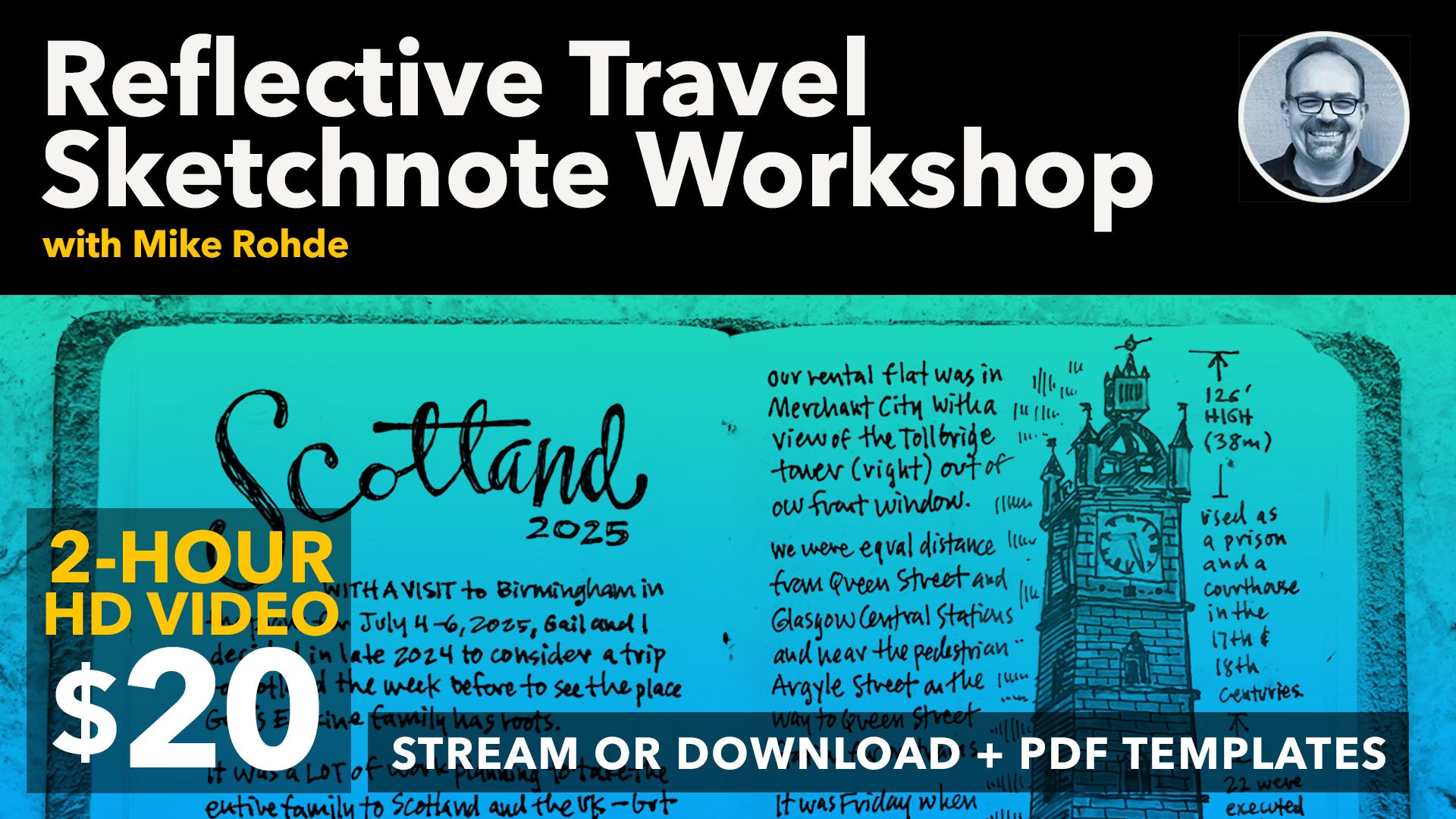
Have you ever wanted to create travel sketchnotes from an experience you’ve had, just using the photos and memories you’ve got?
In the Reflective Travel Workshop, I’ll guide you through my process for creating travel sketchnotes and then help you reflect on your own photos and memories so that you can make travel sketchnotes of your own trips, too!
This 2-hour recorded video includes a set of downloadable, printable sketching templates and a process to kickstart your own travel sketchnoting practice.
All this for just $20.
Subscribe to the Sketchnote Podcast
You can subscribe to the podcast through iTunes, Google Podcasts, Spotify, Amazon Music, YouTube or your favorite podcast listening source.
Support the Podcast
To support the creation, production, and hosting of the Sketchnote Army Podcast, buy one of Mike Rohde’s bestselling books. Use code ROHDE40 at Peachpit.com for 40% off!
Hey, I’m Mike Rohde, founder of Sketchnote Lab. I’m celebrating Summer arriving with 20% off paid Lab memberships through June 30, 2026.
Special link: sketchnotelab.com/summer20
Episode Transcript
Mike Rohde: Hey everyone, it’s Mike Rohde. I’m here with Tabitha Walker. Tabitha, it’s so good to have you on the show.
Tabitha Walker: Hello, I’m really excited to be here. Yeah.
MR: Pretty awesome to have you. I’ve been following you for a while. I think we crossed paths on Substack.
TW: Yeah, that’s right. And I’ve been following your work since I got into graphic recording, like 10 years ago.
MR: Wow. We probably have friends in common — Heather Martinez is one, and Brian Teralo is another. But before we get into reminiscing, let me ask you: who are you and what do you do, Tabitha?
TW: So I am a graphic recorder, instructional designer, and travel artist based in the Washington DC area. I live in Northern Virginia, about 45 minutes outside of the city. I’m originally from North Carolina, born and grew up there. I moved here a little over 15 years ago. It’s definitely not the South. It was a bit of a culture shock. I’ve got a dog, I enjoy traveling, I like eating, I like coffee.
MR: I’m very aware of your travel journals — that’s probably how we connected. This last year I’ve been into travel journaling myself. I traveled to Scotland, did a sketchnote of that experience, shared the story, and it turned into a course. Seeing your work, I really liked the way you approach it.
TW: Yeah, I didn’t start out doing visual journaling when I travel. At first I would just write it out, but over time I thought — I like drawing, I like traveling, I like writing, so why not combine the three? Almost two years ago I went to Mongolia for my birthday with a small travel group. I had a journal and I started jotting down and drawing pictures of the people I was with. One day one of the guys saw my journal and said, you really need to publish this. Everybody started looking at it. That’s where I got the idea for the visual travel log and Substack.
MR: I would love to hear your origin story. Since you were a little girl, what drew you to visual stuff?
TW: One of my earliest memories is when I was three — the first time I remember getting in trouble was for drawing on the wall in my room. Little stick figures, sunshine, smiley faces. My dad saw it and I got in trouble. But about a week later he came home with a huge ream of white paper he’d found at work and taped it to a blank wall in my room. He said, okay Tabby, now you can draw on the wall — if there’s paper on the wall you can draw on that. Fast forward all these years and now I make part of my living graphic recording, where I draw on white paper hanging on walls. It came full circle.
I’ve always been a very artistic person. My mother was also very artistic. Art class was my favorite in school. I didn’t go to school for art or design — I actually went for international relations and area studies. I started out working as an analyst with the federal government, nothing to do with drawing. Over the years I taught English abroad and worked as an ESL teacher at a community college. About seven years ago I went to school for instructional design. And my graphic recording journey happened kind of on a fluke — I was doodling in my calendar one day and a coworker said, she’d make a great graphic recorder. I thought, what’s that? She said go on YouTube and look it up. I saw a guy at a TED talk drawing on white paper hanging on a wall and I thought — I did that when I was three. I could do that.
MR: Was the transition from small-scale sketchnoting to large-scale graphic recording a big one?
TW: It was. The first thing I struggled with was how to fill up the whole chart — spacing, what do you put where, what do you do with the title. The first one I did was internal at work, a leadership conference. I was recording in a separate location so people couldn’t see me, and I remember feeling a little relieved. Now I do recordings while people are watching and it doesn’t bother me.
MR: I think you sort of get into a zone where you’re not even aware people are looking at you.
TW: It’s very almost meditative. When I record, I go to another dimension where it’s just me and the person talking. Over time with practice I’ve gotten better at also reading what other people are doing in the room — feeling people’s energy — even if they’re not talking.
MR: How did your background as an analyst impact your shift into graphic recording?
TW: I did that job for five and a half years. I was a media analyst — looking at trends, key topics. I had to learn to take all this information and distill it into key points that are concise and easy for people to understand, so they can look at one sheet of paper and walk away with the five main things. With graphic recording you get a fire hose and you have to make those decisions in the moment: what am I going to record and what do I leave off? Think of the sketchnoter as the filter — all this stuff comes in and you take out what’s key.
MR: And graphic recorders really strive to be as neutral as they can be. I imagine that carried over from your analyst training too.
TW: Yes — they were very clear that you have to be impartial, you can’t be partisan, you just report what’s there. You can’t make an inference. That carries right over. With the graphic recording I got to draw it out on paper instead of writing reports at a desk all day.
MR: Let’s talk about the logistical side — traveling to events, the toolkit, the challenges.
TW: You have to be familiar with your toolkit, know what to pack and how to pack it, vet the venue. Maybe the lighting’s bad, maybe there isn’t anywhere to hang papers so you have to bring a portable wall — that’s a whole other thing to transport. I now have an intake form with questions I ask before agreeing to even do the recording. There’ve been a few times I was told there’s a place to hang paper and then there isn’t. In those cases I’ll just do large-scale sketchnotes instead. I’ve never had a dissatisfied client when that happens.
MR: What about iPad — do you use that professionally?
TW: I haven’t used it professionally yet. I’ve done some informal recordings over Zoom meetups with other recorders. I’m definitely more of an analog person, but I’m getting my nerve up to do a digital recording. One thing I do like about it is you could be anywhere — I don’t have to travel to the event. I can be at home and record. I’ve also done recordings where a client asked me to create a graphic recording based on slides and notes after the fact — I know some recorders won’t do that, but it doesn’t bother me. It’s practice.
MR: You mentioned doing a chart readout. Tell me about that.
TW: The first time I did one was last year — I was asked on the fly to share with everybody what I’d captured. I spoke for about 10 to 15 minutes, condensing eight hours of content down to here’s what we talked about, the key themes that came up multiple times, the comments that elicited strong reactions. People got a lot out of it. It helps the attendees process when they’ve been deep in the material all day. The recording is also left there for them to look at, take pictures, ask questions.
MR: Have you thought about including it as a paid add-on in your proposals?
TW: That’s a really good idea. And it also helps with impartiality — as the scribe, you’re the impartial third party. I don’t have any stakes in this. I just heard what you said, and these are the reactions I noticed. It even helps clear up miscommunication. At some off-sites, a manager might think people are upset about one thing and it turns out through the recording it’s something completely different.
MR: Let’s talk about tools. I’m going to guess you use a lot of Neuland markers.
TW: I do. For graphic recording I use the Neuland Big One and Number One chisel tip markers. For visual journaling and sketchnoting I use the Neuland Fine One. They also came out with some felt tip pens I want to try. I’ve also just started using a white acrylic marker to add some foil accents to letters — still getting the hang of it.
For my smaller-scale work, my go-to pens are the Uni-ball Signo DX 0.38 — it dries really fast, which matters. I buy them in boxes of 12. The other one is the Pentel Slicci 0.25 — really fine, fits my hand really well. For pencils I use the Faber-Castell 9000 in different grades, and also graphite watercolor pencils where you can add water to get different shades of gray. For travel journaling I’ll bring maybe two small pencils, a couple of the 0.38 pens, a few watercolor pencils, and a water brush pen — just fill it up, screw the tip back on. Make sure you empty it before you go through airport security. Keep it simple.
MR: And digitally?
TW: iPad, Apple Pencil, and Procreate. I don’t know how to use Photoshop or Illustrator — Procreate works really well for my personal style. All the little drawings on my Substack I drew in Procreate. I also used Procreate to turn my handwriting into a font through Gumroad — there was a lot of trial and error but it worked really well. I should write that process up. The biggest hurdle with Procreate has been figuring out the right brushes. When I recently upgraded my iPad they didn’t transfer over, so I had to rebuild them.
MR: Let’s get practical. What would be three tips for someone who’s a visual thinker and maybe stuck in a rut?
TW: Number one: there is no right or wrong way to do this work. Everybody has their own unique way of processing information and transferring that to a journal or a chart or an iPad. The way you sketchnote won’t look like the way I sketchnote, and they’re all valid pieces of work. Just start — don’t get hung up on whether you’re doing it right.
Number two: practice to find your own unique style, and it’s okay if your style changes over time. The way my work looks now is not the same as it looked 10 years ago or even five years ago. It’s going to morph and evolve, and that’s okay.
Number three: it’s okay if your work doesn’t look like other people’s. Don’t feel like you have to dim your light to try to fit in with how other people are doing it. If you want to work in black and white, or all caps, or cursive — that’s your unique style. And that’s also good for business, because when people see a piece of work, they’ll know it’s yours.
MR: Great tips. How do people find you?
TW: I’m on Substack under Sketch Journeys for the travel journaling side. You can also reach me by email at tabitha@sketchjourneys.com or at my business website sketchjourneys.com, which covers the graphic recording side.
MR: It’s so good to have you on the show, Tabitha. Thanks so much for sharing your story and your process. For anyone watching or listening, that’s another episode. Until the next one, this is Mike Rohde — talk to you soon.

Sketchnote Lab is Mike Rohde’s space designed to bridge the gap between sketchnote theory and practice. You don’t need to be an artist to think visually. Join Mike and learn to use sketchnotes to clarify your thinking, solve problems, and move forward. Learn more about Sketchnote Lab.
Mike is the author of The Sketchnote Handbook and The Sketchnote Workbook, bestselling books that teach regular people how to start sketchnoting and build a regular sketchnoting practice.
He founded the Sketchnote Army and hosts the Sketchnote Podcast, where he interviews visual thinkers to understand what makes them tick.
Mike teaches recorded, live, and in-person workshops to help accelerate your sketchnoting practice and provides personalized coaching for your specific visual thinking challenges.
He is the illustrator of bestselling books like REWORK, REMOTE, The $100 Startup, Honest SEO, The Culture Playbook, and The Future Begins with Z.
Become a Supporting or Founding Lab Partner to support Mike’s work.
Some links in Sketchnote Lab posts are affiliate links. If you purchase through them, I may earn a small commission at no extra cost to you. I only recommend tools and resources I use and believe in.
©2026 Mike Rohde, Sketchnote Lab


