

In this episode, I sit down with David Armano to talk about how visual thinkers and creative professionals can navigate an increasingly AI-driven landscape. We dig into how to use AI tools effectively, develop a style that’s distinctly your own, and stay memorable whether you’re working remotely or in person.
Listen to the episode:
Running Order
Introduction to AI and creativity in the digital age
David’s background in design and experience with web and AI tools
Evolution of design education before tech and navigating change
How manual processes shaped early digital work and the push for quality with new tools
Lessons from Photoshop’s early filters and digital experimentation
Blending analog sketches with AI fine-tuning for authentic style
Training AI to match your visual aesthetic and guidelines
The importance of structure and boundaries in AI-generated design
Building consistent visualizations and curating style through feedback
Using AI to manage content and automate visualization in ongoing projects
Combining human and AI efforts for scalable, reliable outcomes
Identifying your niche to stand out and create memorable, in-person experiences
The power of in-person presence, personality, and memorable engagement
How to differentiate your work and avoid being commoditized
Creating memorable sketch notes and in-room experiences that evoke “magic”
Developing a unique style that stands up to AI mimicry
Transitioning from designer to creative director—guiding AI as a tool
Embracing the opportunity for anyone to leverage AI, even with simple sketches
Tips for overcoming creative rut and the importance of reflection and intentionality
Resources to follow David Armano and stay connected
Final thoughts on innovation, community, and future opportunities
Resources & Links:
TBDaily — David’s curated and AI-generated daily update.
DALL-E 3 — for image generation with prompts
Sponsored by The Reflective Travel Workshop
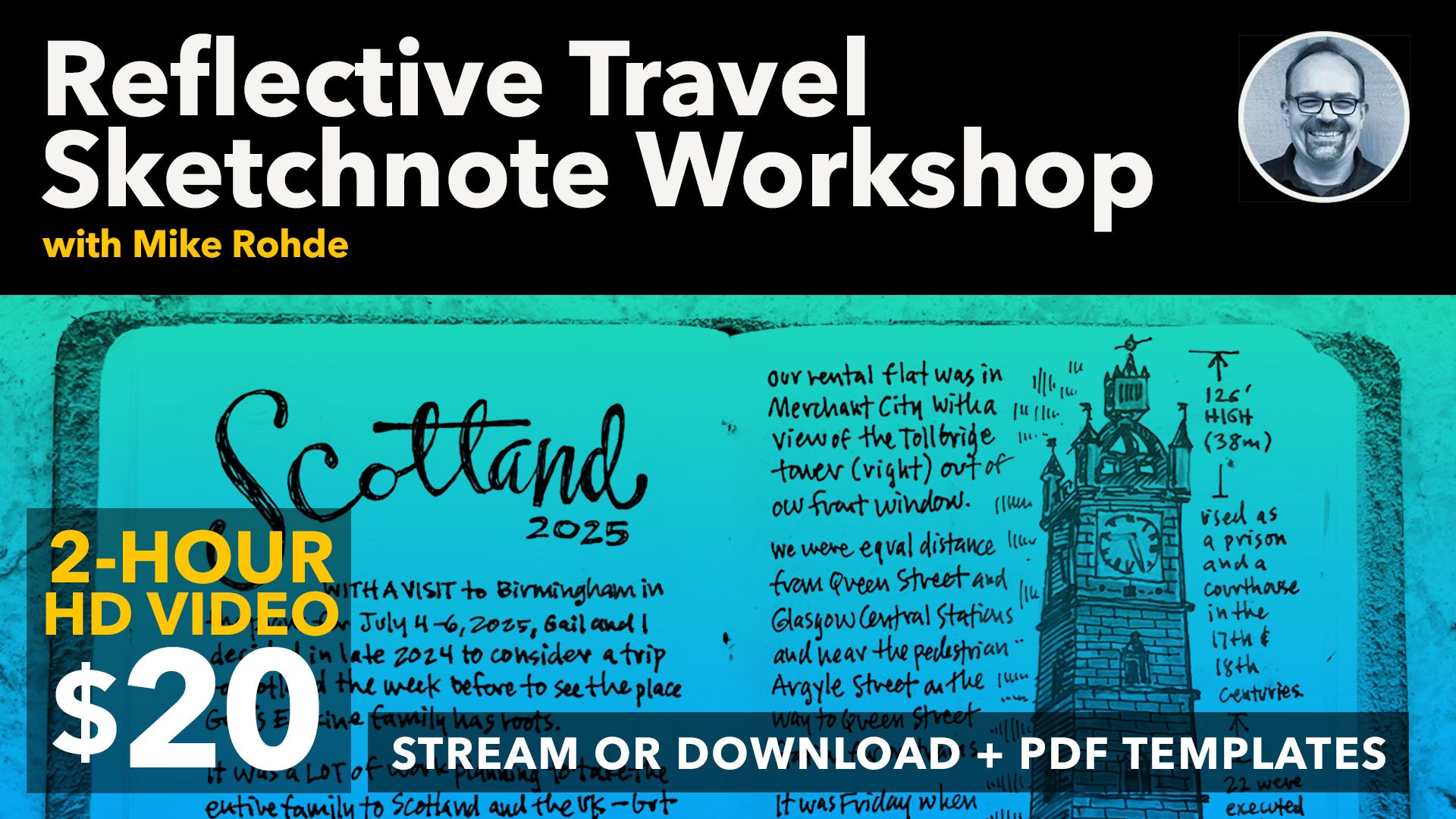
Have you ever wanted to create travel sketchnotes from an experience you’ve had, just using the photos and memories you’ve got?
In the Reflective Travel Workshop, I’ll guide you through my process for creating travel sketchnotes and then help you reflect on your own photos and memories so that you can make travel sketchnotes of your own trips, too!
This 2-hour recorded video includes a set of downloadable, printable sketching templates and a process to kickstart your own travel sketchnoting practice.
All this for just $20.
Subscribe to the Sketchnote Podcast
You can subscribe to the podcast through iTunes, Google Podcasts, Spotify, Amazon Music, YouTube or your favorite podcast listening source.
Support the Podcast
To support the creation, production, and hosting of the Sketchnote Army Podcast, buy one of Mike Rohde’s bestselling books. Use code ROHDE40 at Peachpit.com for 40% off!
Episode Transcript
Mike Rohde: Hey everybody, it’s Mike Rohde here again with another episode of the podcast. I’ve got my friend David Armano here calling in. David, good to see you.
David Armano: I’m Mike, and Mike’s audience, glad to be here.
MR: So David is an interesting guy. We’re talking before we start recording like when did we meet? I’m pretty sure it’s South by Southwest, probably in the glory days in the early 2000s, which are the mid 2000s, I guess 2010s. Yeah, so. But David’s been doing some really interesting stuff on Substack. I’m on Substack as a platform with Sketchnote Lab and he’s been pushing using AI and sort of the way he thinks about
DA: Yeah, I think so. I think so.
MR: the market and creative people and creativity. And I just thought it was really fascinating. And I thought David would be a really good voice for people who are sort of maybe jittery or not concerned about what if nano banana takes my job? Like how do you differentiate and how do you think about using AI in an ethical way that doesn’t lose off? Like I’m real concerned about people losing skills. Like by just turning over stuff to other tools, like you
what if that tool like the subscription goes up by 10x or it stops doing that thing that you used to rely on it and you’ve now got to do it again what if you’ve lost that skill so that’s sort of my concern but let’s get into it by seeing like David what do you do and then we’ll get right into your origin story
DA: Sure, yeah. So by day, I work for a very large company that probably a lot of people haven’t heard of. It’s one of the big tech consulting companies. It is called NTT Data. I work for sort of a boutique within NTT Data that’s kind of an experience design, centric, human centric kind of product design.
It’s called Launch by NTT Data and my title is
DA: And the second part, I guess like when I’m not on the job clock, I do a lot of thinking and writing kind of what you alluded to. I write a Substack newsletter called David by Design. You can get to it by davidarmano.com.
And, apropos this podcast, I do usually at least one visual that goes with my posts. Sometimes I do a series. And that’s been something that I’ve been doing that goes back, gosh, 18 plus years. Kind of the following during the blogging years, which created all kinds of opportunities for me that were really fun. Got to travel the world. And so
visual thinking, my style has changed, my approach has changed, but it’s been core to both my day job and my sort of little kind of what I do for a hobby and just to try to stay sharp.
MR: That’s really cool and I think you know I can relate to that too because I have a day job and I do stuff on the side as well so yeah that’s and I imagine there’s a lot of people like that who have something running on the side whether they it’s for fun or profit or both but I’m really curious I think you’re from out east I think from New York City if I remember my memory and yeah
DA: Yeah. Yeah, originally, New York City, Queens, I was born and was there until I was seven, then moved out to the suburbs of Long Island, also New York, Nassau County, and then moved to Chicago.
MR: Okay.
DA: just right out, almost right out of college, few years out of college. I did work my first couple of years in New York City as a visual designer. Started off, started my career as a visual designer and then a broadcast designer. And then as the internet was taking off, moved to Chicago, my first job in Chicago was with the Chicago Tribune and their interactive team as a formation designer.
MR: Okay.
Nice.
DA: So you can connect the dots there. And then Chicago, kind of got into marketing and advertising communications, really after like a pretty great foundation and sort of web design in the early days of web design as a creative director. And then...
My career really blew up during the social media days and sort of imploded during COVID. I got laid off after 11 years with a company, great company. And then I made a move, I made sort of a COVID move to Texas. I decided, okay, I’m gonna get a little.
MR: Hmm.
MR: Yeah.
DA: Going to leave the Midwest in the long winter, trade it for hot summers and sun. And now I’ve been in San Antonio, Texas now for about four and a half years now.
MR: Wow, I’ve been to San Antonio a few times, friend of the show, Prof. Michael Clayton. He teaches at the University of Incarnate Word in the graphic design group there. As a matter of fact, two years ago, International Sketchnote Camp was at that campus and it was a lot of fun. So we had really good food, of course, tacos and Tex-Mex and stuff. So that was a great memory. But yeah, that’s a great area.
Excellent. So going back, I think you went to design school like I did. I think you’ve talked about the school and I don’t want to say the school because I want to guess it wrong. Pratt. OK, it was either that or Cooper Union was one of the two that I thought it might have been. But so you have a traditional design education a lot like I do. Like, you know, I think about we went to school before any of this tech stuff.
DA: I went to Pratt.
Yep, on to Pratt.
MR: probably even existed, right? So we’ve had to navigate and adapt to lots of changes in our lives. And that’s really interesting.
DA: Yes, although for me, I will say it was a little different. It was actually just developing a computer graphics program. And so when I went, I had...
MR: Hmm.
DA: That was my major, but I did, I really feel like I learned so much more in the visual communications. I mean, I did learn the tools and that allowed me to get a job out of school. Like I did get a job as a graphic designer, like using Quark and Illustrator, because I knew the tools. And it was really interesting. My first job right out of school was Columbia House CDs. I designed, yeah, I designed the alternative little music catalog that you would get.
MR: Right.
MR: Really?
DA: Did all the layouts for like a section of those and what was interesting was I remember starting and I had one person left who had the big desk, the big drafting table and was doing everything by hand still and then within two or three months like they were no more and it stuck with me because
MR: Yep.
DA: I really had been working in technology related fields, honestly, ever since then, more or less. And that has been kind of an ongoing thing, which is sort of ironic given now where we are. It’s like, there’s always some major technical revolution, but it’s only gotten faster and more intense over the years. But even back then, it’s happening. The desktop publishing revolution. Yeah.
MR: Yeah.
MR: Yep, I was there for that too. I was there for the web transition, sounds like you were as well. And we both kind of rode those waves. I shifted into user centered design after that and had been kind of focused there and, you know, user experience stuff with software has been my fun spot. So I focused in that area, but a lot of change. And you know, the other thing I would say too is like, you think back, man, I’m thinking back like the way, how much manual stuff you had to do.
to just produce something simple and how much even like the jump to QuarkXPress or InDesign or whatever tool accelerated that. It didn’t like, like I think about it like the way it provided the basics that you didn’t have to think about anymore. Like, oh crap, I measured the board a 16th too short.
and now something the margins wrong or like that stuff was on me right because I was the one actually measuring the board out because I had the spec now you could still do the same you do still do the mistake inside quark but it was you know once you sort of established these things like you didn’t think about them anymore right like the it’s just letter size or whatever so like it sort of pushed you up a level to you know thinking more about the design and
DA: yeah.
MR: I kind of feel like it doesn’t really solve everything, but it pushes you up a level. And I feel like even in the AI stuff, there’s an opportunity for us to go up a level, but we still, a human influence seems like important in that mix for sure.
DA: Yeah. You know, there’s one parallel with all the AI stuff, since you’re going back to the design school days that I’ve been thinking about.
A unique thing about my experience back at Pratt was I remember, you know, learning the basics of Photoshop while I was also taking kind of like illustration or Vizcom 101, which is like foundational classes. And yes, I did learn the programs, Photoshop, Quark, Illustrator, right? And I remember specifically like my first few months with Photoshop, my output was just the worst because all I was, I was enamored by the
MR: Hmm.
MR: You
DA: filters. We probably all went through this like, Gaussian blur, remember? Like all these filters and that would be your output. But there was nothing about your ideas or even learning the craft of layout and juxtaposition and you know, just all the things that you have to learn. And my portfolio kind of reflects that. Like my non-digital stuff was way better than my digital stuff. So my digital stuff allowed me to get a job. And when I
MR: Yeah. Yeah.
MR: Right.
MR: Interesting.
DA: think about it, there’s a parallel to what’s happening today with all the vibe coding, because there’s a novelty. I think you have to get to this novelty phase when you’re learning something and then all the things you can do, especially if you haven’t mastered the basics, you get enticed by the novelty. And so we’re seeing a lot of people just build silly things that really shouldn’t be built or do all these things with AI that... Yeah.
MR: are unsustainable.
DA: Exactly, or like the slop, you know, things that we talk about, because it’s the novelty. Plus, it’s also they haven’t developed the domain expertise. But over time, that changes. And then what happens is the more people that actually have the domain expertise, you know, master these new technologies, and we were seeing that now, that’s when things get really interesting.
MR: yeah yeah for sure I think I think about that too like we used to have a joke inside the design firm is like if it showed up on the Sears catalog it jumped the shark so like if Sears suddenly had drop shadows on stuff like crap we can’t use that anymore right like that was our internal joke that we would always mess with and so it’s and I probably had the same things like
I always had stuff running on the side. I made, so I made the mixtapes back in the day for friends who all went away to college. And I had, was fortunate to have a local college radio station to play alternative music. So I sat at night, I would sit with my tuner and I would tune that station and try and catch good songs and string them together on two sides of a cassette. The fun part was designing the card that went inside and then duplicating it and mailing it to them. So that was, but that, you know, when I did the design, it was like all this experiment.
DA: Yeah.
MR: like Gaussian Blurs or whatever weird thing I could try in Photoshop and like I look back, okay
DA: I know it’s embarrassing when you look back, it’s like, I went to design school for that. But then again, one of my best, I think I took a photo of it somewhere, but I did, one of our assignments was to redesign the choking victim poster and just like be creative with it. So I did the choking victim poster from years ago, I went to school in the late nineties or mid nineties.
MR: Huh.
DA: and they probably still have versions of them today. I did it all using Keith Haring style illustrator. It was awesome. I mean, I could look back at that today and like I had train cars, like with the step one, step two, step three were all train cars and then all the little figures with all the bursts and it looked like a Keith Haring painting. It was so great. It was so creative and actually well executed. It was physical painting. It was acrylic on poster board.
MR: Interesting.
MR: Okay, so some of the sparkles were coming through and I kind of think too, like you had been trained in the analog ways and the digital was so new that you get enamored by what could be done that eventually it settles in and your digital catches up to your analog and then they become, you know, you can now express yourself, right? Like I think even like an iPad, using some of these tools, like it takes a while to kind of get to the point where understanding how what I want to achieve is possible.
DA: I think so.
MR: with this tool, you know?
DA: Yeah, the funny thing is that’s a great segue to my process with the way I do visuals right now is that it’s exactly that. It’s exactly sort of this blend of analog and AI. That’s all intentional, by the way. My best visuals do not look AI generated and that is by design.
MR: Okay.
MR: Mm. Mm-hmm.
DA: And the ones that do, I will say this. Sometimes I do a range. Sometimes I’m like, okay, this is a big idea. I want to give it the premium treatment. The artisanal treatment. And so the artisanal treatment looks like this. I’ll show it to you.
And I made this decision years ago, and it’s funny because I’m seeing this as a trend now where things are. This is the first thing I did, I got started doing stuff on my iPad and then I was like, okay, I want to actually take it even to more a paper like experience and strip away distractions and limit what I can do. So this is the Kindle, which is very comparable to,
MR: Huh.
MR: Rudimentary, yeah.
MR: Okay. Remarkable tablet, I think, right?
DA: Really is. It has a very tactile feel. You can get that nice pen weight. So what I’ll do is I’ll start with a sketch kind of like this, right? And maybe you’ve seen this one. I actually just posted on LinkedIn. That’s a long good, the AI version of it. And I’m really
MR: huh.
DA: mentally coming up with the concept for what I want to communicate visually, I sketch it out. And then I’m using AI to just like get the type to look handwritten, but a little bit less shaky, the lines a certain way, certainly the colorization, all that’s done with AI, the fine tuning. Yeah. Sometimes I’ll add things in AI. So my artisanal version really is like starting with...
the analog and my hand and bringing that in, the AI carries that over pretty well. And then I’m just not, instead of firing it up in Photoshop or pick your tool of choice where I’m actually manually, I’m now just saying make this line way thicker or thinner, try this color. I give it, I have trained an AI on my aesthetic look.
MR: That’s going to say that would be the next question.
DA: Yeah, it’s got a set of guidelines. And even I usually have to remind it, always use a white background. Dall-E always wants to use this yellowish background. So everyone’s going to have to re-hammer it. But it’s getting better. But yeah, it gets the results. I’ve kind of gotten it down to a science now.
MR: Okay.
MR: Yeah.
MR: Hmm. Yeah, I think about if we’re in early days, like where could this go if you could really define it? So two things. One, I think in my experience, at least, maybe this is not 100% true, but like it feels like AI does better when it’s given boundaries and structure and context, which is not what I’m learning a lot about. If you just
type, you know, give me this thing and describe it, our language is still not real super defined. So by you providing the drawing and then you’ve got these set of boundaries and like what kind of line weights do I want? What’s the font look like? What is always have a white background, whatever those things are. And then it just mixes those two and then you’re going to get a reliable output. That’s the thing. The other thing I observed was I think I watched a design person talking about using
DA: That’s right.
MR: another AI tool for design work because I was curious and you said something really interesting it’s like well you know you set the prompts up and you submit it to the AI if you do it today it’ll turn out one way but if you do it tomorrow it’ll look different and I was like I don’t know that that’s a good thing like I understand the novelty of it but like
DA: Consistency is hard to get, I will say. Yeah. And even if I look at my output, some look a little different than others. I’ve kind of just accepted it. Some are, but even with some of the variations, like some have like a little more of a watercolor, this and that. It’s also, I’m not super strict on it because I still feel like I’m still developing my style.
MR: So having structure helps for sure. Yeah.
MR: Hmm. Yeah.
MR: Hmm.
DA: with it. And when you look at it as a body of work, it is still pretty close. There’s still something in there where you go like, where you recognize it as one of mine, even if it’s like a slightly different style. I do think though, the goal, but then the technology will get there, will probably be more consistency.
MR: Yeah, experimenting.
MR: Mm-hmm.
MR: Yeah. And I think that was interesting. I mentioned the same problem to a developer on a design problem at work. And he said, it’s almost better, like if you want consistent output, don’t go to the AI to do something even with specs. It’s actually build an app to produce the output you want and then submit to the app because then you take that variability out.
that the AI produces, you build an app that actually would generate. So you would actually build a fine-coded app, I guess, that would take your instructions and build it a certain way. Like, that’s interesting.
DA: Yeah, that is...
DA: That is interesting. Yes, that would probably be a really good way to do it. You know, in a way, I kind of did that recently. So I don’t know if you saw my little Vibe experiment was creating like a curation website, because I do a lot of curation.
MR: Yeah, yeah, I saw that, that was cool. I wanted to mention that.
DA: I approached that very deliberately. I wanted it to not look like there’s an aesthetic that’s developing with these vibe codes. Because if you leave a default or you don’t really know the design, they all look the same and well, it’s not good, right?
MR: Mm-hmm. Yeah.
DA: So I was like, I did it differently and I actually did it. Yes. First I started with a hand-drawn sketch. Then I took it into, you know, don’t judge me, but it worked. I just, I wanted to get the basics. I brought it into Canva and I had a design header and like got the basics of like the tabs.
MR: huh. Yeah.
DA: And then I started the Vibe coding process and it was pretty amazing. I told it the font information, had the color of the tabs and then it just started building away. The really interesting part was on the backend because it actually, the TBD.ai is the URL and it looks deceptively simple. It’s got this backend where it...
I’ve trained the agent to look for stories the way I do. I gave it a bunch of parameters, which it does. And every day I work with the agent and it gives me a number of choices based on my preferences. And then I act as the human in the loop or the editor in chief, and then it publishes the next day. I also though, to the point that you brought up, I also just connected the Dall-E API. I’ve settled, today it doesn’t have it just cause I wanted to keep it simple, but
MR: Mm-hmm.
MR: Okay.
MR: Mm.
DA: I’ll pick about three because it’s manageable and each one of the stories, it’ll create a visualization. And usually the way that, so what it’s doing is the agent now hits the Dall-E API with my parameters of like, do this visual style. And then when it gives me the list of, you know, I picked the final, it’s usually nine. And then for, say, let’s do it now at the end. Say, let’s see a visualization for these three. And I do actually in this case, because this is the non-artisanal approach.
MR: Mm-hmm.
DA: I do see what it comes back with. Usually it’s good enough, because these are daily, every day this thing pumps out new story. Right, new story. So I’m like, I’m going to keep the human intervention minimal. And then I only will refine it if like there’s a misspelling or something really blatant, the wrong visual. And usually I try to limit it to like two prompt refinements for the three visuals. But it’s like, here, I’ll show you an example.
MR: Mm. Mm-hmm. Yeah. Gotta be sustainable, yeah.
MR: Hmm.
DA: I could just pull one up. It’s not bad. It’s not like the ones that I do that are much more like, this is a good example. Like this is an example of what it would look like. So that story’s summary, that visualization, that’s one that actually, I will tell you that one right there, it got it on the first try.
MR: Okay. Yeah.
MR: okay well I wonder too like if you like if now you’ve got a collection of these you could go through and say these 15 out of the 60 you produced are what I like, feed those back and say follow these as a reference and as you build like you just start refining it by saying I like this I don’t like that so it’ll veer away from the things you don’t like
DA: That’s right.
DA: That was going to be another side project I was going to do. I won’t give away the idea, but I wanted to create a very, very consistent set of icons. And what I was going to do was actually
MR: Mm.
DA: I’m just going to use one of the Google tools. I forgot which one I recommended that I think I might be able to get what I’m looking for, but I was going to take my best, the ones that I really, exactly what you just said, like 20 of them. And then just say like, this is what I’m going for. And even now, like when something goes off, I’m like, no, follow it and I’ll give it two or three. And it usually course corrects. I’m doing it pretty organically, but
MR: Mm-hmm.
MR: Yeah.
DA: You know, from my perspective, it gets really close. It’s so much faster. I don’t render things by hand. It does the majority of the rendering. And it gets it to where I want it to be. And I’m going off the feedback. The number one thing I’m going for is it feels...
MR: Mm-hmm.
DA: Actually, I’m going for a couple of things. People are like, that’s AI. That’s the first thing they say is they’re like, that doesn’t feel like AI. I’m like, good. That was by design. And then the second thing they say is anytime I see one of yours, I know it’s one of yours. I’m like, good. Those are my two. Right. That’s like, doesn’t feel like AI, feels immediately recognizable as a new style. That’s what I’m going for. And if there’s a little watercolor effect or a line or this and that, I’m like, those are negotiable for me.
MR: Yeah, style.
MR: It’s really interesting to hear that process and show notes are a big part of the show so I’ll definitely get a bunch of links from you that people can go poke around and see. The app basically that you built to gather stories that you’re interested in, different categories, pretty interesting, I’ve checked it out. And as well, your Substack David by Design so they can follow your stuff.
My question for you is, since you’re in the space of kind of, you’ve always been, I guess, a futurist or a strategist or I don’t know, a mixture of those things. So there’s someone, let’s assume there’s someone listening who, maybe they’re a professional sketchnoter or visual thinker, graphic recorder that are doing this. And they see like Nano Banana is starting to do like you could dump a transcript on it and it could produce, for somebody who doesn’t have a budget,
it might produce a good enough sketchnote that they don’t hire me anymore. How does somebody like that look at AI and what are some maybe mental strategies they could think about to get ahead of that curve or to leverage it, right?
DA: Yeah, I’ve got some thinking on that. So I should share, like during my day job, the visual thinking does manifest in different ways. Like just yesterday I was working on a deck and just to say, at the enterprise, we tell very, which we’re in a lot of ways, it’s very technology, technology is so core and sometimes that’s just a very complicated story. So I’m trying to figure out.
MR: Yeah.
DA: And so visual thinking plays a role in that. It’s very much the copy that you write and like simplifying visuals. So that’s one way. Another way in my career, I still do it now. I actually, sometimes in in-person meetings, I’ll be the person that gets up and I’ll actually do like a very low fidelity version of like visual note taking and it’s magic.
MR: Hmm.
Yeah. Go up to the whiteboard? Yeah.
DA: They love it. They love it. I look at my stuff and I compare it to what the real people, like the professionals do. And I’m like, wow. They’re like, are you an artist? I mean, it’s laughable because that’s nothing for the quality of the stuff that I’ve seen people like yourself do. But here’s some thinking based on everything that you said. I think if someone’s doing that and that’s their business.
MR: Yeah.
MR: Ha
DA: They probably want to evolve their model so that it kind of goes off in two directions in a very distinct and intentional way. One is like build a machine for the remote meetings so that, you know, like they can be generated, but you’re the person actually sort of facilitating and like as a value add tapping into that. And you’re the human in the loop. You’re going to get better output versus them trying it, number one.
MR: Hmm.
MR: Right, right.
DA: That’s you can do those remotely. And so that’s not your premium offer, but that is something that you can do and you can do repetitively. You know, you can probably get it to like, as we’re talking about, you can probably get it to like a virtual whiteboarding, not using nano banana or something else, like you’re like, this feels good enough. And that can be part of it. And then the other one is triple down on your in-person, anything that you can do to make your in-person
MR: Mm-hmm.
MR: Mm-hmm.
DA: person more memorable or then if you have to show up wearing something okay Mike I’m going to show this to you or not me. I, in the past year I put myself out there so I’m not going to ever pretend to be shy but I
put myself out there in a way you’ll notice you don’t see a ton of video of me it’s actually I’m not like, I’m like if someone puts a camera on me I could do it but I’m uncomfortable putting it on myself. I’m also not very comfortable drawing a lot of attention to myself like the physical you know but something that I learned and I did this a few times the past year we had an event and our president wanted the team to show up wearing like she wanted us to be her tiger team so everybody wore like
MR: Okay.
DA: Tiger, you know, whatever and I yeah, and so I found a hat as like I found a tiger hat with the tiger pattern on it and my guy said wear this and she was like well I guess you could but like I always say go big or go home. I was like, alright so I wore a whole like sport coat and it looked like a Tony the Tiger smoking jacket and I mean in a way it wasn’t super high quality, but it was very loud and it certainly
MR: stuff.
MR: wow.
with the velour lapels and everything.
DA: People could not get enough. I had person after person after person coming up to me and I was absolutely uncomfortable at first. By the end of the day, I was like, okay, what did I learn? I learned that I’ve been doing this wrong and that actually these people have figured this out that I’ve kind of judged honestly, like people like this, they figure it out that they’re creating an experience. By the way, things that you and I have been talking about for years.
And so my point is like, I’ve actually since then, I’ve now created a tradition of like, find these kind of eclectic sport coats and I wear them and it’s always the same thing. So all this to say is if you’re sketchnoting, really triple down on making experience, even if it’s like, feels gimmicky, people love it. We’re moving toward a world right now where synthetic feels synthetic.
It can get the job done. It’s kind of like what you and I were talking about before you turned this on. It’s like the gap is widening between the mediocre and the exceptional. So your in-person sketchnotes should be exceptional. Like that should be a memorable experience, not just what you put on boards, but how you show up. Like make the entire thing an experience because people value that now and face to face is more valuable than it’s ever been. But on the other side, yeah, do the.
MR: Yeah.
MR: Mm-hmm.
DA: sort of just good enough and create a system on that because there’s a great model there to be had that you can do remotely, right? And so be really intentional about the divide and the directions that they’re sort of, you know, the fork that those are going into. That would be my advice.
MR: you
MR: Hmm.
It’s.
and the implication is don’t get stuck in the middle, where you’re neither, you know, you’re dead, you know?
DA: Don’t. You will be. You will be roadkill in the middle. If you’re not, make yourself memorable in person. And if you’re not now beyond your art, the art’s not gonna be enough. Think about it. People who see those things, they may assume that’s AI, even if you crafted it by hand.
MR: Yeah.
DA: That’s it. So many people now think, oh, that’s done by AI, even if it’s not, because that’s where AI is now so good at mimicking. So you have to look at the experience that you can create while you, and by the way, it kind of already is the fact that they’re in the room and you’re doing a good job, but dial it up a notch, do something like literally wear something, show up, bring personality, like figure out what’s going to be your own thing.
MR: That’s a level above, yeah.
Go up again.
DA: And then figure out how to scale the remote stuff so that it’s like, you can almost get it done like in your sleep or whatever the case. Do not be that person in the middle.
MR: Yeah, no, two things that come to mind is one of the things you could do on the high end is maybe you dive deep into a niche, right? So like you talked about, you were in the room doing these whiteboards. The reason that you’re getting such a reaction is well, partly because you are able to distill those ideas. So that’s your knowledge. And that’s because you’re overlapping on that specific niche and you can talk intelligently to it.
So for me, that’s software. I could talk about software. I have a really good rapport with developers. I understand their challenges. And so that’s my special sauce. But like, if you’re in the, I don’t know, landscaping, like you could sort of combine those two. Like you go in with a client instead of just talking landscape. Maybe you actually, while they’re there, you’re drawing it with them, right? So that’s an experience. And then the second thing, I kind of forgot what I was going to say. I think, I know what it was. Go ahead.
DA: Well, I was just going to say, don’t hold onto that thought because I want to hear it. I think the other thing that makes that, even though I’m sort of like, I know it’s not to the quality of, I don’t want to sell myself short. I do the, I listen to the lines really well. I’m just talking about.
MR: Sure.
DA: I don’t think my artistry is all that great. But part of the reason why they love it, I think is because it’s also unexpected. It’s one thing to go to a retreat and then they have like a professional visual note taker and you kind of almost expect that. I’m showing up at a very typical meeting with a whiteboard, you know, in a run of the mill, like it’s just any other day with a bunch of executives filling up. And then all of a sudden the whiteboards are filled up. Right. Yeah. It’s like magic.
MR: Mm-hmm.
Magic, magic, yeah.
DA: in an otherwise mundane business meeting.
MR: It makes it more memorable. And then, you know, you’ve got the chops to understand the context of everything they’re talking about. So you can tailor it to their understanding. And then like the thing I’ve done with software developers, like hearing what they’re saying and drawing it while they’re talking, it’s like freaks them out in a great way. Right. So that’s been good. The other thing I just remembered was, say this is a long time ago, this was back in like...
DA: Yeah.
MR: must have been 2010, this is pre book and everything. We had this really interesting experience because I work with a team that was really forward looking. So they flew to Oakland, they met with the school district and they were trying to help them.
with I can’t even remember what the topics were. But what we tried was we had a really crappy webcam. So they turned a really crappy webcam on in the room and I was observing the discussions and listening to the talks and I was sitting in Milwaukee on the other end on my computer and I was making sketchnotes out of it, what they were saying and trying to make sense of it. It’s all black and white, pretty straightforward. By the end of the day I think I had 12 pages or something. Scanned them in because there was no phones that were good enough back then. Cleaned them up in
Photoshop, made a PDF and I emailed it to the team in Oakland so the session was done they received the PDF they ran to Kinko’s they had them printed bound into books and showed up at dinner with that team and presented them with books so like you know that again that’s like okay we have very limited resources the technologies you know
DA: That is awesome. That’s so awesome.
MR: limited but with what we have what can we, like I always think like what resources do I have and what interesting thing can we make out of what seemed like sort of like an amazing chef could take the same ingredients that I make an average dinner and they make it amazing because they know like how to cook it right or the spices that will fit and like that’s again your knowledge making it a unique experience so we all have that capability
DA: Something almost, I did almost the exact version of what you just explained in one of these sessions and I scanned visuals off of the boards I did my little AI treatment cleaned them up with AI and basically incorporated them as slides and as a part of our follow-up with them like they had them and so instead of them just being the raw photos they were like blueprints and they were just a little bit more polished but yeah yeah a little nicer. There’s so many
MR: Mm-hmm.
MR: Nice.
MR: Well.
MR: Yeah, little nicer.
DA: And again, that could be a part of the kind of experience that you curate. Like they’re getting the boards, but what else could they get? What else could they be getting digitally behind that as well? Yeah, there’s lots of options. I love that you used the word magic because I think that is the potential that this has.
MR: Mm-hmm.
MR: Right.
MR: Mm-hmm.
DA: Yes, something that I imagine your audience, and I’ve seen that your craft is very good. My craft is not as good as yours. But that doesn’t mean you can actually hit the same level of magic without the level of craft that you apply to your notes.
MR: right exactly that’s kind of what I’m trying to teach people is the the overlap of your experience and the tools makes it magic right it’s you being in there to do that to interpret it
and I think you mentioned like we didn’t talk a lot about the low end so of course naturally the high end make yourself visible do something unique on the on the low end or on the average end what what comes to mind is like you know those jobs where they had maybe they had a big week-long conference and there’s a hundred talks well you can’t be at all those hundred talks but they can record them they can make transcripts you can throw it at your stylized nano banana or whatever the thing is and produce outputs and then think of yourself
as a creative director where individually you’re going through them and editing them and changing things maybe you have to draw some bits and replace them and then you end up with you know this ability to do more capacity than maybe you could as an individual that could that could be interesting too
MR: Hey, networks, networks.
DA: I just lost network, just totally went dead for like three minutes.
MR: Okay, yeah, maybe the heat wave affecting you guys down there.
DA: Sorry, now we’re forcing an edit.
MR: that’s fine, easy, I just find the spot and cut it out with Riverside it’s pretty easy because you’re actually editing text like Descript did so I’m kind of experimenting learning a little bit more so basically the point when you dropped out was to think more like a creative director with the lower end of things where
DA: okay, good.
MR: Like in the past, if you had a hundred sketchnotes, you would have like, I would have sampled like, you know, which stuff is most important, go to those, produce a set that represents those. You would now in a position, you could transcript all of them, edit the transcript, dump it into some tool and then basically creative direct, you know, it would be trained on your style and produce a hundred sketchnotes. So everybody gets one, right? That’s a new offering that didn’t exist, you know?
DA: Yeah. I’m sure.
I’m so glad you brought up the creative direction and that’s something that I’ve done, something that I learned. It’s funny, cause this has been kind of a theme that naturally came up, but I’m going to call it out. Yeah. I, even though I went to design school, I learned early on. I transitioned from hands-on designer to creative director pretty early on in my career. I want to say within the first,
MR: Mm-hmm.
DA: five years. And so I was still pretty hands-on as a creative director, but over time became less so and less so. What I realized was that I was just a much better director than I was a designer, right? You know, I was a better director of talent. And what’s really interesting is that I talk to people about this, because I find that I get
MR: Okay.
MR: Mm-hmm.
MR: Mm. Mm-hmm.
DA: good results from AI when people are like, this and that. I’m like, I don’t know. I can kind of get what I want because I’ve been directing for 30 years, literally. Language models are at a point now where I can direct and talk to a language model. So for work, I basically, I work with AI and the output that I create for work, you know, deckware, whatever the case.
MR: Yeah.
MR: Yes.
DA: And basically like I have AI acting as a researcher and an analyst, you know, and a writer. Why not direct a researcher, an analyst and a writer. And so when I’m working with AI, I’m directing them, like I’ve directed teams for the past 30 years of my career. And I know how to get what I want to get from those teams. And so if you have those director skills, even if you’re running your own business, like that’s something you’ve had to build muscle and you’re going to do great. If you have to build that muscle, figure it out.
MR: Yeah.
MR: Yeah, might be an advantage.
DA: Because that’s how you’ll get it. Yeah.
MR: That might be an opportunity for creative directors, creative direction for AI might be an interesting training for those who don’t have that, who are doers, right? Because the doers are the ones that are in trouble because if you just do production that can be maybe mostly replaced unless you have some really unique skill. But yeah, that.
DA: Yeah.
DA: You’ll be in a much better place if you know how to direct.
MR: Yeah. Yeah. And I think, you know, if you think about the high end, we go back to the high end example. There’s direction in there. There’s creative direction. You’re also directing, depending on what level you’re doing it at, you know, you’re trying to create an experience, but you’re defining what is happening. And you’re also in the room. You’re probably doing research if it’s a new topic to understand that space so you can accurately represent what they’re talking about. So they don’t look at that, working, say, like, what the heck is he talking about? Like, doesn’t make sense.
DA: Well, there’s also a parallel here to the example that I’m giving and it’s going to be an uncomfortable one for people. Early in my career, I remember the, I had a light bulb moment. It was like, these designers are better than me. And so I realized my talent was in making that, you know, getting even better results from them and being an intermediary with clients, right? Which is what a creative director does.
And so it’s, I’m kind of having a little bit of a deja vu with AI, but it’s scary because you have to say like, this is smarter than me or can do X, Y, and Z better than me. And so it’s the same thing. Like why would you compete with it on that level versus direct it and where you can actually elevate it, but only if you figure out how to work with it.
MR: Mm-hmm.
MR: yeah it kind of moves it to a different stratosphere than it could with if you didn’t have those skills or direction skills to you know know like a lot of it is knowing what to refine and like you’re working on a deadline too right so what can I divine within the time frame that I have available what’s going to be most impactful like I could spend all kinds of time because the brush isn’t quite as textury as I want so am I going to spend five hours getting the brush textury
maybe not this round maybe that’s a future thing that I do for the whole model so that everyone that comes after has that thing but maybe for this one it’s focusing on getting this metaphor right or tuning that thing which is you know more of again creative direction and decision-making it’s really interesting any other thoughts for someone who is in that place you’ve given some great stuff I want to make sure I don’t take away opportunities for other ideas if you have them
DA: Yeah.
DA: Well, I would say yes. I think a lot of what we’re talking about, at least for the past 15 minutes, has been more toward someone who’s either full-time or part-time, they’re doing the sketchnoting thing. You mentioned to me that you also connect with a lot of people who are getting over that hump of I’m not really a designer or like the baker, right? Give that example. Wow. If this is an area that you want to, could not be a better time.
MR: Mm-hmm.
MR: Yeah.
DA: Now I picked up my book, right? And I showed the sketches. You can see like clear connection between a sketch and then the finishing, right? And I deliberately don’t make my sketches very involved because I know what the output is and I’m kind of working within the range that I want to work within. But let’s say you were that baker and you want to do visual, you know, like you want to do sketchnotes or whatever. Absolutely. You can put in something extremely crude, like stick figures.
MR: Hmm.
DA: And probably if you know what you want, to get back to the directing, you can probably get to some pretty great output. So there’s never been a better time. If this is an interest of yours, it’s the same thing with vibe coding. I mean, it’s like vibe noting. Have you used that term yet? I think you may want to use vibe noting in the future. That’s my gift to you. Vibe noting. Take it.
MR: Mm-hmm.
No, not yet. Vibe noting. Interesting. Free gift. All right.
DA: Take it, take it, and go forth.
MR: interesting that might be that hundred you know the hundred sketchnote challenge where you do every meeting in a week long event and you know you’re more of a creative director around a style that maybe that’s vibe noting
DA: Yeah. I mean, again, the Baker who draws stick figures, you know, they can absolutely, if they can figure out how to direct an AI and tell the AI what they want it to look like, they can get the output they’re looking for. 100%.
MR: especially with this I mean the thing I think what’s unique about your approach is a lot of LLMs depend on you describing, you’re typing and trying to describe what’s in your mind, you’re at an advantage by going to the next level which is you’re drawing what you exactly want so the LLM or the tool actually has a reference that it’s building some framework against instead of
guessing every time you hit it with that prompt right you’re giving it structure because it seems like AIs do better when they’re given tight structure and are highly defined than open world kind of stuff you know
DA: Right, and our friend Dan Roam probably wouldn’t like this, but theoretically, to use the Baker example, you could do the stick figure with the house and then show it to Dan Roam and say, hey, could you have a look roughly in the ballpark of this style? And then when you kind of figure out how you get that to look like, you already said this, you can then feed it back into the AI and say, I want it to look like this again and again and again. You can create whatever and it’s not going to look exactly like Dan Roam, it’s going to look like some kind of merger between the direction that you’re giving it and the references that you’re giving it.
MR: Mm-hmm.
Yeah.
MR: Well I mean ChatGPT can do Studio Ghibli stuff already right so I mean it’s been done, I’ve obviously force fed it a ton of comics apparently and could be done for anyone. I think you even in your tool, your vibe coded tool, you’ve done your voice right so you can have it read to us right so I mean if it can do it with a voice yeah so that’s really interesting
DA: I did. That’s right. It’s pretty close. Yeah. But again, now the risk with that though, is that this is why I do try to, again, there’s something about the level of control I give to my sketches. It does help me get to that. That feels like Armano. And if you’re going to do what I just described as like the Baker, you’re emulating, you are in that middle ground area because it’s going to feel like somebody else’s work.
MR: yeah yeah you really kind of need to develop a style in that case that’s really I mean this whole this is going to be a continuing discussion for many years probably beyond you know we’ll be long gone when they’ll still be having discussions about this who knows where it will end up going and so we’ll see but it’s really fascinating to talk and hear thank you for the strategies for people who are listening or watching and trying to figure this thing out and how they think about it
DA: Yeah, it’s not gonna be as vulnerable.
MR: I’m really, so we’ve talked a little bit about process. I want to get a little bit into, and we’ve started to step into this, tips for someone who is listening, they’re a creative person, they do visual stuff. But maybe they’re kind of stuck in a rut or they’re just bummed out or whatever the reason they need a little inspiration from you, David. What would be three tips you would give them to maybe get their mojo back or get them a little bit more on track or maybe look at things differently if you were to offer that?
DA: Well, ironically, I found myself in a little bit of a rut, not a couple of times. I’m doing the thing that you’re probably reading articles about telling you not to do, which is don’t use your AI as your therapist or even your career coach.
Here’s why they tell you that because absolutely AI is sycophantic and will absolutely tell you what you want to hear as a default. But I will say this, I’ve learned you can push it. If you’re really, really clear with it, it’s kind of the same thing of like, I get what I want. It’s the same thing. It’s like, I get what I want in my visuals. I have been using, and it’s not.
The only thing, I mean, I talked to my wife and you whatever, like, so you obviously like, you feel like, but I will say I have had pretty good luck with AI helping me get unstuck and I can even compare it. There’s at one point I worked with a career coach, real accomplished guy. He was just building his hours and I’m like, yeah, I’ll sign up and it was great, but I’m even comparing that experience to sort of like now getting stuck and now I don’t have access to a human career coach.
I find myself like yesterday, I did something that I got some counsel on from my AI and I was like, okay, that was really good. Like that was actually good advice. I have to be really selective. So I would say if you feel confident that you know yourself well enough, that you could get what you want out of it, that could be one thing. The second is, gosh, I was just talking to Noa Hanley.
MR: No, I don’t know her.
DA: Oh, she’s an author. We had just had a great conversation about intentionality. And I was talking about how I went from the shift from using my iPad to even just like getting a scribe to just pair back. For me, I didn’t need the iPad because I didn’t want to, again, I have the developed process but going to a scribe
has been helping me like it feels like paper, like a Remarkable, gives me the best worlds of digital and analog and strips it down to where I feel like I could be more intentional with it versus an iPad. But I think anything that you can do, that’s an example in visual thinking, but even just like going for walks and giving yourself the breaks. I think our number one nemesis these days is just
MR: Mm. Mm-hmm.
MR: Hmm.
DA: all the technology and distractions that take away from our ability to be intentional with our time. Ironically, yeah, ironically, you’re hearing this from an engineer, but it’s not just engineers. It’s like when you’ll find in vibe coding or in working with AI, it moves so fast. It’s almost like, I had another revelation about this. It almost acts like another, like if you’re in Slack too long or you’re multitasking, you’re not in flow.
MR: Yeah, intentional and present probably, right?
MR: Hmm.
DA: that you can, when you’re spending time multitasking with AIs and doing all these different things, it almost puts you in a state of what is the opposite of flow.
MR: I think it’s, I’ve read an article, there’s an article I read about this last week, it called it puts you in brain fry where your brain basically gets fried and you have to step away yeah
DA: Yes. Yes. Yes. So you have to be mindful about that, that that’s now another thing that we have to deal with, like this brain fry versus being in flow. Yeah, I mean, now if I were just to sort of distill down to one thing, I would say out of all of this, or maybe two things, figure out ways where you can be intentional about all these new emerging tools and then find ways to be
memorable, experiential, distinct, find ways that you can own it and really lean into, like it’s great that we’re doing a podcast as a remote. I think there’s so many awesome things, but you know what? If there’s opportunity where we meet in person or, you know, like that’s really, it’s more important than it’s ever been.
MR: different.
MR: Yeah, I think I’ve been feeling the same way leaning into in-person and human things that you’re talking about here and that definitely helps. You know, we work in tech, both of us, so it’s real easy to kind of get seduced into just staying there, but I think you have to push yourself out. So for sure, that’s really great. Well, thanks for the tips.
Where would be the best place to find you? I guess davidbydesign.com. Is that the, or no, it’s davidarmano.com, yeah.
DA: Yeah, go to davidarmano.com, it will take you to the Substack. And then there’s davidarmano.me, or I always tell people, something I did right in my early years. You can ask about me in your AI of choice and I will show up in all of them. Yeah. Yeah. Yeah. I mean, yes.
MR: Okay.
MR: Interesting. Interesting. Is that like AISCO kind of a thing or something? Or just partly because you’ve been around for so long, right? Yeah.
DA: My legacy SEO was strong enough to get me in all the AI engines. Yeah.
MR: I think I’ve heard someone reach out to me and said that they discovered my book through their ChatGPT or something. So probably the same thing, you know, just having, we have the advantage of being old. So we’ve been around long enough to develop these histories.
DA: I bet.
DA: It’s like an AARP card, right? It’s like, we got something out of it.
MR: yeah exactly you get the free wallet or whatever they’re trying to pitch you now
DA: We got the AI AIO.
MR: There we go. Well, David, thanks so much for making time for me and chatting about this. I think it’s going to be encouraging for people and hopefully opening some minds and getting people thinking about like, what is this tool and how can I use it in an interesting way to set myself apart? Because I think there’s definitely opportunities if you think of it that way, rather than being afraid, because afraid doesn’t get you anywhere. You just don’t do anything. So, you know, move forward. So thank you.
DA: Thanks for having me, Mike. And I appreciate that you’ve been doing this for years. It’s a great community that you’ve built.
MR: Yeah.
MR: Well thank you, and there’s a lot of people involved besides me so I have to give credit to everybody and it’s definitely a friendly welcoming community and you’re invited to come anytime you like if you want to go to Verona this year we’re going to have an event on the weekend so anybody who’s listening go check out International Sketchnote Camp is merging with European visual practitioners and putting on a thing in Verona like go to the city of Romeo and Juliet and hang out with cool people so
With that, it’s another episode. We’ll talk to you again in the next one. See you soon.

Sketchnote Lab is Mike Rohde’s space designed to bridge the gap between sketchnote theory and practice. You don’t need to be an artist to think visually. Join Mike and learn to use sketchnotes to clarify your thinking, solve problems, and move forward. Learn more about Sketchnote Lab.
Mike is the author of The Sketchnote Handbook and The Sketchnote Workbook, bestselling books that teach regular people how to start sketchnoting and build a regular sketchnoting practice.
He founded the Sketchnote Army and hosts the Sketchnote Podcast, where he interviews visual thinkers to understand what makes them tick.
Mike teaches recorded, live, and in-person workshops to help accelerate your sketchnoting practice and provides personalized coaching for your specific visual thinking challenges.
He is the illustrator of bestselling books like REWORK, REMOTE, The $100 Startup, Honest SEO, The Culture Playbook, and The Future Begins with Z.
Become a Supporting or Founding Lab Partner to support Mike’s work.
Some links in Sketchnote Lab posts are affiliate links. If you purchase through them, I may earn a small commission at no extra cost to you. I only recommend tools and resources I use and believe in.
©2026 Mike Rohde, Sketchnote Lab


