

In this episode, I sit down with Sarah Greer and Adrian Peryer, co-founders of Shared Vision Toolkit, to talk about how they’ve spent decades transforming ordinary meetings into immersive, co-creative experiences.
We dig into their Design-Centric Facilitation™ approach, the magic of a well-designed room, why 80% of the work happens before anyone walks through the door, and how visual thinking helps build genuine alignment within organizations.
Listen to the episode:
Running Order
Introduction to transforming meetings into immersive, collaborative experiences
The role of environment: whiteboards, lighting, and space design
The extensive preparation process: months of research and iteration
Using questions and frameworks to guide co-creative sessions
The magic of walking into a thoughtfully designed room
The impact of immersive environments on productivity and engagement
Redesigning weekly meetings to maintain freshness and effectiveness
Icebreakers and humor: building trust and vulnerability
The power of visual listening and capture techniques
Navigating virtual environments and building shared spaces online
Case studies: product feedback sessions, strategic off-sites, and re-purposing physical spaces
The origin story: from initial practices inside HP to scaling across tech giants
The importance of leadership sponsorship and organizational culture
Capability transfer: training clients to sustain practices
Making tools affordable and accessible for broader impact
Practical tips for listeners: navigating creative challenges, challenging oneself, and seeking inspiration outside work
Setting up environments to sustain flow and energy
The journey of scaling practices, including the transition from corporate parent to independence
Embracing chaos and turning moments of disruption into opportunities
Resources & Links
Sponsored by The Reflective Travel Workshop
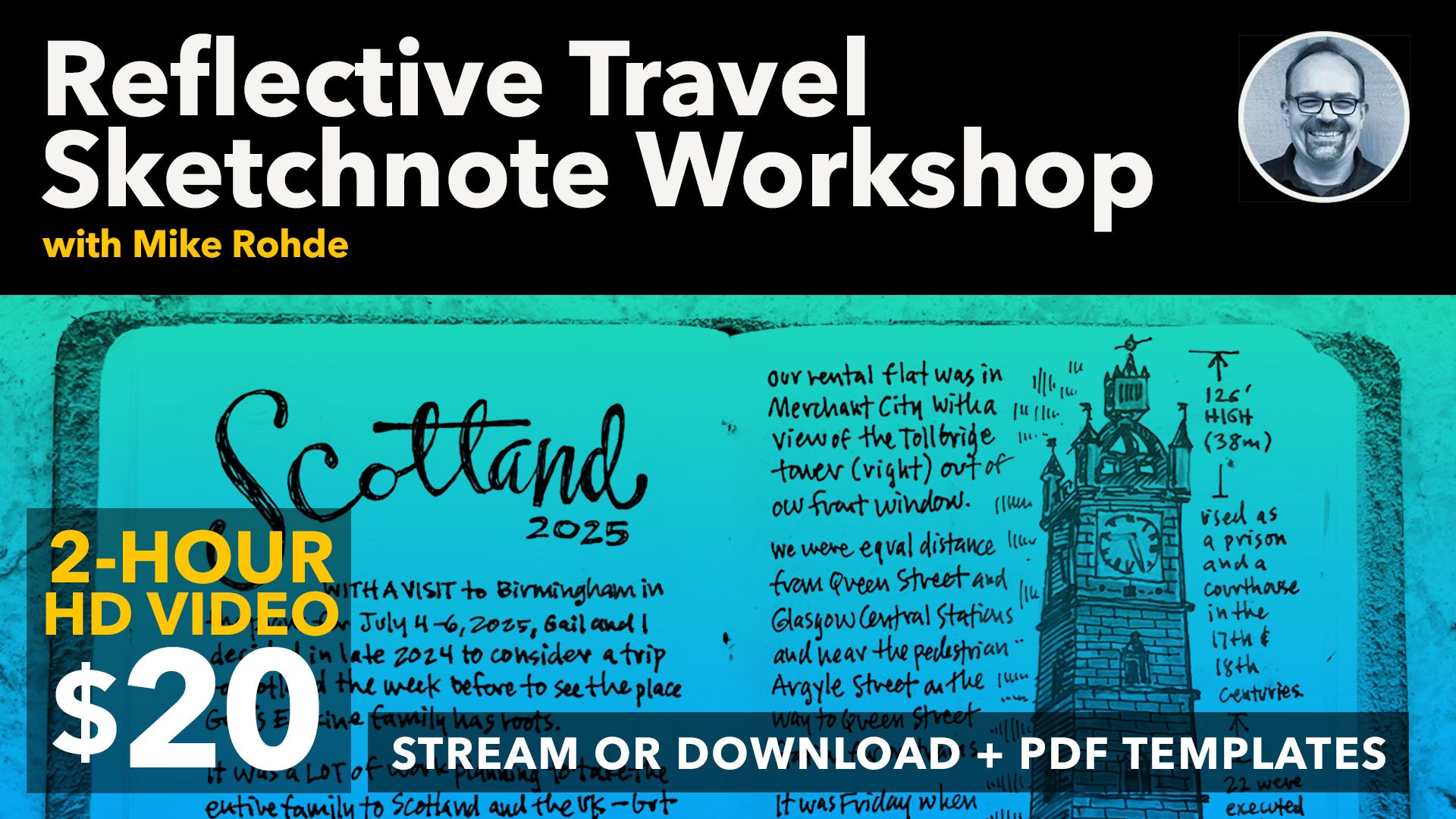
Have you ever wanted to create travel sketchnotes from an experience you’ve had, just using the photos and memories you’ve got?
In the Reflective Travel Workshop, I’ll guide you through my process for creating travel sketchnotes and then help you reflect on your own photos and memories so that you can make travel sketchnotes of your own trips, too!
This 2-hour recorded video includes a set of downloadable, printable sketching templates and a process to kickstart your own travel sketchnoting practice.
All this for just $20.
Subscribe to the Sketchnote Podcast
You can subscribe to the podcast through iTunes, Google Podcasts, Spotify, Amazon Music, YouTube or your favorite podcast listening source.
Support the Podcast
To support the creation, production, and hosting of the Sketchnote Army Podcast, buy one of Mike Rohde’s bestselling books. Use code ROHDE40 at Peachpit.com for 40% off!
Episode Transcript
Mike Rohde: Hey everyone, it’s Mike Rohde and I’m here with my friends Sarah and Adrian. Sarah, Adrian, thanks for being on the show.
Sarah Greer: Hey, thanks for having us, Mike. Before we ever say anything, I really wanna thank you for doing this podcast. I’ve listened to just about every single one of them. I think I told you this before. I’m working out at the gym with my weights and stuff, and I just love it as a practitioner in this field. I’ve gotten so much out of all of the very diverse people that you’ve talked to, and it’s just amazing. Thank you so much.
Adrian Peryer: And we sometimes talk, Mike, we talk about the episodes we’ve listened to.
MR: Well, thank you. Yeah, we have a really fascinating community. Really interesting people that came from all kinds of strange places, which is like the most fun part. So, maybe we just get right into it — Sarah and Adrian, tell us who you are and what you do. We’ll do Sarah then Adrian, just so we have a standard order.
SG: Excellent. So we are Shared Vision Toolkit. We’re basically designers of meetings. We design super engaging meetings for folks all over the world. We mostly work in the tech space. We’ve been doing this for such a long time now. We believe so wholeheartedly in this methodology that what we really needed to do was teach other people how to do it. Because we see people all the time getting stuck in the default mode — turn up, have slides, chairs and tables. What we do is the complete opposite. We work with our clients to design agendas and create these amazing immersive environments for clients to come and spend a day or two days with us. We take away the tables, use rolling chairs, have floor-to-ceiling panels we turn into whiteboards, and create frameworks depending on the type of meeting.
MR: Interesting. Adrian, anything to add?
AP: What people don’t see is probably 80% of the effort isn’t in the meeting. These things take minimum three months from concept, sometimes six months. We interview customers — we do voice-of-customer reports, anonymous interviews. We’re regarded as Switzerland neutral. Because of that, we get to spend most of our time in deep preparation. Then of course, whatever we plan doesn’t actually happen because reality meets your plan. But we always go in with a detailed hypothesis for every session. We love to work with questions — what question are we trying to answer? Then frameworks to help people explore it together.
MR: The image that came to me was an iceberg — you see the tip, but there’s a lot underneath. I imagine a lot of the planning is not only research, but contingency planning too. If this happens, go to plan C.
AP: And the process of designing for clients is itself a forcing function. Sometimes the value is in preparing for the session and realizing you shouldn’t do the session.
SG: We work with electrostatic white gridded paper — Magic Whiteboard — in 66-foot lengths. We draw the base layer structure right on it. Adrian pushed me to make everything modular, and he was absolutely right. If I allow 10 feet for a conversation and it takes 12, I can just move the header over. The modularity really lends itself to this type of work.
MR: I imagine for people who go through this experience it must feel like magic — you thought of that, you know about that — because you’ve done all the research and the back-channel discussions.
AP: The magic starts when people walk into the room. Most people’s experience of meetings is they normally suck. They walk into our room — no tables, these wonderful walls Sarah’s prepared, frameworks and art, thoughtful lighting. People come in and go, “wow.” The second time they’re invited, they never have a problem attending. We find the environment, the immersive space, the absence of tables — all of it helps people move rapidly into a flow state and stay there for hours. The facilitator says time’s up and people go, “what?”
MR: Right — you may not be able to do the six-to-nine-month planning every time, but for recurring meetings, why couldn’t you plan all these things until they become routine?
AP: That regular meeting is the hardest thing in our view. Sarah and I looked at our own weekly meeting and said, isn’t it getting a little stale? And we realized — aren’t we meant to be the people with the mission to make meetings engaging? So we designed our own weekly meeting and keep redesigning it. We measure it. We do an after-action review. The big aha is meetings go stale very easily.
SG: We always kick off every meeting with an icebreaker, and we rotate who hosts. We’ve been cataloging the best ones and plan to give them away. Icebreakers that take people back to their childhood are the best — a few layers of the onion just get peeled back immediately.
MR: I can relate — I do sketchnote workshops and I made up an exercise called The Treehouse Exercise. People love it because it’s personal and lets them express themselves freely. It’s been in my workshop hundreds of times and it keeps working.
SG: The minute you said treehouse I was transported back to Girl Scout Camp. Icebreakers that take people back to childhood just work. There’s something about it that sets a great tone — people are being a little vulnerable with each other.
AP: And we’re on a virtual meeting right now. We have people in the UK, California, Ohio. In 2020 all our work evaporated in a couple of weeks.
SG: Within a week or two I was set up in my studio using my iPad to record myself capturing on the wall. We just carried on.
AP: Our customers still wanted to do customer advisory boards. How do you do that virtually? One tech company needed to do a big transformation — a virtual leadership off-site with a new team who’d never met physically. We worked with them for about six months, doing town halls and things. Sarah built a shared vision with that team and then animated it.
SG: They had a racetrack metaphor for their team. I figured out the animation feature in Procreate — cars zooming around the track, people in the stands waving as they went by. It wasn’t difficult, but they were just so tickled with it.
AP: Now when people come to us needing a virtual product advisory board on short notice, we can do it. What holds it together is the live visualization — as people talk, Sarah’s picture gets richer and bigger. We did two hours yesterday, 30 customers for a large tech company, 15 product managers. The product space is very early — nobody really knows what problem they’re solving. But the live capture held it all together.
SG: I was using Concepts. I make these feedback buckets — just a pretty bucket — and as customers speak, I synthesize and capture the essence. To me, that magic is demonstrating the deepest form of active listening. You don’t have to be an artist. You just need decent listening skills, and they’ll get better. Find a flip chart and start capturing what people are saying. You’d be surprised.
MR: There’s almost a spatial, positional thing that ties meaning and solidity to it — rather than a fleeting stream. I once claimed a little strip of a room for a project and the whole project lived in that room. I’d bring people in and they’d say, “I’m inside the project.”
AP: We did a session with engineering leaders in a large tech company — security engineering. A year later, they said, “we’ve still got the vision up on the wall in the engineering department. It’s our orientation.” Another client — an energy company CEO we’ve worked with for 12 years — booked a hallway for six weeks so all leaders could be walked through the strategy in context of the space. That’s what they wanted: walk and explain the strategic outcomes, the vision, the from-to journey, the key initiatives — all laid out where you can see everything at once.
MR: The client was so convinced of your process that they’d already thought through where it would happen and what the follow-on use would be.
AP: Two years later they reached out about an AI strategy session. The first thing they said was, “we’ve got a really good space to do this.”
SG: That just raised the bar on us. I think of it like a mission control — if we could just get more clients to build these spaces and leave them up, it’s so powerful.
MR: Being a really good listener is an intimacy. For someone who maybe is never listened to, finally somebody is — and it’s seen as valuable. That’s what we can do as visualizers for our clients.
SG: I love that. When Adrian and I work as a team, he can focus on facilitating and I can focus on designing and synthesizing — center justifying, making bullet points, coming up with an icon that represents what’s being talked about. We had a brand new client a couple weeks ago. They came in visibly nervous. By the end of two days, there was hugging. It’s a connectedness people are yearning for. I always say a little prayer: please let me be of service to this group today, that they can feel heard and make connections they haven’t been able to make before.
MR: Teams that were most effective were the ones aligned and all going for the same thing — 10 people working like 30 because they were aligned and integrated.
AP: Alignment is sometimes the result of managing through conflict. Leadership teams are not all on the same page — they have legitimate, opposing points of view. Putting people together in a space where they can say, how could we make the pie bigger differently? What is the win-win? That takes time and effort. Getting aligned on a shared vision for a product is one of the single most important activities a team can do. Using pens and whiteboards, you can figure out a lot of the hard stuff before you spend millions building out software and hardware.
MR: How did this all start? Tell me the origin story.
AP: Hewlett Packard bought EDS and merged it into their services division. They said, can you have a look at this interesting thing EDS does — a British company called Group Partners with a neat way of visualizing and working collaboratively with customers. We said, can you build one of those practices inside our company? We had CEO Meg Whitman sponsoring it. She quickly figured out that collaborating live with customers was what was needed. We got the mandate: set up a global practice, scale it. Sarah came in as one of many talented artists. It grew and scaled.
MR: And then eventually you left HP?
AP: Nothing lasts forever in tech. They split the company up. Sarah and I went independent. A group went to Amazon and set up another practice there — still running, very successful. We’ve been doing this now for getting onto 18 years.
MR: Have you ever had a customer intentionally bring you in to teach them to do this internally?
SG: Yes — sometimes we’ll do an advisory board and stay an extra day, leave all the content up, walk through the facilitation, talk about how we captured and why we prepared what we prepared. Those days after are fantastic.
AP: We call it Capability Transfer. We’ve built multiple courses for customers — how as an executive can you be a really effective contributor to an advisory board, for example. We also pivoted from trying to sell the whole practice guide to offering small, affordable technique modules. And we’ve gone from enterprise sales to asking, how do we make this affordable for anyone? Our latest is a culture diagnostic survey tool built in partnership with Professor Ron Westrum — $4.95 per person. Team of ten, less than $50.
SG: Culture is always coming up, especially now with AI. Cultures that aren’t generative are struggling and lagging behind.
MR: Let’s get practical. Three tips for someone listening — maybe they work in a company, maybe they’re a graphic recorder or sketchnoter. What would you tell them?
SG: First: learn to navigate the shitties. We did a Pixar course and they talked about this — the creative process is a roller coaster, and when you hit the downside, just hang in there. Go for a walk. It’s always darkest before the dawn. Second: challenge yourself often. I got an iPad and threw myself into the deep end — a week later I was doing live orals for a big tech company virtually. I just recently got into Mental Canvas, which is really hard, but that’s the point. Third: find inspiration outside your daily practice. Go to museums, plays, musicals. Get fresh eyes. For me it’s crawling around on the floor with my grandson — looking at the world at a completely different level.
AP: First: set the environment up right for yourself. Figure out what will get you and others into flow state more often. Second: find your wise mind every day. Try to be balanced, check your ego at the door. Sarah talked me into yoga and it’s the single best thing for helping me start each day in the right mode. Third: remember that emotions are a wave — they will pass. Under pressure, when you feel like it didn’t work, pause. It will get better.
MR: Six tips for the price of one. Where’s the best place to find you?
SG: SharedVisionToolkit.com, and we’re both fairly active on LinkedIn. We also have a podcast on culture and a YouTube channel.
MR: Well, thanks so much you two. This has been a fun surprise — we went a little off the rails and I loved every minute of it. My tip for today: when things go sideways, ask what’s interesting about this, because there are opportunities in that chaos.
SG: Thank you so much, Mike. Your podcast is food for the soul. Keep making them.
MR: Thanks — I’m planning on it. Until next time, talk to you soon.

Sketchnote Lab is Mike Rohde’s space designed to bridge the gap between sketchnote theory and practice. You don’t need to be an artist to think visually. Join Mike and learn to use sketchnotes to clarify your thinking, solve problems, and move forward. Learn more about Sketchnote Lab.
Mike is the author of The Sketchnote Handbook and The Sketchnote Workbook, bestselling books that teach regular people how to start sketchnoting and build a regular sketchnoting practice.
He founded the Sketchnote Army and hosts the Sketchnote Podcast, where he interviews visual thinkers to understand what makes them tick.
Mike teaches recorded, live, and in-person workshops to help accelerate your sketchnoting practice and provides personalized coaching for your specific visual thinking challenges.
He is the illustrator of bestselling books like REWORK, REMOTE, The $100 Startup, Honest SEO, The Culture Playbook, and The Future Begins with Z.
Become a Supporting or Founding Lab Partner to support Mike’s work.
Some links in Sketchnote Lab posts are affiliate links. If you purchase through them, I may earn a small commission at no extra cost to you. I only recommend tools and resources I use and believe in.
©2026 Mike Rohde, Sketchnote Lab


