

In this episode, I talk with Atom Brum of Studio Heartfelt to talk about how he's built a deeply personal creative practice that blends hand-drawn illustration, needle felting, and AI tools, without losing the heart and intention that make his work uniquely his.
We dig into his origin story, his workflow, why story always comes first, and what it means to stay a creative person through a period of real upheaval.
Hey, I’m Mike Rohde, founder of Sketchnote Lab. I’m celebrating summer's arrival with 20% off paid Lab memberships through June 30, 2026.
Special link: sketchnotelab.com/summer20
Listen to the episode:
Running Order
Introduction to Atom Brum and his unique artistic approach
How AI amplifies Atom’s visual storytelling and character design
The multifaceted nature of AI: helpful tool vs. distracting fad
The importance of capturing emotion over technical perfection
Stories that defy Hollywood conventions, rooted in authenticity
Atom’s visual and narrative style — simple moments, deep messages
Finding inspiration through everyday observation and mindfulness
The origin of the “green nose” signature and playful branding
Atom’s creative background and how it influences his process
The importance of organic, unfiltered creation and embracing imperfections
Practical tools: drawing on paper, digital platforms, and AI workflows
Using AI platforms like Nano Banana for character stylization and scene building
The challenges and opportunities of AI in creating complex scenes with many characters
The limitations of current tools and the importance of human oversight
Moving from digital characters to physical needle felt creations
The impact and ethics of AI — control, control, control, and environmental considerations
Tips for creatives: letting go of filters, preparing materials, and trusting the process
The significance of humor, playfulness, and authenticity in artistic expression
Atom’s playful “green nose” as a symbol of fun and spontaneity
Building resilience and a positive mindset amid rapid technological change
Final thoughts and encouragement for fellow creatives
Resources & Links
Sponsored by The Reflective Travel Workshop
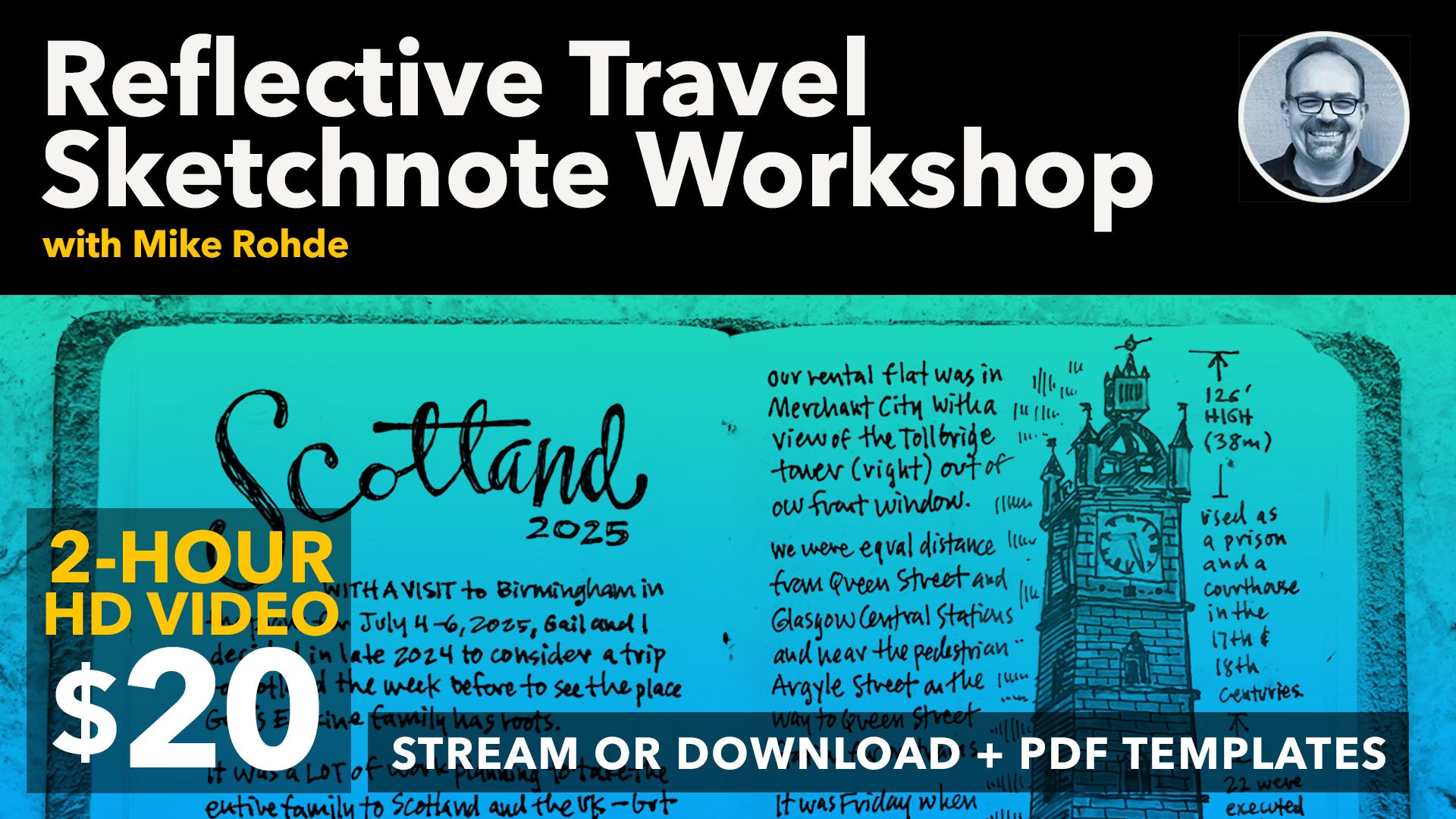
Have you ever wanted to create travel sketchnotes from an experience you’ve had, just using the photos and memories you’ve got?
In the Reflective Travel Workshop, I’ll guide you through my process for creating travel sketchnotes and then help you reflect on your own photos and memories so that you can make travel sketchnotes of your own trips, too!
This 2-hour recorded video includes a set of downloadable, printable sketching templates and a process to kickstart your own travel sketchnoting practice.
All this for just $20.
Subscribe to the Sketchnote Podcast
You can subscribe to the podcast on iTunes, Google Podcasts, Spotify, Amazon Music, YouTube, or your favorite podcast-listening app.
Support the Podcast
Support the creation, production, and hosting of the Sketchnote Podcast by buying Mike Rohde’s bestselling books. Use code ROHDE40 at Peachpit.com for 40% off.
Hey, I’m Mike Rohde, founder of Sketchnote Lab. I’m celebrating summer's arrival with 20% off paid Lab memberships through June 30, 2026.
Special link: sketchnotelab.com/summer20
Episode Transcript
Mike Rohde: Hey everybody, it’s Mike Rohde here again with another episode of the podcast. I’m here with my friend Atom Brum. Atom, it’s so good to have you here.
Atom Brum: Hey hey, Mike, thanks for having me.
MR: Atom is someone I stumbled onto doing Sketchnote Lab, who also writes on the Substack platform. What he produces is something really unique and interesting. He’s with a company he started called Studio Heartfelt, and he produces these really lovely, upbeat, friendly, happy, soft and fuzzy videos using a variety of tools — some that we’ll know and some we won’t. I wanted to hear his process, how he arrived at it, and what his origin story was. So with that, Atom — what is it that you do? How would you describe the work you do with Studio Heartfelt?
AB: Yeah, totally. To back up a little bit — I just passed my first year on Substack. The foundation of my work is stories and poems. What started with illustrated poems has evolved as AI has evolved. I’ve been amplifying my original artwork to adapt it into a felt look, then using those felt digital characters to create visual stories and vignette stills — a lot of six-panel visual stories, and some short films as well. I want to call out that AI has kind of become a dirty word within the space, and I’ve felt this need to pull back the curtain and show how everything starts with stories first, then illustrated characters as the foundation, and AI comes in later once the vision is set. What’s also exciting is taking my 2D illustrations, having Nano Banana adapt them into a physical-looking digital felt character, and then — after months of falling in love with the aesthetic — actually getting into physically making needle-felted characters in the real world.
MR: Yeah, and I think what you’re putting your finger on is that AI is like everything and nothing — there’s a huge range, from a tool that helps you not screw up your grammar, all the way up to doing everything for you. And then there’s the story of people who want to make money off it and couldn’t care less about creativity. It’s a fuzzy, confusing time. What I see in you is that it’s preserving your vision while producing something you couldn’t do before.
AB: Yeah, totally. Something I want to call out for folks listening through audio — the aesthetic I’m going for is a physical needle-felted, photographed look. It’s really important to me that I’m capturing that photographed quality. If it comes out looking digital, I’d have already been doing this in Blender. What I’m doing as a one-man band would not be possible without an understanding of photography, lighting, all of that. And I want to acknowledge that animation and stop motion are crafts and specializations in their own right — I respect that.
MR: I would describe what you’re doing as capturing a feeling. You’re not coming at it with technical perfection as the end result — it’s capturing a spirit, a feeling, an experience. And I think Nano Banana will only get better over time. But the encouraging thing is that you’re focusing on the heart of it first, and the technical stuff is secondary.
AB: Yeah. And I’m starting to see the term “native AI” getting thrown around — I wouldn’t say that applies to what I’m doing, because everything starts with story. The six-panel vignettes might just be a pleasant day at the farmer’s market with friends. The message is showcasing these beautiful little moments of life. The short film — Every Night I Leave My Body — was based on a poem first. At the highest level, the takeaway is that we’re spirits who come to earth for a human experience, and each trial has been designed for the spirit to advance. It all comes from a really natural, organic place. I don’t sit down and think, “what’s the message?” It just comes.
MR: It feels like an exploration. And those little moments in time — I’ve learned this is common in Japanese culture, where there are shows about daily life, just working at a sushi shop, who comes in. In some ways that’s what Cheers was. It’s a way to step out of your life and into someone else’s and empathize with that experience.
AB: Yeah, it’s been incredibly healing for me. How I found Substack was through layoffs — finding a private place where I could express myself. I’ve been slowing down and being more observant. I do a lot of nature walks on the trail these days. I’ll see a ladybug on a leaf and think, that could be something. It’s kind of at odds to use AI this way — trying to create slow, relaxing moments — but it’s really coming from a place of, I need to create this.
MR: Let’s hear your origin story, and about the green nose — people watching can see it, and it’s definitely in your artwork. Then let’s get into your process and tools.
AB: Yeah, like a lot of creatives, I’ve been drawing since I was a kid. I grew up in a household of creatives — my mom is a painter. I really consider visual communication my first language. Whether it was claymation stop-motion films on VHS or making music, I’m just a creative person. My work doesn’t use a lot of perspective or light logic — it’s flat and simple. After three-plus decades of creating, my style has gotten more simple, not less.
When I was graduating high school, I wasn’t jazzed on going to college, so I took what I’d call a gap decade. I worked as a contract illustrator and photographer, primarily food photography in Los Angeles. I was also a screen printer professionally at one point. When I finally did go to college, I studied interaction design at CCA — which is actually what introduced me to your work. Sketchnoting was super helpful for me as someone with a bit of dyslexia. As for the career shift — AI and layoffs really rocked the tech workforce, and that’s shaped where I am now as a lifelong creative pursuing visual storytelling.
MR: And what about tools — where does the process begin?
AB: These days I’m primarily on the iPad. When I draw on paper I prefer pen — I gave up pencils in like second grade. My style is very much let it happen, work with the mistakes. I don’t like looking at photo reference, so sometimes things come out wonky, and that’s the fun of it. For paper I prefer lined Mead notebooks — it takes away the preciousness. For line work on the iPad I use Concepts because it’s vector. The flexibility of stretching, squashing, and moving things is really valuable. Then I’ll export to Procreate for color, because the organic brushes there are really nice.
MR: I’m a big Concepts user too — the vector adjustability is great. So once you’ve colored the character, where does it go next?
AB: From there I’ll bring it into Flora, a creative canvas that aggregates a bunch of AI models. That’s where I’ll select Nano Banana — specifically Nano Banana Pro now, because you can get 4K resolution. I’ll use a prompt like, “use my character and adapt them into a three-dimensional needle-felted look.” Then I make character sheets with multiple angles, and it’s all node-based — you’re constantly pulling reference into various nodes. From there you start feeding characters into different nodes. You can be extremely specific: “the Yeti is on the left side of the frame playing a guitar, sitting...” — the more you articulate the blocking, the more pride you’ll have in the result. The more characters you add to a scene, the more the stability gets rocky. One still — for my Year of the Fire Horse scene with five or six characters — took over 400 tries. On average a still takes 20 to 30 tries.
MR: You’re really using Nano Banana as a production facility with your heavy direction. There has to be a lot of readjustment.
AB: Yeah, it’s a slot machine. When something comes out weird, you look at your blocking and ask: do I need to revise something? Do I need to be more articulate? There are certain things you can recover from in Photoshop and certain things you can’t — like if a character’s head has swapped completely. What I want to say is: AI is absolutely a shortcut to a lot of things. As creators we really need to have the eagle eye and recognize when a shot isn’t good enough, even when you’ve got something that’s 90 to 95% incredible. I want to see people hold a higher standard.
MR: And the limitation of the tool is just that — the tool’s limitation, not yours.
AB: Yeah. I’ve even started drawing characters with their usage in mind. I’ve got a Marionette character held by little birds with strings — the physics are just so far off right now. There’s another character with really twisty arms and legs. I’ve put them on the shelf for a couple of months. Rolling with the limitations.
MR: And now you’re bringing some of these characters into the physical world with needle felting?
AB: Yeah. Looking at these characters for months just pushed me to want them in the real world. My style with a lot of things is: get the supplies and figure it out by jumping in. My journey with needle felting started about six weeks ago and I’m hooked. I’ve made I don’t even know how many characters physically. And honestly, I’m not even sure I’m doing needle felting correctly — I just last week looked into whether I was using the safety bead washers right. I really love sharing my process because art and creativity energize my soul so much that I want people to feel the same thing. I’m getting back in touch with my inner child, and I feel incredibly excited that I’ve found a way to do crafting, drawing, and AI all at once.
MR: You’re clearly using these tools to achieve your ends — not for speed, but for control and expression.
AB: Right. I see so much of the conversation focused on “I made this commercial in five minutes” — and it’s like, whose benefit is that for? It’s just a weird time. And there are ethical and environmental considerations with AI too — water consumption, all of it. I don’t want to be ignorant of that, especially since so much of my work is inspired by the natural world.
MR: Let’s get practical. What would be three tips for someone who’s listening, maybe stuck in a rut, who wants some encouragement?
AB: First — let go of the filter. Just let it flow. Especially in sketchnoting during a live talk: if you’re tripping over details, you’re going to miss information. Get it out. Second — prepare your materials. Do you have the right size notebook? Do you have pens that are satisfying to write with? For me it’s the Marvy Le Pen — I can’t fully explain it, but there’s something really satisfying about those pens. I also use Micron 01, 03, and 08. Third — I’d say just embrace imperfection. Work with the mistakes. When things turn out wonky, that’s all the better.
MR: The Marvy Le Pen! I don’t think anyone has ever mentioned those in 10 years of this podcast. I need to dig those up. The tips tend to get mushy fast since they’re felt-tip, so you need a few in different states.
AB: Oh yeah, I’ve ruined some 01s on the first go. Definitely heavy-handed over here.
MR: Tell me about the green nose as we wrap up.
AB: Yeah, it’s obviously becoming a frequently asked question. It’s my way of just keeping things playful. The work I’m doing is super lighthearted, and how seriously can you take it when you’re drawing a cloud with a face or yesterday’s octopuses? A lot of my characters have a green nose. It came from boredom when my wife was on a trip — I got out the sandpaper, sanded my nose down, and slapped some green paint on it. It’s just become a little signature.
MR: I love those little unique signatures. Well, Atom, thanks so much for being on the show — for sharing your process, your inner motivations, and how you took something negative like a layoff and turned it into something positive and encouraging. Hopefully this discussion will inspire some people who hadn’t thought about it to play around with these tools, and maybe something new comes out of it for them. That’s kind of why we do this.
AB: Thank you so much for having me. I do have a pretty deep dive on the process that walks through all of this with the short film, so folks can get a better understanding of the intentionality and what I’m bringing to each phase. I’ll make sure to send over all the links.
MR: Perfect. Show notes are a big part of the podcast, so we’ll get everything in there. For everyone watching or listening — it’s another episode. Until the next one, this is Mike and Atom. Talk to you soon.
Sketchnote Lab is Mike Rohde’s space designed to bridge the gap between sketchnote theory and practice. You don’t need to be an artist to think visually. Join Mike and learn to use sketchnotes to clarify your thinking, solve problems, and move forward. Learn more about Sketchnote Lab.
Mike is the author of The Sketchnote Handbook and The Sketchnote Workbook, bestselling books that teach regular people how to start sketchnoting and build a regular sketchnoting practice.
He founded the Sketchnote Army and hosts the Sketchnote Podcast, where he interviews visual thinkers to understand what makes them tick.
Mike teaches recorded, live, and in-person workshops to help accelerate your sketchnoting practice and provides personalized coaching for your specific visual thinking challenges.
He is the illustrator of bestselling books like REWORK, REMOTE, The $100 Startup, Honest SEO, The Culture Playbook, and The Future Begins with Z.
Become a Supporting or Founding Lab Partner to support Mike’s work.
Some links in Sketchnote Lab posts are affiliate links. If you purchase through them, I may earn a small commission at no extra cost to you. I only recommend tools and resources I use and believe in.
©2026 Mike Rohde, Sketchnote Lab


