
That AI “sketchnote” isn’t a sketchnote
You can create a simulation of a sketchnote by dropping a transcript into an AI and prompting it to generate an image, but it’s not a sketchnote. Here’s why.

I’ve seen more and more AI-generated images that look like sketchnotes, and I understand the desire to create them.
Sketchnotes work partly because they condense complex information into images. But a sketchnote is more than an image that looks a certain way.
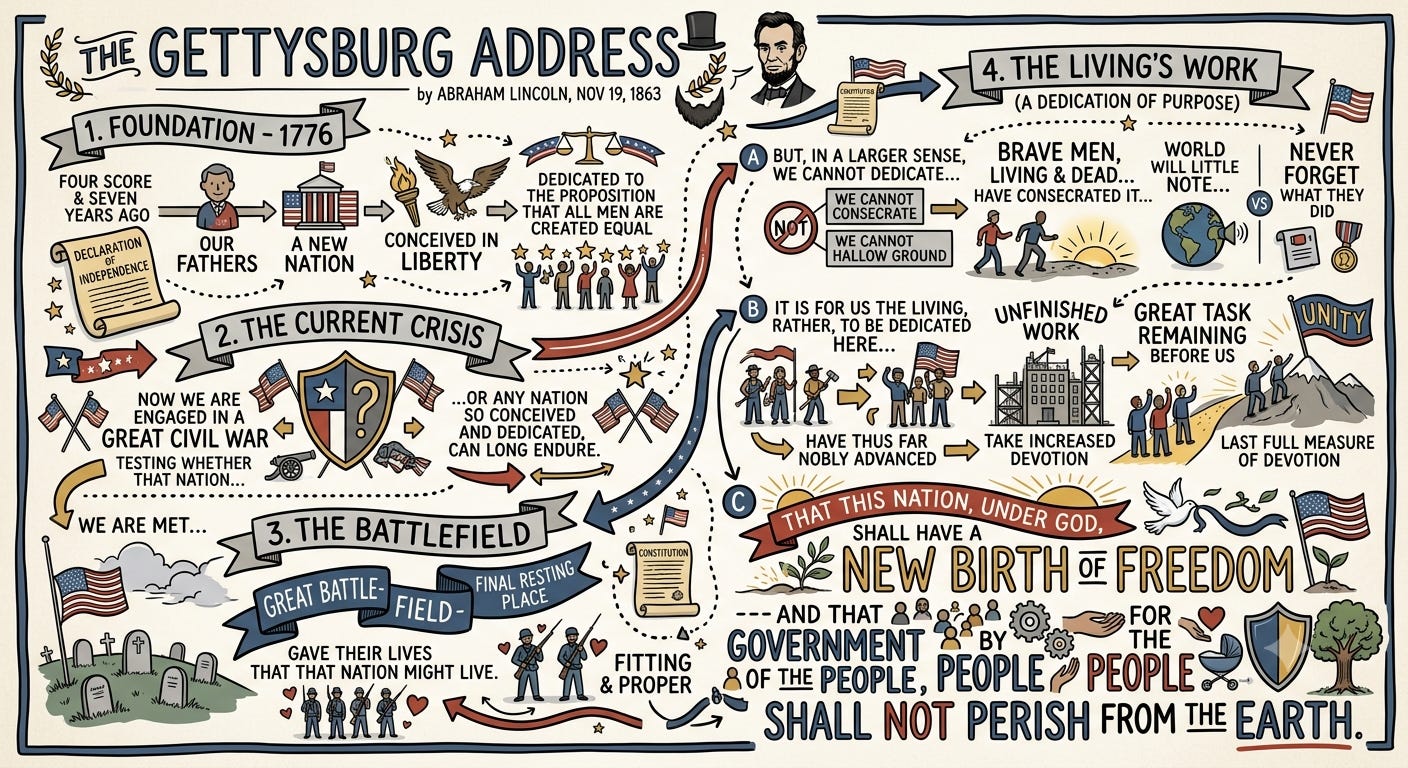
Sketchnoting is a personal practice where a person listens, understands, processes, and visualizes their thinking. Sketchnoters do this work to understand it first for themselves, and if others get value from it, bonus.
Professionals who sketchnote at conferences or in group meetings to help other people understand, do the thinking work themselves, too.
Here’s why AI-generated, sketchnote-style images are not sketchnotes:
When a transcript or a block of text is dropped into an AI with a prompt to make it look like a sketchnote, the work, thinking, and internal dot-connecting (the heart of a sketchnote) are lost to the machine. Even worse, your skills in these areas begin to atrophy from disuse.
You did not listen.
You did no processing.
You did no synthesis.
You did not connect the dots.
You did no sketching or noting.
You’ve created a simulation of a sketchnote.
When you delegate the hard part of a sketchnote to the AI, you’re bypassing the purpose of sketchnotes: the work of listening, processing, thinking, synthesizing, sketching, and noting the idea into a sketchnote.
A sketchnote may be rough or finely polished, but its purpose is the same: to build your understanding, to reveal your thinking, and to reward you with a visual artifact for reference or sharing. You’re building knowledge as you visualize ideas.
Call an AI-simulated image an infographic, an illustration, or a visual. Just don’t call it a sketchnote, because you didn’t do the work.
— Mike Rohde, Chief Scientist, Sketchnote Lab

Sketchnote Lab is Mike Rohde’s space designed to bridge the gap between sketchnote theory and practice. You don’t need to be an artist to think visually. Join Mike and learn to use sketchnotes to clarify your thinking, solve problems, and move forward. Learn more about Sketchnote Lab.
Mike is the author of The Sketchnote Handbook and The Sketchnote Workbook, bestselling books that teach regular people how to start sketchnoting and build a regular sketchnoting practice.
He founded the Sketchnote Army and hosts the Sketchnote Podcast, where he interviews visual thinkers to understand what makes them tick.
Mike teaches recorded, live, and in-person workshops to help accelerate your sketchnoting practice and provides personalized coaching for your specific visual thinking challenges.
He is the illustrator of bestselling books like REWORK, REMOTE, The $100 Startup, Honest SEO, The Culture Playbook, and The Future Begins with Z.
Become a Supporting or Founding Lab Partner to support Mike’s work.
© Copyright 2026, Mike Rohde
Couldn’t agree more. I have tested many different ones to see what they will create. And while it does create images like the one you showed, it doesn’t do the hard work of thinking/asking ‘what is most important? What image or metaphor could make this clearer.’ Most of sketchnoting for me is that filter. I continue to see that AI is being used by people to fill a talent gap. But for Ai to work the best, you have to bring talent to it and use talent after to adjust. Otherwise you just get AI slop!
Yes!! Others like to see the end result, but it’s hard for them to understand that it’s really made only for me and it’s how I made sense of the material.