

In this episode, I sit down with Danny Gregory, artist, author, and co-founder of Sketchbook School, to talk about how a personal tragedy late in his advertising career became the catalyst for a whole new creative life.
We dig into his philosophy of art with a lowercase ‘a’, why constraints and personal projects are the best way to push through plateaus, and how travel journaling can deepen your experience of place while building your artistic voice.
Listen to the episode:
Running Order
Introducing Danny Gregory and his approach to accessible art
Danny’s shift from advertising to personal drawing practice
The life-changing event that inspired Danny’s artistic journey
The therapeutic role of drawing and storytelling in life challenges
Recognizing style and personality in beginner artists
Developing Sketchbook School and its mission to democratize art
The concept of travel journaling and capturing memories in sketchbooks
Using constraints and personal projects to foster growth
How travel influences perception and the importance of experiencing place
Travel storytelling and how sketching enhances the experience
Overcoming plateaus: beginner’s mind and trying new things
Rethinking practice: applying skills through projects and constraints
The value of frequency, variety, and embracing life’s unpredictability in drawing
Final thoughts: making art accessible and inclusive for all
Resources & Links
Sketchbook School- Danny’s online creatiity and drawing school
Paris in a Day - A live workshop with Danny on Saturday, May 16th! Save 15% with coupon code SKETCHNOTE
Sketchbook School (Danny’s YouTube Channel)
I Drew Across America - See Danny’s sketchbook unfold as he and his wife drove across America.
Sponsored by The Reflective Travel Workshop
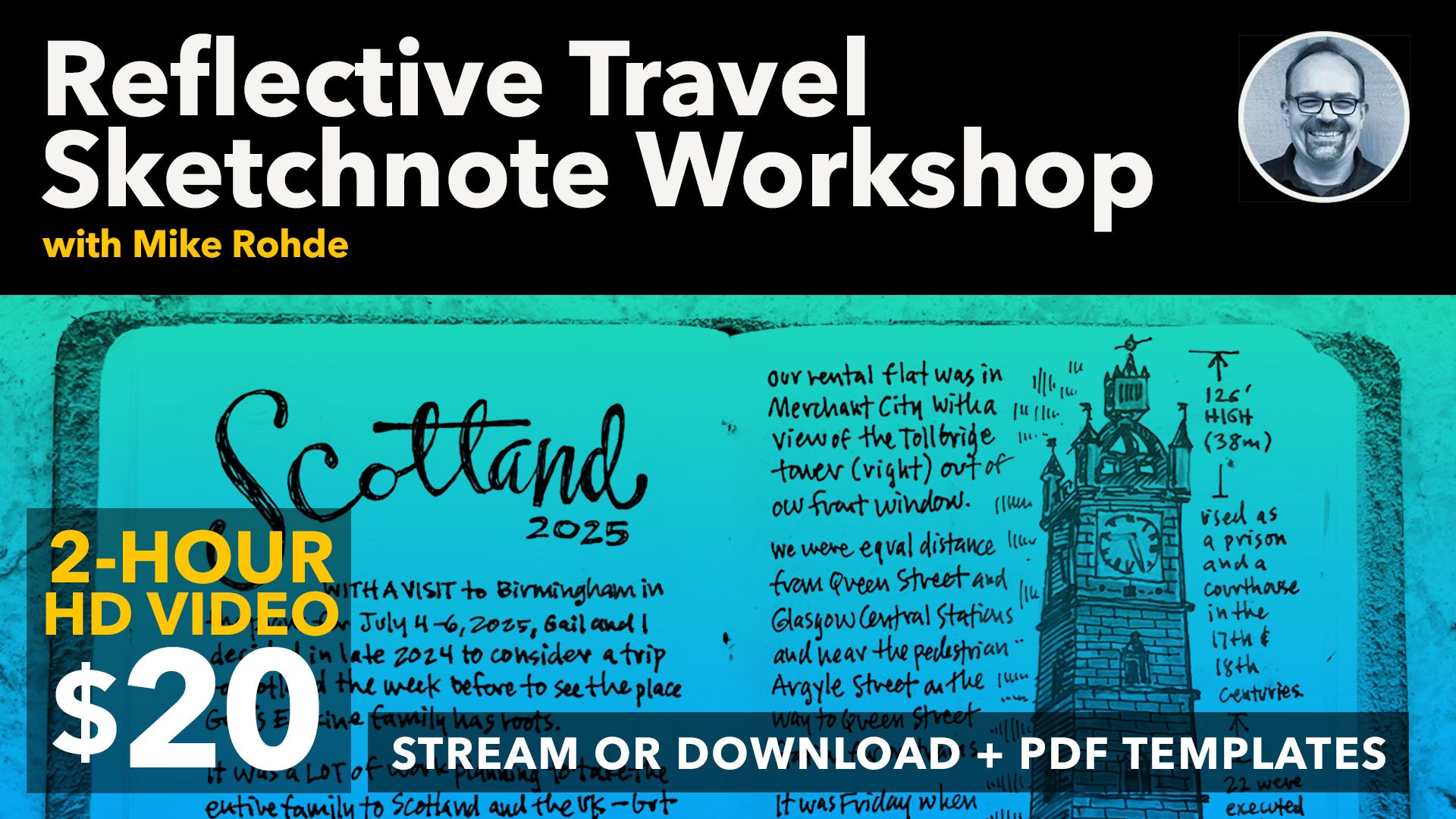
Have you ever wanted to create travel sketchnotes from an experience you’ve had, just using the photos and memories you’ve got?
In the Reflective Travel Workshop, I’ll guide you through my process for creating travel sketchnotes and then help you reflect on your own photos and memories so that you can make travel sketchnotes of your own trips, too!
This 2-hour recorded video includes a set of downloadable, printable sketching templates and a process to kickstart your own travel sketchnoting practice.
All this for just $20.
Subscribe to the Sketchnote Podcast
You can subscribe to the podcast through iTunes, Google Podcasts, Spotify, Amazon Music, YouTube or your favorite podcast listening source.
Support the Podcast
To support the creation, production, and hosting of the Sketchnote Army Podcast, buy one of Mike Rohde’s bestselling books. Use code ROHDE40 at Peachpit.com for 40% off!
Episode Transcript
Mike Rohde: Hey everybody, it’s Mike Rohde. I’m here with Danny Gregory. Danny, it’s so good to have you on the show. Thanks for making it.
Danny Gregory: Great, I’m glad to be here.
MR: Yeah, it’s I’ve been a huge fan of yours for a long time. I don’t know when I came across your work, probably on YouTube, I would guess. But I really liked your attitude toward simple drawing. I am the same way, feel similar about it. I see all these people that say I can’t draw. So my mission in life is getting people to do one step forward and draw like just basic stuff. And I think you sort of take over after that, or you’re probably doing the same thing, but you then
push them further. And I love the way that you approach this. And I thought you’d be a great guest to have on the show.
DG: Great, I’m looking forward to it.
MR: So I’m kind of curious, we always start out like, who are you and what do you do? I think I have an idea, but I don’t know that I totally do. So I’m kind of curious myself to know all the things that you do. So why don’t you start there and tell us a little bit about yourself.
DG: Sure, so right now my job has been for the last dozen years or so, I’m the founder of Sketchbook Skool and we’re an online art school. It’s changed in various ways over the years, but basically it’s designed to focus on drawing in a sketchbook, watercoloring in a sketchbook, lettering, expressing yourself, but just taking a sketchbook from being a sort of a preliminary thing.
MR: Mm-hmm.
DG: to being an art form because I, and I’ve published about a dozen books now that are kind of around this idea. So one of them is called The Illustrated Life, which is about, I went to some of my favorite artists and I just made a book about their sketchbooks as kind of the final art. And then I did one on travel journaling as well called An Illustrated Journey, which is people who keep great travel journals, which is an art form I really love.
MR: Hmm.
DG: And then I have also written a couple of different visual memoirs and I wrote a book called How to Draw Without Talent, which is also the name of one of our courses. And I wrote another book called Art Before Breakfast, which is about how do you make art if you have no time? How can you like fit it into your life? So I’m a writer and I’m also, you know, a guy who draws.
MR: Hmm.
MR: Yeah.
MR: Hmm.
DG: And I have a YouTube channel. I have about a half a million subscribers and I make videos about drawing, about not drawing and about various things in between, and I write an essay every week on a thing called Danny’s Essays, which is about the creative life, about the things that get in our way or the weirdness of it or just advice on it. And I’ve been.
MR: That’s great.
DG: I’ve been blogging for more than 20 years, but before that I was in advertising and I was an executive creative director at a couple of big ad agencies in New York. And so I spent, I don’t know, 30 years being a copywriter in advertising and working on lots of different kinds of accounts. So I understand the sort of the creative life.
MR: Mm-hmm.
DG: and the creative life as I experience it, what it’s like to have clients, what it’s like to come up with ideas on demand and how to produce ideas, because I did a lot of like Super Bowl commercials on down to small space print ads. So I’ve done, I have a lot of experience in that arena. And yeah, so that’s who I was and that’s who I am.
MR: Mm.
MR: That’s really interesting. There are some parallels. I worked as a graphic designer as my former life and worked with ad agencies in Milwaukee, smaller ad agencies. But I always remember this is back in the day pre-computer. So a lot of my work was sketching and the art director that really liked my work because he would give me an idea in the morning and I would have like a ton of sketches by the afternoon that he could then filter through and like that one, that one, and then we would do the production.
So that was really fun. I have, there’s some crossover there. I didn’t really get into the advertising world too much other than that. It was more in the graphic design world, but it’s really interesting to think about. I always think about Mad Men, of course. Now you came a little bit after that, but still I’m sure there was some of that culture that existed in New York City, right?
DG: Yeah, I mean, I came, I started my career at the kind of the end of the three martini lunch. But, you know, I certainly, you know, I don’t really understand the way advertising is functioning these days. I know, but I think it’s a very different experience than it was. You know, I was there during really at the heyday. People represent Edmund as sort of the heyday. But to me, to be able to spend millions and millions of
MR: Okay.
MR: Yeah.
DG: of other people’s money to make my ideas come to life. I think that that’s increasingly less the case now. But when I started out in advertising, I graduated from college with a degree in political science and I had been an intern at the White House. I had worked for my congressman and I had no interest in politics. From that point of view, I had no interest in being an academic. I’d grown up in a family of academics.
MR: Wow.
DG: And I had been the editor of my school paper, but I didn’t want to be a journalist. So I kind of had no real career path besides being a guy who could write and make stuff. So I blundered into advertising and I started my career doing that without any training or preparation. And in those days you could do that. Now you have to have gone to ad school and so forth. But I, you know,
MR: Yeah.
DG: When I was in advertising, you could just be a guy, you know? And so that was, as a creative person, there weren’t that many things that you could do for a living. Now there’s a million things that you can do for a living and you can be entrepreneurial and you can express your creativity in a million ways. But in those days, it was kind of like, you go into advertising, you could go into graphic design, which really wasn’t as much of a thing as it became.
MR: Mm-hmm.
DG: And I don’t know, you could maybe go into working in entertainment, but that I had no idea how to do that. Yeah, so it was a great business to be in and I really enjoyed it. And I kind of left as I started to see increasingly the power of sort of interactive technology in general, but also seeing that
MR: Yeah, music or something maybe. Yeah.
DG: advertising agencies were no longer at the forefront and that clients were going to lots of other places to get ideas and to get execution. So I remember working, I was working for a big oil company as my client and we went and had a meeting at the New York Times and they showed us some of the things that they were doing on the web that an ad agency could never have come up with, could never have executed, way too slow. And I thought,
MR: Hmm.
DG: there’s no way that this business is going to keep up with that. And so, you know, I had been really interested in online technology for a long time. IBM was my client for a long time as well. And I had built my first website probably in the mid nineties. And I really love that world. But I remember when I first started to get really interested in it and,
MR: Hmm.
DG: other creative people would say to me, why are you bothering with that? You can’t laminate it and put it in your portfolio. So what, like, what are you going to do if you make something, who’s going to see it? And I was like, I don’t know. It’s really fun. It’s really interesting. Plus kind of nobody’s paying attention. So I love to write long copy and you could write a website. I mean, I wrote websites with linking text that would take you to other pages. And that would, as a writer, that was just.
MR: Mm.
DG: amazing as opposed to trying to just write one paragraph that would go in a print ad. So, you know, I always thought the advertising business as it’s now constructed doesn’t get it. And I need to sort of try other stuff. So I ended up quitting and I wasn’t really sure what the hell I was going to do. And I kind of stumbled into what I do now because I had started to draw in my late thirties and
MR: Ha ha.
DG: that kind of opened everything up for me in a new direction.
MR: What spurred you to start drawing in your 30s? Was it frustration with work? Or you just remembered what it was like when you were a kid? I’m kind of curious how that happened. What was the...
DG: So when I was 37 or so, 38, my wife, my son had just been born. He was nine months old. And my wife who worked in the fashion business was going to work and she, we lived in New York and she fell onto the tracks and the subway train ran over her. And it broke her back and paralyzed her. She was a paraplegic.
for the rest of her life. And I was on a photo shoot and I was working on this big campaign and the police came and got me, went to the hospital. And basically from one minute to the next, our whole life changed. Our whole path that we had been on, all my attitude towards my career and where we were going, everything changed. And I had to cope with it. My wife had to cope with it.
And so she kind of adjusted to her new life and she carried on with it. But for me, I was just in my head. I was just a mess. I couldn’t. I just lost my sense of meaning, purpose. It was like the ultimate sort of midlife crisis. And I just wasn’t sure what I was doing with myself. And I went and I looked for meaning in books and met with priests and.
MR: Hmm.
DG: rabbis and various things. I was just really on a quest. And then one day I had this impulse to go into my bathroom with a piece of paper and draw the contents of my medicine cabinet. And I hadn’t really drawn since I was in high school. And I mean, I had doodled, you know, when you’re in advertising, you draw an idea, whatever, but I hadn’t really, yeah, I had never really tried to do a drawing for any other purpose. So I did this drawing and
MR: Yeah, functional stuff.
DG: For the first time, I just felt this like sense of calm. I felt grounded. I felt present in the moment. I wasn’t worrying about stuff. And so I started to just draw kind of stuff. And I had a sketchbook with me and I would just take it around with me and I would just draw my life, you know. And this process of drawing and writing about what I was doing helped me to see the purpose and beauty of my life, you know, to see.
MR: Mmm.
DG: life in New York, see my family, my home and to draw these things. And you know, again, I didn’t really know how to draw. I hadn’t taken art lessons, but I was just, I’m just going to draw this thing. I’m going to look at it and I’m going to draw it. And so I just fell in love with doing that. And I did it sort of at lunch. I did it as I walked to work. I would stop. If I saw an interesting building, I would draw it, you know, in the evening when I was hanging out with my family, when watching TV, whatever, I would just.
draw stuff and I would fill pages with lots of little drawings in a kind of a collage style with little sentences and quips and stuff like that and sometimes lettering and I would just fill these pages and it’s kind of what you do but I was doing, I kind of came to it from this other direction because I wasn’t doing drawings to have drawings, you know. I was doing drawings to be drawing, you know, because being drawing was
MR: Mm. Mm-hmm.
MR: Mm-hmm.
Different perspective, yeah.
MR: Hmm.
DG: was my therapy and you know, and then I, the more I did it, the better I got at it. The more comfortable I was with it, but you know, I’ve basically been doing it for 30 years now, starting with that thing. It’s just become this thing that I,
MR: Hmm. Wow. Wow. Just that one impulse like changed your life.
DG: Yeah, so I ended up, yeah, so I did, I wrote a book called Everyday Matters, which was about this experience that I just described to you, how my life was transformed there. And then that became, then I did another book called The Creative License, which was kind of about how do I teach people to think like this? And how do I do a thing that I encountered a lot with advertising people, which was, you know, you mentioned art directors hiring you to do drawings.
MR: Okay.
MR: Mm.
DG: there are a lot of art directors who can’t draw or who don’t draw. And, you know, I was just encountering a lot of creative people who weren’t really very creative. You know, they were, they knew how to function in an ad agency, but they kind of didn’t do anything else creatively. And they, their world was kind of the world of advertising award annuals and advertising trade magazines. And my world was like, I don’t know,
MR: Yeah.
Mm.
MR: Mm-hmm.
DG: books and going to museums and going to galleries and looking at art. I just didn’t, I didn’t particularly care about advertising as a creative thing. It just felt like pretty low grade to me compared to the things that great graphic designers do. There were just higher levels of things. So, and I think I wrestled also with the idea of like, am I allowed to really be creative? Because I’m not going to be an artist. I’m not going to like quit my career to go and paint in a garret somewhere.
MR: Mm-hmm.
MR: Mm-hmm.
DG: So how does this fit in? And I had a little kid, I had a disabled wife, I had a pretty intense career. So how do I do any of this stuff? But I knew that I needed to do it. I needed to do it to be able to deal with all of this stuff. So I just found ways to do it, to integrate it with what I was doing. So that’s, anyway, that’s yeah.
MR: Mm-hmm.
MR: pretty cool. That’s really cool. You know, finding like, I think the perspective that I like is finding little slots of time where you can do this, right? It sounds like it wasn’t, like you said, you’re not going to quit your job and go and paint somewhere. And I think I kind of got a sense there are people that are creative or could be creative and they just, this is why I have the statement in my books. It’s ideas, not art. It’s not that art is bad or that we shouldn’t do it. It’s like, I think there’s
a ton of baggage tied to art. And so it’s like, either you’re an artist or you’re nothing. Like there’s no gradient in between it in that thinking. I kind of wanted to push people to say, well, you know, the first step is you can draw these little symbols and draw something and express yourself. That’s a form of creativity, but it’s functional, right? It moves you to the next step or whatever. And then there’s a whole gradient all the way up to being an amazing artist. You could be somewhere in between.
And then I think the other thing I like, and the thing that I see in your work is even though you were not trained per se, is your stuff has a style. When I see it, that’s Danny Gregory. Like I didn’t even have a second thought when I see your work because now I know it, I spot it. No, because it’s just, I don’t know, it’s the way that you, I find it really attractive. Someone else that you remind me of, maybe you know this guy, Tommy Kane. He’s also in New York City. He sort of has a really.
DG: Because it’s bad, yeah.
DG: So Tommy Kane is my best friend. He and I worked together in advertising for 20 long years.
MR: Yeah, that’s right. He was also an advertising guy. He’s got a really unique style too. Like, and I wouldn’t say, you know, you look at the work that you do, it doesn’t look the same, but it’s got kind of a, it’s related or something. Like, I don’t know the way you guys look at things and call them out on the page here, but I just love that. Like, and I think that’s what gets me excited when I encourage people to do sketchnoting and they, with the basic skills they have, and I see what they do. Like I start to see their personalities kind of sneak out a little bit.
DG: Yeah, he copies me. He copies me a lot.
Thank
MR: And it’s not, they’re not necessarily trained as artists, but they’re able to produce something. And I think when they get excited, that gets me excited. Right. So I think maybe in the same way, the kind of work you’re doing with Sketchbook Skool is the same, right? You’re getting people to just make that first step kind of like you did in your bathroom. How did, maybe talk a little bit about that, how you now shifted into Sketchbook Skool. Was that a pretty immediate thing that you started doing, or did it take a while to kind of figure out that, hey, this is kind of the school thing and I’m helping other people.
Obviously you’re writing books that seem like you were leading that direction. When did it actually like officially turn out for you?
DG: I said I started to draw probably in 96, 96, 97. And I published Everyday Matters in 2003. You know, six or seven years later, and I started Sketchbook Skool in 2014. So like 17 years later. So there’s a long distance between. And I started Sketchbook Skool when I left advertising. So I left advertising.
MR: Mm-hmm.
MR: Okay. Okay.
Okay.
Okay.
MR: Okay.
DG: And I was doing, I did a bit of freelance, but I was also like doing public speaking and I wrote another couple of books then. And I was interested in the idea of teaching online. This is like before it became the kind of thing it is now, 2014, yeah. And in 2012, I got my hands on a DSLR for the first time. And, you know, having spent all these years in advertising, filming stuff and suddenly realizing like I can actually.
MR: Yeah, yeah.
pretty early.
MR: Okay.
DG: film things with a DSLR that don’t look like they were shot with a VHS handy cam, but they look like at least 16 millimeter film and you know, you can get really beautiful images. So, and I had seen people teaching online and they had been like, it was a lot of like web cams, you know, and people who just didn’t know anything about presenting. They didn’t know anything about filming. And I thought, well, I know a lot about production.
MR: Yes.
MR: Production, yeah.
DG: And so I thought if I could teach online, I could. And my idea at the time was there’s a TV show called Chef’s Table, which is, you know, a big Netflix series that they did for a long time. And what was interesting to me about Chef’s Table is they took like the standard way of like talking about cooking, you know, which had been sort of going back to like Julia Child or something like that. It hadn’t really evolved much, but it was kind of like.
MR: Mm. I’ve heard of that. Yeah, yeah, Mm-hmm.
DG: have a camera above the person and they would be talking to a camera and that was kind of it. And Chef’s Table said we’re gonna make like documentaries about chefs. And so I thought, well, nobody’s really done that with art. Nobody’s really made like art classes or art documentaries that are like films, you know, couldn’t you do that? So that was how we started Sketchbook Skool, my partner who I had started with, she had been a photographer, she also was
MR: sort of cut back and forth.
Yeah, yeah.
MR: Mm-hmm.
DG: an illustrated journal keeper. And so we just started making films about artists that were filmed well and were good stories and stuff like that, as well as demos. But it wasn’t just about like, here’s a technique. It was more like, what would it be like to spend a day with an artist in their studio? What would that experience be like? What would the conversations be? What would they show you? Like they pull tools out and say,
MR: Mm-hmm. Yeah.
MR: Mm-hmm.
MR: Yeah.
DG: I use this watercolor brush or I like to draw this way. They would take some sketchbooks off the shelf and say, let me just show you some stuff that I did. And then they would do a demo, you know, kind of as part of it. So that was sort of our approach to making courses. And it was phenomenally successful right away. I mean, it sounds weird to say, but it was the point where I was like, wow, this is what I need to be doing. And so we, you know, I mean, we had.
MR: Mm-hmm.
MR: Hmm.
MR: Yeah.
DG: we’ve had like 50,000 people have taken our classes now. And it just became a real phenomenon using lots of different sketchbook artists. That was kind of my thing. I want to bring sketchbook artists to people and make them understand that this is a thing. And it’s evolved since then, but that was really what the impetus was. For me, was I differ with you a little bit on the idea of a continuum.
MR: Wow.
MR: Hmm.
DG: because I’ve been interested in art with a lowercase a as opposed to art with a capital A. And so to me, art with a capital A is at the top, it’s like you’re a gallery artist in, you know, Chelsea in New York and you’re a conceptual person and you’re part of that whole world of dealers and collectors that has nothing to do with it. And then there’s the world of like, I guess, illustrators who are selling their art.
and people who are professionally trained and who make a living doing it. What I’m doing is different. I feel like I’m not trying to open a restaurant. I’m trying to make a tuna sandwich. And most people are afraid of making tuna sandwiches. Like, I’m not a, I have no talent for making a sandwich. And it’s like, yeah, you do. I mean, you don’t need talent to make a tuna sandwich and you don’t need talent to start drawing. And it isn’t because
MR: Mm-hmm.
DG: you’re eventually going to quit your job and become a professional illustrator. That’s not the goal. The goal is to be a human being who expresses themselves and reacts to the world around them and is engaged with the world and with their imaginations. And it’s just part of life, just like it was when you were six. When you were six years old, every single six year old draws, that’s a given without exception. And none of them worry about talent.
MR: Mm-hmm.
MR: Mm-hmm. Yep.
DG: None of them have any of these limitations and they’re not interested in developing a portfolio and they don’t give a damn what anybody else does. They just make art and you did that too. And it was so much fun and that’s how you learned about the world was by drawing it, you know, and eventually when you were nine, that all fell apart and you know, 1% of you ended up becoming, went to art school, but the rest of you were just like, forget it. I’m not, I have no talent.
And I just have this feeling constantly that there’s like a con that’s been played on all of us by, I don’t know if it’s like the art world or if it’s capitalism or what it is, but something has said to us, only special people can do this. And you’re absolutely forbidden from doing it in any way because you will suck at it. And that just seems so unfair that this thing has been taken away from us completely unnecessarily.
And it’s so much fun and so interesting and can take you anywhere. You can do so many things with it. Why aren’t we allowed to? And so that’s kind of been my sort of thing, the flag I walk around waving, which is like art for all. Like we can all do this and just do it. Even if it’s just taking notes and doing a drawing of, you know, just start there, why not?
MR: Mm-hmm.
MR: Yeah, yeah, that’s great. I love that. I love your attitude about that. And I don’t know what the big con is. I think partly I have a sense maybe education and pushing toward writing and then junior high school, you know, the battle of like, well, he’s better than me, so I’m just going to give up, probably a bunch of different things involved in it.
DG: Yeah, and also professionalizing everything. You know, it’s like a lot of things we learn in school, we don’t become professionals at it. We don’t become professional mathematicians and geographers and biologists, but we still learned it and we still, you know, it’s good to have. So like why is this thing taken away from us? And part of it is because the art world changed and also artists had it, it was in their interest and in gallerists’ interests to make it seem like this is a special thing that not everybody can do because.
MR: Yeah.
DG: If you want to sell something for millions of dollars, you can’t have made it yourself, right?
MR: It’s got to be exclusive. Yeah. It’s like, you know, diamonds, right? You know, diamonds are prolific, but if you control the access, suddenly they become really valuable, right? Similar kind of idea. Interesting. Well, you talk about some of these courses, the one that I saw most recently you’re promoting, I don’t know, depending on when this comes out, that might already be passed, but you’re talking about visiting Paris. I want you to talk a little bit about what’s your thinking about this, because I’m sure you’re going to do other ones like it.
DG: you
MR: I’m really curious how you’re approaching that and what the thinking is.
DG: So I love travel journaling and I think like when you go somewhere and you bring a sketchbook with you and you draw what you see and you write down notes about what you’re experiencing, you’re creating memories that you will have for the rest of your life. You’re burning it deep into your brain. And you think about when people go on vacation, they spend like $5,000, $10,000, whatever on a vacation. And then you come back and you have like a few photographs that you took, snapshots. Most people are not very good photographers.
MR: Yeah
DG: and they kind of like snap, snap, snap. So, you know, I feel like I’ve been on this mission to try to convince people to do this. One of the things that people say is, well, I’m with a bunch of people and they don’t draw. So what am I going to do? I don’t have time to do it, you know, or I’m not good enough to do it, or I don’t want other people looking at me and seeing what I’m doing and going like, what are you an artist now? You know, I don’t want to deal with any of that stuff. So, and it’s like, well, that’s.
MR: Ha ha.
DG: those are the kind of minor considerations and there are ways around them. But I can show you how to draw quickly. I can show you how to use photo reference, but yet capture things immediately. I can show you how to write your experience quickly. So that’s kind of the idea is let’s do a virtual trip to Paris and we’re gonna go for three hours. And in three hours, we’re gonna start in a cafe and then we’re gonna go to the Louvre and we’re gonna
look at the outside of the Louvre, we’re gonna go inside, we’re gonna look at some art, we’re gonna look at the Mona Lisa, we’re gonna see all the people taking snapshots. You know, go to the Mona Lisa and it’s like a room full of people taking pictures and there’s a tiny little painting way in the distance. So I’m gonna capture that experience, what it’s like to walk along the Seine, what it’s like to eat lunch in a cafe, and then we’re gonna go and visit the Eiffel Tower, we’re gonna just cover all of Paris, we’re gonna do it all in three hours. And you’re gonna...
MR: Yeah.
DG: draw quickly, throw a bit of watercolor on it. I’m gonna show you what you can do back at the hotel that you started somewhere here. I’m gonna show you how to convince your significant other to go and look at a magazine, but in five minutes you’ll have drawn this. Yeah, you’ll have drawn this in five minutes. You’ll have it. And at the end of the day, you’ll have one spread that is packed with stuff. You will be so excited by it that you won’t be able to wait to go on vacation. But also what I find is,
MR: Give me the patience.
DG: When I go away and I do travel journaling, when I come home, I want to do it of my town. Like I immediately want to go, you know, I’ve never been a tourist here. Let me go and do this stuff. It just gets you really excited. And so that’s kind of what we’re going to be doing on May 16th. Yeah, it’s going to be really fun.
MR: That sounds really fun. I’ve been to Paris with my wife a couple times and it makes me want to go as well.
DG: Yeah, I mean, there’s my favorite illustrator is Ronald Searle and he did a book called Paris Sketchbook where he and his wife went to Paris and they drew all the stuff and they did a thing much better, more complex than what I’m talking about. But I was hired by an author, he did a book on Paris and he said, were you illustrated? And I said, so my wife and I went to Paris and we, I think we were there for four days and I did.
I think like 50 illustrations for the book in one weekend, thinking about Ronald Searle the entire time. And I actually got, I was actually corresponding with him and I talked to him about it. He handed me the torch. So I felt like, okay, good. I’m allowed to acknowledge Ronald Searle.
MR: wow. So did he have a list of things that he wanted to be represented in his book or did he kind of turn it loose to you? Yeah, yeah.
DG: I think the guy who I illustrated for? Yeah, sort of, yeah. The book was about going to Paris to write a novel. So the idea was like, you can go to Paris, you can rent an apartment, you can go and do this stuff. It was kind of like, anybody can do this, which was a bit of a stretch, but yes, that was the idea.
MR: Mm.
MR: Well, if you have money, I suppose anybody can, but end time. Yeah, I guess if it’s important, that would be a way to separate yourself. That’s really interesting. Last year, I took my family to Scotland and we did something similar. And I knew with my family, I had the same challenges and I’ve done it live before. I thought, wouldn’t it be interesting if I actually took the limitations of my trip with my family and turned it into a
DG: Right, well, yeah, he thought it was something you could save up to do.
MR: into a challenge. So the way I approached it was I love taking photos, I’m pretty good. So I would, took photos of everything I thought would be interesting to make into a drawing. And then I was really good about every night when we got back, I would write the description of the day or a lot of times I would speak with, you know, Apple Notes, converting it into text. It wasn’t really to be beautiful. It was just not to forget. So every night or the morning I would write that down.
And my intention was, I knew that it was going to be a busy almost two weeks. And so I just captured everything in detail. I wrote descriptions every day, everything we did and all the funny stories and stuff. And then when I came home, I took all those photos and I then sat down and made layouts and stuff and looked at my own reference and rebuilt a travel journal that way, just to see like, would this work? And it was really fun. It was kind of like reliving the trip twice in a way.
Um, but you know, of course I would always prefer to like sit for two hours and draw something. It’s just, you know, when you have a 13 year old boy, it’s not always going to work that way. So now I’m kind of curious to take this as well to see like what your tricks are and maybe I can take those on board for my next family trip.
DG: Sure, join us. Absolutely. Yeah, I think that what you just described to me sounds like work. It sounds like a project that you have to, you know, to me, drawing is part of the experience. And so, and a lot of times I’m not, I’ll draw like a garbage can. I’ll draw like a pigeon. I’m not drawing, you know, perfect photos. Not necessarily. I mean, in this case, we’re probably going to be focusing on that, but yeah, to me, my travel journals are full of like weird cab drivers and stuff. They’re not,
MR: Yeah. Yeah.
MR: The sights, the sights, yeah.
MR: Yeah.
MR: Mm-hmm.
DG: You know, and a lot of it is also when you’re drawing on location. You mentioned my friend Tommy Kane. He’s done so much incredible. He only draws on location when he draws. And then, you know, it’s, you have experiences because you’re drawing, you know, so part of it is you’ll interact with other people, but also you just, you’re looking in a way and you’re seeing things that you’re never gonna capture with a photograph. In my experience, you know, and it’s also.
MR: Yes. Yep.
MR: Mm-hmm.
MR: Right, I agree.
DG: What I like is I’ll start doing a drawing and then it starts raining or I do a drawing and the other person’s like, come on, we’ve got to go. So I have a half finished drawing and that half finished drawing is like, great. That’s a story. You know, started raining. You know, my wallet was stolen while I was drawing, whatever it is. There’s other things that happen that become part of it. Because to me, that’s what travel is. It’s like, it’s an adventure and it’s doing things you don’t normally do and eating things you don’t normally eat and you just, you’re just living life.
MR: Yeah.
DG: you know, more intensely when you’re traveling and drawing is part of that. And I think if you are a person who draws, you should be drawing when you’re traveling, cause that’s what you do, you know? And that’s why I resist the idea of making it into a perfect thing that then later on you can come back and look at it. It’s like spending a lot of time editing your travel photos and like putting them into Photoshop and correcting them, like whatever.
MR: Mm-hmm.
MR: yeah. Yeah.
MR: Yeah. What’s interesting the way you describe it, almost the thing that came to mind is everything is the material in the way that you’re approaching it. So like the pigeon that’s wandering around the garbage can or the angry taxi driver who made you get out of the cab in the rain or whatever the thing is, like everything is the material. My wallet getting stolen, like that’s part of the story. Instead of looking at it as like an inconvenience or a problem or which maybe it is, but it’s also the thing you laugh about when you
look back at the sketchbook and you see, that’s right. I did get my wallet stolen. That was, that was quite a story. Let me tell you about that one. So.
DG: Yeah, I remember my father-in-law came to visit from a small town in Ohio to visit us in New York for the first time. And he went out and he wandered around. He was gone for like a couple of hours. I was kind of worried about him, like, is he getting lost in the city? But he came back and he was like, you wouldn’t believe it. I said, did you have an interesting experience? He was like, you wouldn’t believe it. And I said, really? So like, what did you see? And he said, a six pack of Coke was $5.99.
MR: Yeah.
DG: I was like, really? Like that’s your perception of New York, but that’s your perception of New York. Like that’s a thing, you know, that’s like, that’s very personal takeaway, but he was amazed at how expensive it is here. So to me, it’s like that, those experiences, I just have a lot of them of like, just weird things happen. And they’re the things that you might forget unless you told them and they became like your.
MR: Yeah, yeah.
MR: Yeah.
MR: Mm-hmm.
DG: the story you always tell about your trip to Thailand or whatever. But when you put it down, you know, and I also find that like there’ve been a lot of times where I’ve been drawing in places that are convenient to draw. So you’re sitting in a cafe, you’re sitting, you know, on a bench somewhere. And that’s a lot of times when I first was drawing on location, I would have to look for a place that was comfortable to sit. And a lot of times that place wasn’t a great way to look at the thing.
MR: Mm-hmm.
MR: Hmm.
DG: I was drawing. Since then I’ve learned to have a camp stool that I carry with me and I can sit wherever I want to. But a lot of times you’re sitting in a weird way and there are people in front of you and there’s a tree and you can’t quite see the building. But then that becomes part of the drawing too. That becomes part of the thing. It’s like this experience of discomfort was part of
MR: okay.
MR: Mm-hmm.
MR: Mm-hmm.
DG: the story.
MR: Yeah, I think the other thing that comes to mind too, and maybe you can respond to this is I got a feeling like when you first arrive in a new place, like when we first got to Scotland, a lot of it just feeling it out and like your father-in-law, well, six pack of Coke’s really expensive. It feels like as you sort of settle into the place. So like by day two or something, I was really intent on taking my kids to the grocery store and buying some food because we had a flat that we rented. Right. And I wanted them, my intention with the whole travel thing was what does it feel like to be
a Glaswegian, right? The Glaswegian in the city. We live in a flat. We got to walk to the grocery store. We got to go to the Aldi. We got to walk to the train. Like this is what it’s like to live in the city. I want you to feel what that’s like. Now, maybe that’s not where you’ll ultimately go, but I want you to feel comfortable doing that and experiencing that. So that’s my ulterior motive. And then I sort of piggybacked the experience on my own, but I kept the feeling is like, it sort of takes a couple of days for the shock to wear off. And then you start.
Like you’re noticing changes a little bit, I think. Would you find that as well?
DG: Yeah, and I agree with what you’re describing also because you’re getting to see what it’s like to live there as opposed to what it’s like to live in a hotel there, you know, because hotel living is completely artificial, right? But I’ve lived in apartments in lots of different places, like we lived in, just before the pandemic, we were in Amsterdam for like a month and a half, you know, and so we went from like really loving Amsterdam to frankly not liking it that much because we saw what we had been thinking. We had been thinking about moving to Amsterdam and we spent some time there.
MR: Mm-hmm. Right.
MR: Mm-hmm.
MR: Hmm.
DG: and we thought, I think we don’t want to be here. But I think that that’s, again, that’s what’s so great about travel. And that’s why I love travel writing. There’s just so many great writers who write about travel because you’re going to a weird place and your senses are open to everything. It’s not like being at home where you are so used to so many things and you know where you buy coffee and you know what bus to take and those kinds of things. When you’re in a new place, you’re like, your nerves are all.
MR: Mm-hmm.
MR: Mm-hmm.
DG: raw and so you’re picking up all kinds of stuff. It’s exhausting as well, but it’s fascinating and kind of helps you to, I think, learn about yourself and what you’re capable of.
MR: Mm-hmm. Yeah. Yeah. I find that it feels to me like whenever I’ve traveled, there’s been shifts in my life, either perceptually or I’ve, you know, as an example, I went with my wife to Sweden. I was right at the point where I was deciding, do I want to continue being a print graphic designer or do I want to take this job with this guy being a web designer? It was brand new in 97, 98. And so we went on this trip and I just remember coming back and it was so clear like
You know, I can always get a job as a graphic designer now, but there’s not going to be always this opportunity to be early to web design. I want to go for it. I was single. I didn’t have any bills. I lived in an apartment. You know, I had like a car payment and that was it. So I went for it and it totally changed my life, but I’ve always tied travel with sort of realizations in my regular life, even though I was away from it. That’s really unusual to say, but sort of like stepping out of normality. Let me sort of look at things a little differently. I think.
DG: you were willing to take risks. Yeah, you were taking risks when you traveled, which opened you up to the idea of being risky in your career as well. I had a similar thing when I left advertising. I was afraid that if I stayed in New York, I would, within six months, have another job doing basically what I had done. Somebody else was gonna offer, and I would just be a creative director of some other agency. And so my wife and I moved to Los Angeles for a year.
MR: Mm-hmm. Yeah.
MR: Mm. Mm-hmm.
DG: I kind of didn’t really know anybody. I didn’t really know what I was doing and everything was new. I ended up actually going to clown school because I was like, I’m just, nobody knows me. I can do whatever the hell I want and I can do. And so that opened up so many things to me by just being willing to be in a different place and being away from habit. And because I was afraid that.
MR: Mm.
MR: Wow
MR: Yeah.
MR: Mm-hmm.
DG: all the habits that I still maintained would end up making me just return back like, you know, like a rubber band back to where I had been. And so this opportunity, this door that had opened, I would close it myself and I didn’t want it. And I’m glad I didn’t.
MR: Hmm. Interesting. That’s like the burn the ships moment, right? You don’t have no way back. I mean, obviously you could move back to New York City if you wanted to, but sort of forced you to deal. Yeah. You’re a different person and it was a different place, right? And yeah, really interesting. I know this whole discussion has turned a lot toward travel, but I love travel. I think the other observation that I would say for those that are listening and thinking about, should I do this? I kind of feel like
DG: And we did, we did. But when I came back to New York, I was totally different.
Everything was different, yeah.
DG: Thank
MR: I need travel. Like I realized this, I’ve been realizing this for a long time, but like when I could travel, I come back refreshed and more alive. I’m looking at a trip right now to Chicago, where I was born, to go back and see people. And I just love wandering the city and, you know, I’ll take my family to places where I feel comfortable, but maybe it’s new for them. But I just feel like when I come back, like my life sort of kicks up a notch and I’m just kind of recognizing like, I need this. Like it’s not.
It’s not even like it’s for business or anything. It’s just, I need it for me. And that’s kind of interesting to observe that. So.
DG: Absolutely.
Yeah, I did a lot of business travel over the years, but ironically, I live in Phoenix, Arizona now. And the reason I live here is because my wife and I went for a three day weekend to Palm Springs in March of 2020. So we went away for a long weekend. And when we got to Palm Springs, the pandemic hit that weekend.
MR: Hmm.
MR: Wow. Wow.
DG: and we couldn’t go home. So my sister-in-law was here, she lives in Phoenix, so she said, well, you can’t go back, there are no flights, like the airports are all closed, you might as well just come back to Phoenix with us and you can stay on our couch and whatever, figure it out. I still live here six years later because of that. Literally, like we ended up, yeah, we ended up, like we couldn’t go back for months and months and we ended up selling our apartment in New York and now we live here and it’s, I,
MR: Mm. Mm.
See you guys.
DG: I didn’t know anything about this place. My wife is from here originally, but she hasn’t lived here for like 20 years either. And so that little, and I, but I also will say that the pandemic kind of scared us about travel, not just because of that experience, but just in general, everything seemed so dicey around travel. I would say this year we’re just starting to crawl out of our holes and start to travel again. We’re going to go to France in a couple of months. So yeah, it’s going to open up again.
MR: Hmm. Interesting.
MR: Yeah, everybody’s different, you know, in what they want to do. And I was like you. I went to New York City, I think New York City was one of the last places I did a workshop for sketchnoting, and then down in Jamaica. But I stayed in the city. I try every time I go to New York City to try a different area. So I stayed a little bit closer to, I don’t know what the neighborhood was, but I really enjoyed being there. And it was like my last big, you know, and I walked around the city, which I like doing and just
trying to be like, again, I always approach this travel, like, what would it be like to be a New Yorker? I knew what it would like to be a Chicago kid, but I was a little kid. So I’d walk around, I’d go around to the neighborhood restaurant and have lunch. Sometimes I’d go to the same place a couple of times. And what does it feel like to be a regular here? And like, I met a friend up in Alphabet City and I wandered around and hey, there’s a barber shop. So I went in and I got a haircut. Like, and when I told my friend, he was like, oh man, you’re just being like a New Yorker, right? You’re just getting stuff done.
DG: Ha
MR: And I was just kind of having fun doing that, you know, it’s only for a weekend or a long weekend, but it was fun to do that. So I guess I hadn’t planned on this being so much about travel, but I’m pretty excited about travel. And I think it sounds like you are too. And I encourage people listening and watching to consider it. Like Danny says, take this workshop he’s offering and learn how you can integrate drawing, sneak it in, in a sense, I think is a really great way to make that.
I agree with you, that makes the experience just so much more memorable and interesting for yourself to, you know, rather than just do it and sort of experience it and then forget about it, like to really live it fully. And then you’ve got a record, you know, it’s pretty cool. Well, we can maybe jump into some tips here. I like, I always like something practical. I just was growing up, my dad’s blue collar. I grew up with blue collar.
DG: Absolutely.
DG: Sure.
MR: He would always say, what have you learned, Mike? So I always want to bring something practical for people to apply. So in this context, maybe we frame it around travel stuff. I don’t know. What would be three things you would say? Frame it this way. There’s a visual thinker of some kind listening. They might be just a hobbyist who’s doing it for fun. They might be a pro. They could be a professional who just uses it on a whiteboard.
I think everybody has opportunities to travel. So maybe we frame it around that. What would be three things for somebody traveling to consider as tips they could do to kind of step into this world that we’re talking about that would encourage them.
DG: Well, I think the tips I was gonna give are broader, but they could certainly be applied to this. So the first one, it’s exactly what you just said, which is to embrace constraints. I think we’re so used to, particularly if you’re a creative professional, you’re used to having constraints on what your ideas are. You have a strategy, you have a brief, you have a client, you have this and that, so you work within that box. I think a lot of times when people come to me and they say, what should I draw?
MR: Okay, all right.
MR: Hmm.
DG: I’d love to draw, I don’t know what to draw. They think that they’re supposed to be like making some art. So like, what is that supposed to be about? But I think if you try and find constraints, and the constraints could be just draw a certain way. You could say, I’m only gonna, I’m gonna go to Paris, but I’m only gonna draw things I eat. And I’m only gonna draw food. Or you could say, I’m only gonna,
MR: There you go.
DG: take two colored pencils with me and everything I do is gonna be just using those two colored pencils. Or you could say, you know, I’m only gonna use materials that I find in Paris along the way, you know? So when you have a constraint, that I think stretches your mind to solve a problem. You’ve created your own problem and then it’s much more interesting and I think
MR: Hmm.
MR: Hmm.
DG: When you look at, I don’t know, look at impressionism, for instance, or look at lots of great art works within constraints. I think that’s also aesthetically, I find that really appealing because I think when you think about lots of different ways to solve the same problem, it’s like the old kind of like, how do you drop a light bulb off a building kind of design exercise that we all got in high school, and protect an egg from a
I forget what it was, right? When you work within that and you try and think of lots of things, and I really like this exercise of exercising your imagination by giving yourself a list of 10 things. And saying, you start by saying, I’m gonna come up with 10 lists of 10 things, 10 topics for 10 lists. So the first topic might be,
MR: Mm-hmm.
MR: Hmm.
DG: you know, 10 ways to drop an egg off a building. And the next topic might be 10 things I could cook with radishes. And the next thing is 10 people I’d like to have dinner with who were dead, 10, you know, and you just have a list of, so you make a list of 10 things. And then the next day, and this is literally something you can do every day. The next day you take 10 things, 10 people I want to have dinner with and you come up with 10 things, you know? And so doing those kinds of things,
MR: Hmm.
DG: If you do that every day for a year, that means you’ll have come up with 3,650 ideas. And there might be five really good ideas in there. And you could just spend five minutes doing that as you’re brushing your teeth or whatever. So to me, having, again, having constraints really stretches you. I also like the idea of having, as a part of this, is having personal projects. So I’ve had lots of different kinds of personal projects like
MR: Mm-hmm.
MR: Mm-hmm.
DG: When I first got Procreate, I decided that I would, I wanted to get to know Procreate and I didn’t want to like do a lot of courses or whatever. I just decided, I’m gonna give myself an assignment. Every day on Instagram, I’m going to post, for 100 days, I’m gonna post a different drawing of a dog, a different kind of dog and a different way of drawing that dog.
MR: Mm-hmm.
MR: Mm.
DG: And I’m gonna do that for a hundred days. And so I did that and I did all kinds of things, styles, cartoony and oil painting, all the great things you can do with Procreate. And I learned how to use Procreate really well, enjoying those hundred days. I learned how to draw dogs well. I learned how to kind of come up with ideas, you know, cause each one was a different idea. My thing was just like, I’m gonna spend like 15 minutes doing each one, 20 minutes, whatever it is, quick, get it up on Instagram, move on.
MR: You
DG: I’m just doing it. And the reason I included Instagram was because it was another constraint, which is I have an obligation to do it, and not that anybody cared or was paying attention, but for me it was like, don’t want to break my streak. So I did it for a hundred days and that was really helpful. But I think there’s just a lot of projects that are, you know, I drew my same teacup with the same pen every single day for an entire sketchbook’s worth of a thing while I was waiting for the kettle to boil.
MR: Mm-hmm.
MR: Yeah, don’t break the streak.
DG: I had a tea sketchbook that I kept next to the tea kettle. And then I would put the kettle on, wait for the thing, wait for it to pour the tea, wait for it to steep. The whole thing would take six minutes and I would draw my teacup each time. Sometimes it’s the same way. Sometimes it’s different. So having things like this are just, it’s just, it’s fun. It has no particular purpose, but something might come out of it. Projects can turn into things, but that’s not why you’re doing it. And it’s just a way of.
channeling what you’re doing. So that would be my first tip is constraints and projects. My second thought is plateaus. I think that if you draw a lot, after a year, sometimes longer, you will hit a plateau, where you’re just not getting any better. You had this like incredible run when you first were learning, but now if you look at what you drew,
MR: Mm-hmm. I like that.
MR: Mm-hmm.
DG: six months ago and you look at what you’re drawing now, it’s kind of the same. You’re kind of doing it the same way, you know? And basically you’re getting better and better at the same thing, but your brain isn’t really growing because there’s no more challenge anymore, you know? And I think about it in terms of exercise, you know, the same things happen if you’re like lifting weights or running or whatever. You just kind of get to this point and then you’re just doing it. And I think the danger with that is you will fall off the plateau.
MR: Mm-hmm.
MR: Yeah.
DG: your enthusiasm for doing has changed. So I think that an important way of getting across that plateau, getting back to getting better is beginner’s mind. So beginner’s mind allows you to really take off. What I suggest is like, try something that you are really uncomfortable with doing. You know, it might be subject matter that you never like to draw. It may be a tool that you’ve never used before.
MR: Hmm.
MR: Mm.
DG: It may be looking at some artists who are very different from you and really like studying what they do and maybe doing some, you know, just try to draw in their style. But whatever you can do to snap that default way you have of doing things will help you to grow into a different thing. Yeah. And I do this thing called Draw With Me, which is a weekly live stream on YouTube, but I’ve been doing it for six years now.
MR: Hmm.
DG: And every week, we draw something really different. And sometimes we draw one thing and sometimes I’ve done as many as 40 things in an hour. Sometimes we draw people, we draw animals, we draw things from our imaginations, we draw things from photo reference, we do lettering, we do all kinds of stuff. But my objective in doing all of this is to really stretch myself and to stretch
MR: Mm-hmm.
DG: people who come and to just say like, here are things because everybody will say I never thought I could draw X. And I can’t believe that I did it. And a lot of what I do is I really move fast. I’m like, going, and I’m not waiting for you, you’re gonna keep up with me. And if I have photo reference, it’s gonna, you know, if you haven’t taken a screenshot, you’re out of luck. And I’m amazed at how people can do it. People can just, they can
MR: Hmm.
MR: Ha ha.
DG: learn to draw really quickly and they can draw really weird things and we can draw, we draw upside down sometimes, we draw with our non-dominant hand sometimes, we do watercolors, all kinds of things and it’s, and then at the beginning of each show, we show all the things that people drew and posted from the week before. So you get to see like all the different things. So to me again, that’s, if you’re just feeling like, ugh, I’m just not getting any better.
MR: Hmm.
DG: try something like this or come join me on YouTube. But you know, just get over yourself, get off what you’re good at and get bad at something, get bad. And then you will shake it up. So that’s my second thought. And then the third thought is I don’t like the word practice, you know? And I think a lot of times we’re like, well, I really got to practice and I should practice. And I like thinking of, yeah, I think it’s like,
MR: Hmm.
MR: baggage on that one.
DG: I think of practice, and I think when it comes to drawing practice, drawing practice is really bad. It’s like drawing an egg or putting the light, shading. This is like a horrible thing. I just, I don’t know, I just, maybe it’s because I didn’t go to art school, but every time I sat down to teach myself and I would open a book on how to draw, it’s just, I didn’t want to do it. So I like the idea of thinking of practice the way lawyers think of practice.
Doctors think of practice or yoga instructors think of practice. It’s just a thing that you do. And what you’re doing is you’re practicing the thing you do. Not because you’re doing exercises, but because you’re applying it. That’s what practice really means. It’s you’re practicing what you preach. You’re practicing what you’ve learned. You’re applying it. And so I think to think about like, what can you do so that instead of trying to learn fundamentals, but maybe you do want to learn fundamentals, but you’re applying them.
MR: Mm-hmm.
DG: in some way. So if you say, I want to like get better at drawing noses, well then fill a whole sketchbook with portraits of people with big noses, you know, make it something else, but don’t just draw like grids and cubes and you know, all that stuff. I think it’s terrible. And people who are first learning to draw, that’s where they start. It’s like learning chopsticks. I don’t want to play chopsticks. Nobody wants to play chopsticks, right? You want to play songs. So like great.
MR: Mm-hmm.
MR: Yeah, doesn’t apply to anything necessarily.
MR: Mm-hmm.
DG: Go and do that. You’ll be bad at it, but keep going and then you’ll get good at it. But it’s really like keeping it interesting, keeping it varied. Those are the things that, you know, I think push you forward. So those are my three tips. Constraints and projects is one. Plateaus and beginner’s mind is two. And then the third one is practice redefined. You find practice for yourself.
MR: Yeah. It’s interesting when you talk about that, the way you describe practice, it’s almost like you’re putting yourself in a plateau, right? If you think of it that way, because you’ve got this thing you’re not that interested in, but you feel like you have to do it. That sounds like plateau to me. But the solution that you offer, I think of it like I tie personal projects with practice, like the doing is like, I want to learn how to draw noses. So what I’m going to do is I’m going to find out who are the most interesting people in history who had big noses.
DG: Yeah
DG: Mm-hmm.
MR: I’m going to find pictures and draw them and then tell their story and make it into a personal project of big nose people or whatever. You know, just to like, I feel like when I do any kind of work, like sometimes it’s best when I have a project where I have to use the tool that I don’t want to use to force me to learn how to use the tool, right? Maybe it’s going to take a little bit longer, but by the end of it, then I’ll have a better sense of the tool and how it works as a practical way.
DG: But also I think if you apply the tool, if you apply the tool to something that you are interested in so you can form a linkage between them. Like for me, there were things about Procreate that were like, yeah, I could do lots of tutorials about it. But I like dogs and I like the idea of that challenge. And so then I was applying the tool so it became painless, you know, and I wasn’t constantly failing at it, you know, which is I think another thing that becomes really painful is that.
MR: Yeah.
MR: Right.
You
MR: Yeah.
DG: if you’re just trying to learn a tool without having some purpose, you’re going to fail a lot and that’s very discouraging.
MR: Yeah. Yeah. It becomes secondary. Like the learning Procreate is almost secondary to the project itself and the doing the dogs. And I think the other thing I like is you’re kind of overlapping. Like I want to learn Procreate and I like dogs and I’m going to challenge myself. So you’re sort of doing this overlapping activity so that it’s not one thing. It’s like three things at once. So if you
DG: Yeah, and related to that is like life drawing classes. Like I’ve gone to life drawing classes at various points, you know, and a lot of times I’ll get to the point where I’m like, why am I spending three hours drawing this naked person? I don’t know. Like, what’s the point? Like, what am I going to do with this? And you know, and also this way of drawing, spending three hours doing a single person and drawing them with charcoal, whatever, like it has nothing to do with anything that I want to do. It is kind of fun to spend three hours in a concerted way drawing.
MR: You
MR: Yeah. Yeah.
DG: but I often would feel like, okay, I have all these drawings that I’ve done. I just, I think I could find a better way of spending three hours drawing. And you know, and I know that not everybody feels that way and life drawing is great and all those things, but for me, it’s just like getting to know yourself, but not giving up, just modifying it so that you find a way of continuing to draw that fits with you, your way of seeing the world, the kinds of things you like to do.
MR: Mm-hmm.
MR: Mm-hmm.
DG: the amount of time you have to do it in, all that stuff, keep it fun.
MR: Yeah, I love those tips. Those are great. Thank you so much for doing those, for sharing those. Well, Danny, it’s been great to have you on the show. What are the best places for people to go find more about you? Of course, I’ll have show notes with all kinds of links, everything we’ve talked about. But is there one place where you would send people?
DG: You bet.
DG: Yeah, I would say I mean, yeah, I mean, I have sketchbookskool.com is our website and Skool is spelled with a K. We also have our YouTube channel, which has thousands of videos on it. And also Danny’s Essays is my weekly essay. That’s free. YouTube is free and my courses are affordably priced. Yeah.
MR: Okay.
MR: Mm-hmm.
MR: I think they’re all pretty reasonable. Yeah, I think they’re all really reasonable. Yeah. And I think the latest book you published I purchased, is your Danny’s Essays book. And I’m also a subscriber to that as well. So I really enjoy your essays when they come out. Yeah, for sure. Got to support your people. Yeah, not a problem. Well, Danny, thanks so much for being on the show. It’s great to have you. Thanks for sharing. I love.
DG: yes. Great. Thank you. Thanks for wanting it.
Yeah, every Friday.
Yes, thank you.
DG: Thanks.
MR: just your whole mindset and approach and the work you’re doing. Thank you for doing it. You’re making the world a better place. I think I just want to say thank you for that. Yeah. And for anybody who’s watching or listening, this is another episode. Talk to you soon.
DG: So glad to hear that.


